How is the spring-plate compression Tester tested?
Structure and working principle
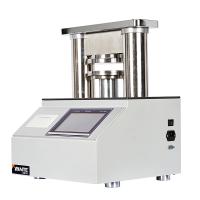
The spring plate compression Tester consists of two supporting knives, a pressurizing device, a spring plate and a deformation measuring device. When the upper pressing plate is pressed down at a certain speed , the pressure is transmitted to the spring plate through the sample. Due to the pressure, the spring plate is deformed, which is indicated by the dial indicator. When the sample is crushed, it springs back to its original position due to the sudden drop of pressure on the spring plate, and a spring plate inside the dial indicator is rubbed to make the pointer stop at the original position, and then it is detected according to the stress-strain curve of the spring plate. Stress value, that is, the compressive strength of the sample.
The spring plate compression Tester is designed based on the beam bending theory, as shown in Figure 2-32. Assuming that the stiffness of the spring plate is EI and the stress density is q, then P=qL, the maximum deflection of the spring plate is:
y=5qL³/384EL
When the maximum deflection is measured with a micrometer, the stress value can be calculated, namely:
P=384yEI/5L²
where y is the maximum deflection of the spring plate
The main technical parameters
a. The descending speed of the upper platen: (12.5±2.5 )mm/min.
b. Platen pressure increase rate: (110 ± 23) N/s, (67 ± 13) N/s.
c. The amount of horizontal shaking when the upper platen moves downward: less than 0.05mm.
d. Parallelism between the upper and lower platens during the test: less than 0.05mm.
e. Maximum deflection of spring plate: less than 2.27mm.
Calibration procedure
a. Spring plate proofreading.
b. Correction of parallelism between upper and lower platens. Repeat the measurement of the four corners and the center between the upper and lower pressure plates, measure each sample 3 times, and measure 5 samples continuously. The difference between the maximum value and the minimum value of the 15 measurement results should be less than 0.05mm. The standard uses a 50kg platen.
c. Calibrate the amount of lateral shaking of the upper platen.
d. Proofreading of the dial gauge pointer recording device.
e. Check the lowering speed of the upper platen.
f. Sensitivity calibration of upper platen and lower limiter.
- 1How to test the bonding strength of corrugated cardboard?
- 2Principle and operation of compression Tester
- 3Structure and Use of Type 48 Compression Tester
