Working principle and test method of puncture strength Tester
The puncture strength of cardboard refers to the work required to pass through the cardboard with a pyramid of a certain shape, including the work required to start puncturing and to tear and bend holes. It is expressed in terms of the total energy loss of the pyramid, and the unit is Expressed in kgf·cm (1kgf·cm= 0.098J), the international unit is J. The puncture strength belongs to the dynamic strength, which simulates the strength performance of the cardboard when it is subjected to a sudden impact force. For example, in the process of loading, unloading, and transportation, cartons are often damaged . The essential difference between puncture strength and bursting strength is that the bursting strength is the uniform application of pressure to burst the sample, which belongs to the static strength while the puncture strength is the sudden application of an impact force to puncture the cardboard, which belongs to the dynamic strength. Therefore, for cardboard packaging materials, the puncture strength is more practical.
(1) BK-52 piercing Tester
①Structure and working principle

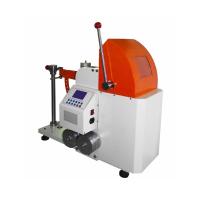
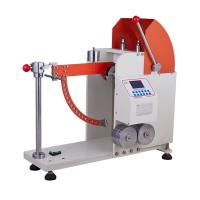
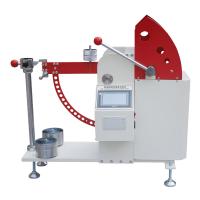
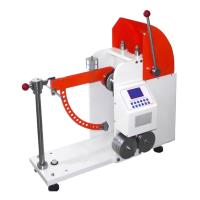
Figure 2-42 BK-52 piercing Tester
1-dial;2-pointer;3-balancer;4-fixer;5,8-handle: 6-swing arm; 7-counterweight: 9-swing rod;10-piercing head;11-column;12 -level; 13-tripod; 14-adjusting foot; 15-adjusting nut; 16-pressure spring; 17-lower pressure plate; 18-sample; 19-upper pressure plate; 20-protective cover
The BK-52 puncture Tester is suitable for measuring the puncture strength of cardboard. As shown in Figure 2-42, a swing arm that can carry different counterweights is installed at the center of rotation of the upper part of the instrument , and a circular arc is fixed on the swing arm. A pendulum in the shape of a pendulum, and a triangular cone piercing head that meets the standard requirements is fixed at the lower end . 5mm。 Pyramid is an equilateral triangular pyramid, high (25 ± 0.7) mm, edge fillet radius is 1. 5mm. When the swing arm is in the horizontal position, it has potential energy. When the swing arm is released, the puncture head exerts an impact energy on the sample. The energy required to puncture the sample is called the puncture strength. The instrument is simple , easy to operate and accurate in testing.
②Main technical parameters
a. Measuring range 0~5J, 0~10J, 0~20J, 0~36J.
b. The measurement accuracy corresponds to the measurement range, which are 0.1J, 0.1J, 0.2J, 0.2J in turn.
③ Calibration procedure
Lift the swing arm so that it is in a horizontal position and push the aluminum sleeve towards the back of the piercing head. Move the pointer to the far left , and then release the swing arm. Because there is no sample and no resistance, the pointer points to zero. If it does not point to zero, turn the dial so that the pointer points to zero. If necessary, the above operation can be repeated for zero adjustment.
(2) Test method
Test according to the national standard GB 2679.7 "Determination of cardboard puncture strength". The specific test steps are as follows.
①Sample collection and processing. Sampling according to GB 450, cut 8 pieces of 175mmX 175mm samples along the paper web, and carry out temperature and humidity pretreatment on the samples according to the requirements of GB 10739.
② Check that the pointer indicates "0". After installing the proper counterweight on the pendulum, lift the pendulum to the horizontal position, lock the pendulum with the semi-circular locator, turn the pointer to the far left, move the locker to release the pendulum, and observe whether the pointer points to zero on the dial. bit. If the pointer does not indicate the zero position of the dial, swing the dial to make the pointer indicate the zero position. The combination of aluminum sleeves piercing the back of the head should be moderately tight.
③ Place the sample in the middle of the triangular hole of the splint. If the clamping force is not enough, you can turn the knurled nut on the column under the splint to increase the clamping force.
④Adjust the pendulum, and when necessary, add a heavy thallium to select the appropriate work range, so that the measured value remains within the range of 20% to 80% of the full scale.
⑤Talk the pointer to the highest value position, put the anti-friction ring behind the piercing head of the triangular cone, release the swing arm gently, and the pendulum body will fall freely puncture the sample. When the piercing head of the triangular cone passes through the sample, the aluminum sleeve is stuck in the hole of the sample, so that the hole is in an open state, and the pendulum has no frictional braking effect at this time.
⑥ After the pendulum stops, read the energy value indicated by the pointer from the dial, that is, the piercing strength of the sample.
⑦ Lift the handle of the pendulum body to reset the pendulum body, dial back the pointer, release the pressure device, take out the tested sample, and prepare test. 4 samples are tested in the direction parallel to the swing plane of the pendulum in the longitudinal direction, and the test is carried out in the direction of the other 4 samples in the direction parallel to the swing plane of the pendulum in the longitudinal direction.
The test results are reported as the arithmetic mean of all test values (including vertical and horizontal), accurate to 0. 1kgf·cm. If expressed in J, when the test result is less than 12J, it is accurate to 0.1J, otherwise it is accurate to 0.2J.
(3) Pay attention to the problem
① When the instrument is empty, do not release the pendulum at will, so as not to damage the sample fixture and pendulum.
② After the test, the pendulum should be fixed.
③When using a piercing meter with a protective cover, the protective cover must be firmly installed on the instrument to avoid accidental injury to the human body.
(4) Factors affecting the piercing strength
① As the relative humidity increases, the puncture strength also increases slightly, but the change is not large.
②With the increase of beating degree, the puncture strength increased slightly, and then with the increase of beating degree, the puncture strength began to decrease again.
③The test results decrease with the increase of clamping pressure, especially for corrugated cardboard, when the clamping pressure is too high, the corrugation of the sample will be crushed, resulting in a decrease in puncture strength. However, if the clamping pressure is too small, the sample is easy to loosen during the test, and the test results tend to be high. Therefore, it is necessary to reasonably control the clamping pressure.
④ If the friction force of the pendulum shaft of the instrument is too high, the test result will be high.
⑤The anti-friction ring is to keep the opening of the sample supported after the triangular conical piercing head punctures the sample, so as to prevent the sample bouncing back and causing friction against the pendulum or clamping the pendulum. When this happens, the pendulum cannot swing automatically, which affects the test results.

Table 2-10 Relationship between corrugated cardboard puncture strength and relative humidity
For example, for AB type double corrugated cardboard, the surface paper is 300g/m2 kraft paper, and the inner paper and core paper are 180g/m2 corrugated base paper. The test environment temperature is 20C, and the relative humidity is respectively selected as 60%, 70%, 80%, and 90%. The analysis results of the puncture strength test shown in Table 2-10 and Figure 2-43 show that with the increase of the relative humidity of the environment, the puncture strength of the AB type double corrugated cardboard gradually decreases, and the puncture strength at a relative humidity of 90% is relatively The puncture strength at 60% humidity decreased by about 5.8%, which was a . Because the plant fibers in the paper are almost distributed in a star plane, the impact on the plane structure of the fibers after moisture absorption is small, so that the puncture strength only has a small decrease.

Figure 2-43 Corrugated cardboard puncture strength and relative humidity change curve
As another example, Table 2-11 shows the analysis results of the puncture strength test of the Tetra Pak paper/plastic/aluminum composite material. The longitudinal and transverse directions little influence on the puncture strength of the composite material.