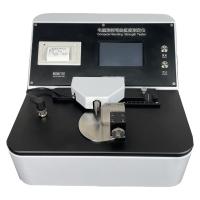
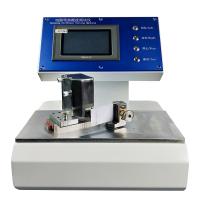
How does the horizontal stiffness meter operate?
The horizontal stiffness Tester indicates the stiffness by the force value when bending a 38mm wide sample to an angle of 15° or other angles. It can be used to measure the stiffness of paper and cardboard. However, its bending distance is different when measuring paper and cardboard. The bending distance when measuring paper is 10mm, and the bending distance when measuring cardboard is 50mm.
(1) Horizontal stiffness Tester
①Structure and working principle The horizontal stiffness Tester is suitable for measuring the stiffness and bending resistance of cardboard. The sensor is mounted on a bracket that can be screwed to adjust the bending length. The pressure sensor is connected to the sensor interface of the instrument panel with a wire, and the rotation angle can be adjusted with the rotation angle regulator. After installing the sample, use the knob to adjust the position of the knife edge to make the knife edge contact with the sample. When the power is turned on, the instrument is adjusted, and the start button is pressed, the holder will rotate at a specified angle, and the rotational moment (ie stiffness) of the sample will be transmitted to the electronic circuit through the pressure sensor, and will be displayed on the display after transformation. stiffness of the sample. The instrument is equipped with an output interface BCD, which can be connected to a printer or computer to print measurement results or perform data processing.
②Main technical parameters
a. Rated load: 5000mN. b. Indication accuracy: less than 1%.
c. Bending angle: stepless adjustment within the range of 5°~30°.
d. Bending length: lmm, 5mm, 10mm, 15mm, 20mm, 25mm, 50mm. e. Gripper Width: 38mm.
③ Calibration procedure
a. Adjust the sample holder to the initial position, select the function at the "OP" position, and use the zero adjustment knob to zero. Then put the selector in the "CHECK" position, and the deviation is required to be within ±1%.
b. If the "CHECK" position deviation is greater than ±1%, the displayed value on the display can be adjusted through the potentiometer until it meets the requirements.
(2 ) Test method
①Sample collection and processing: Sampling according to GB 450, cut 10 pieces of samples with a width of 38.1mm and a length of 70mm along the paper web, and carry out temperature and humidity pretreatment on the samples according to the requirements of GB 10739.
② Check whether the installation and connection of the pressure sensor is correct.
③ After the instrument is preheated for 30 minutes, turn the two knurled screws on the upper end of the pressure sensor bracket to adjust the bending length (referring to the distance between the chuck and the pressure sensor) to the desired value. The bending length of paper is 10mm, while that of cardboard is 50mm.
④Rotate the knurled nut on the bend angle adjuster to select the desired bend angle, such as 5°, 7.5°, 15°, 20°, 25° or 30°.
⑤Turn the knob behind the pressure sensor bracket and move it to the rear end.
⑥Choose the unit mN or mN·m to express the result. When "mN" is selected, the bend length, width and angle may vary on a case-by-case basis. When "mN m" is selected, the bending length is 50mm, the bending angle is 5°, and the sample width is 38.1mm.
⑦ Check whether the function selector is in the "OP" position, and the "FORW-REV" button should be popped out.
⑧Use the adjustment knob "BAL" to adjust the test system to zero. Put the function switch in the "CLACK" position, the corresponding value of the digital display is the calibration value, and the error is ±1% of the given calibration value.
⑨ Clamp the sample in the sample holder, and move the cutter head slightly until it just touches the sample, and the display reading is still zero.
⑩Press the "START" button, the sample will carry the sample, and turn to the direction of the blade at a specified angle. When the maximum bending force is reached, it will automatically return to the initial position and reset to prepare for the next test. The maximum value displayed on the monitor is the stiffness value of the sample. The test results are expressed as the arithmetic mean of all test values.
For example, Table 2-13 is the stiffness test analysis results of paper/plastic/aluminum composite materials for Tetra Pak packaging, because the plant fiber direction of the cardboard is longitudinally arranged, the cardboard has good strength in the longitudinal direction, and its stiffness ratio The transverse direction is higher, and the difference is not obvious when the bending angle is 5°, but as the bending angle increases, the difference between longitudinal stiffness and transverse stiffness increases.




- 1Precautions and maintenance methods for the use of paper stiffness Tester
- 2Comparison of commonly used stiffness meters
- 3Measuring Principle and Method of Taber Stiffness Tester
- 4Test method and principle of Gurley stiffness meter
- 5Clark stiffness Tester test method
- 6Taber stiffness test method
-
![Yunda YD-TD-B cup stiffness Tester 0-10N]() Yunda YD-TD-B cup stiffness Tester 0-10N$ 2264.00
Yunda YD-TD-B cup stiffness Tester 0-10N$ 2264.00 -
![YD-WTD Paper and Cardboard Static Bending Stiffness Tester 0~500mN.m]()
-
![CHENCHI ZBT-10S Paper cup Stiffness meter 1~ 30N]()
-
![LD-TD-A-01 Bending Stiffness Tester]() LD-TD-A-01 Bending Stiffness Tester$ 1691.00
LD-TD-A-01 Bending Stiffness Tester$ 1691.00 -
![CHENCHI ZBT-10 Paper cup Stiffness meter]() CHENCHI ZBT-10 Paper cup Stiffness meter$ 1879.00
CHENCHI ZBT-10 Paper cup Stiffness meter$ 1879.00