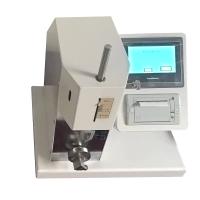
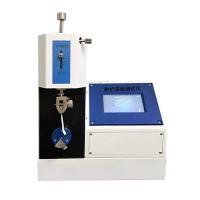
The principle and test method of Schopper folding resistance Tester
Schopper folding resistance refers to the ability of paper or cardboard to withstand 180° reciprocating folding under a certain tension, expressed in the number of reciprocating folding.
(1) Schopper folding Tester
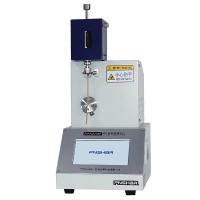
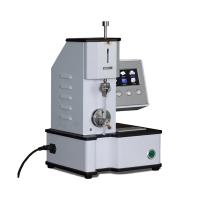
①Structure and working principle
The Schopper folding Tester is composed of a transmission part that drives the blade movement, a testing part, a recording part, etc. The test part is mainly composed of a folding blade and two pairs of folding blades with a certain diameter. In order to apply a certain tension to the sample, a pair of springs are also installed in the fixture. The record section is primarily a counter. The paper sample is 15mm wide and 100mm long; the cardboard sample is 15mm wide and 140mm long. During the test, the sample is folded back and forth approximately 180°, the initial tension of the paper is (7.55±0.10)N [or (770±10)gf], and the maximum tension after stretching is 1kgf (or 9.8N). The initial tension of the cardboard sample is 9.8N (or lkgf), and the maximum tension after stretching is 12.74N (or 1.3kgf). The sample is put into the jaw of the chuck through the folding head straightly, and clamped The initial tension is applied to both ends according to the regulations, and then the crank arm mechanism drives the folding piece to reciprocate, so that the sample is folded repeatedly at approximately 180° between the rollers. The tension of the sample changes periodically during the folding process, and the cycle is half of the arm cycle. When the folded sheet moves to the extreme position, the tension on the sample is the maximum. Due to the folding action, the paper fiber structure in the folded area is loose, and the strength is gradually reduced. When the strength is reduced to the maximum tension, try The sample is broken, and the number of folds at this time is the folding endurance of the sample.
② Calibration procedure
a. Spring tension calibration. Clamp the collet vertically on the bracket with the set screw, loosen the clamp nut to open the clamp, and hang the weight to extend the spring. When the total weight of the weight and the chuck is 1000g (1300g for cardboard), the chuck should protrude 13mm. If there is deviation, adjust the rear nut to make the spring tension reach the standard. When the weight is reduced to a total mass of 770g (1000g for cardboard), the chuck should protrude 5mm. If the deviation is large, a new spring should be replaced.
b. Collet spacing calibration. Pull the spring barrel apart first, then let the spring bounce back to its original position, and then use a vernier caliper to measure the distance between the two jaws on each pair of spring barrels. For the paper folding Tester, this distance is 90mm, while the cardboard folding Tester is 130mm. If not, check whether the limit screw on the collet spring barrel is loose.
c. Folding speed proofreading. The reading on the counter of the instrument should be 100~120 times/min. If the value does not match, check the transmission part to see if the transmission belt is slipping or loose or not.
d. Fold mixed spacing proofreading. According to the distance between each seam, insert the seam ruler gently, check the width of each seam, and slide the seam ruler up and down at the same time to check whether the seams are parallel. If it is not parallel, the axle seat should be removed and carefully adjusted until it fits.
e. Check the verticality of the blade.

(2 ) Test method
For paper and cardboard with a thickness in the range of 0.25~1.4mm, the test shall be carried out according to the national standard GB 1538 "Measurement of Cardboard Folding Endurance (Schober Tester)". For paper with a tensile strength greater than 1.33kN/m (or 2.okgf/15mm) and a thickness less than 0.25mm, the test shall be carried out according to the national standard GB457 "Measurement of Paper Folding Endurance". The testing instrument is a Schopper folding Tester. Note that these two standard methods are not suitable for folding other high elongation and fragile materials. The specific test steps are as follows.
①Sample collection and processing. Sampling according to GB 450, cut at least 6 samples with a length of 100 mm and a width of 15 mm along the longitudinal and lateral directions of the paper web. The two long sides of the sample should be cut evenly and parallel, and do not touch any part of the sample exposed between the two chucks with hands. According to the requirements of GB10739, carry out temperature and humidity pretreatment on the samples.
② Adjust the position of the folding knife, clamp the sample between the two clamps of the instrument in parallel (the front of half of the sample and the back of half of the sample should be folded outward first), pull the spring barrel to the locked position, and give the test Apply an initial tension of (7.55±0.10)N [or (770±10)gf], reset the counter, start the Schopper folding Tester, and the maximum tension is 9.8N (or 1kgf). For cardboard samples, the initial tension is 1kgf, and the maximum tension after stretching is 1.3kgf.
③ Begin to fold the sample back and forth until the sample breaks. Record data when the instrument stops automatically, remove the broken sample, restore the instrument, and prepare for the next test. For the double-folding head instrument, if one of the samples breaks, the corresponding counter stops counting, and the broken sample should be removed from the chuck to avoid unnecessary friction and blade grinding off the paper wool and falling into the instrument, causing failure .
The test results should give the average (longitudinal and horizontal) double folding times, accurate to an integer; the average (longitudinal, horizontal) folding endurance, accurate to two decimal places, maximum value, minimum value, standard deviation or coefficient of variation. If the specimen does not break at the fold line, the test shall be omitted. If the specimen has delamination during the folding process, it shall be stated in the test report.



- 1Folding Tester - paper folding performance test
- 2Talking about the application of folding resistance Tester in metal foil
- 3Plastic film folding resistance testing by folding resistance Tester
- 4How is the folding resistance Tester used for the detection of tissue paper?
- 5Analysis on the Application of Folding Tester in Cardboard
- 6What is the folding resistance of paper and cardboard?
- 7What are the factors that affect folding endurance?
- 8Test method and principle of corrugated cardboard folding resistance meter
- 9FRANK horizontal refractometer test method