Brech-Imset Double Tear Tester and Edge Tear Tester Test Method
Brech-Imset double tear test method
(1) Brech-Imset Double Tear Tester
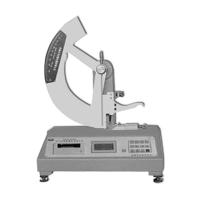
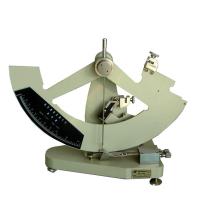
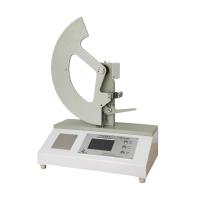
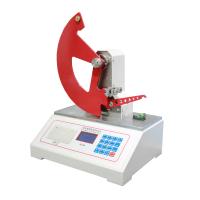
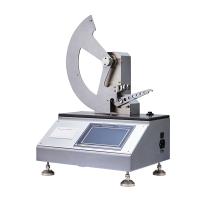
The Brech-Imset double tear Tester manufactured by Frank Company in Germany is mainly used to measure the tearing degree of tracing paper. Its structural feature is that there is a slider on the pendulum that can slide back and forth. The sample is impacted and torn, and the upper and lower tears are torn out at the same time. The main technical parameters of the Brech-Imset double tear Tester: the maximum measuring range is 2940mN cm/cm (or 300gf cm/cm), and the graduation value of the load dial is 49mN cm/cm (or 5gf cm/cm ), the pendulum weight is 755g. The calibration procedure of the Brech-Imset dual tear Tester is to first adjust the level of the instrument and check the zero point, and then check the displayed value.
(2) Test method
①Sample collection and processing Sampling according to GB 450, cut 10 samples of 90mm×60mm, and when tearing a single sample, the measured direction is parallel to the long side. According to the requirements of GB10739, carry out temperature and humidity pretreatment on the samples.
②Adjust the level of the instrument and carefully adjust the zero point.
③Move the pendulum to retract the slider into the frame. Take a sample that has been processed and insert it into the sample holder in parallel.
④ Place the instrument at a fixed position, and at this time, the slider of the instrument is stretched out, cut the sample into two small openings, the upper and the lower, and turn the needle to the maximum scale value indication. Loosen the fixed pin of the pendulum, let the pendulum fall freely, the slide block is knocked out immediately, tear the sample along the two incisions, and record the indicated value of the pointer.
⑤Move the pendulum to return the slider to the frame, take out the tested sample, and proceed to the next test.
The test results are expressed as the double tearing degree by the arithmetic mean of all the measured values, taking three significant figures, and the unit is mN·cm/cm (or g·m/cm).
Edge tear test method
(1) Edge Tear Tester
The edge tear Tester is suitable for measuring the force required to tear the paper apart in the same plane along the edge of the paper. It consists of a clamping sample system, a loading mechanism, an indicating mechanism, etc. The main technical parameters of the edge tear Tester include: the height of the clamp is 55mm, the distance between the clamps is 5mm, the measuring range is 0~300N, the loading speed is 50mm/min, and the force couple between the pendulum center of gravity and the rotating shaft is 87gf·cm.
(2) Test method
①Sample collection and processing, sampling according to GB450, for the edge tear test, 10 samples of 50mm×100mm should be cut, and the test direction is parallel to the short side of the sample. According to the requirements of GB 10739, carry out temperature and humidity pretreatment on the samples.
②Adjust the level of the instrument and check whether the components of the instrument are normal.
③Turn the handwheel counterclockwise to make the inner edges of the fixture parallel to each other until the handwheel stops turning. Observe whether the pointer points to zero at this time.
④ Put a sample in the fixture, tighten the fixture, and clamp the sample. Turn the loading handwheel clockwise at a speed of 30r/min, and the pendulum starts to move at this time. When the sample is torn, the pendulum stops automatically, and the reading indicated by the pointer on the pendulum is recorded. If the side tearing value is small, the additional tuo on the pendulum can be removed. If the edge tearing value is large, the test should be added, and the test result should be within the range of 20%~80% of the full range of the instrument as much as possible.
⑤ Rotate the hand wheel counterclockwise to return the fixture to the initial position, press down the brake pawl of the pendulum with your hand, and hold the pendulum with your hand to make it slowly return to zero for the next test.
The test result is expressed as the arithmetic mean value of all the measured values to express the edge tearing degree, take three effective figures, and the unit is N.

- 1Paper tearing determination - Alimendorf method and instrument operation guide
- 2Tear Tester of paper strength
- 3Test method for tensile strength of fabrics
- 4What is tear strength? How to test fabric tear strength?
- 5Test method and principle of LW tearing Tester
- 6Elmandorf single tearing meter test method
- 7What is tearing degree? What are the factors that affect tearing degree?
- 8Paper tear Tester operating instructions
- 9What are the common mechanical performance indicators of paper?


