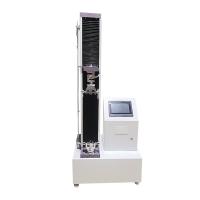
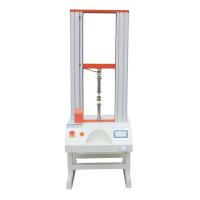
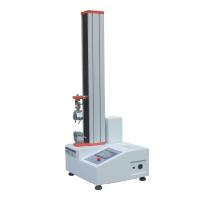
What are the principles and test methods of peel strength testing machine?
1. Experimental principle
The principle of testing the peel strength of various soft composite plastic materials is to perform T-shaped peeling on a sample with a specified width at a certain speed, and measure the average peel force between the composite layer and the substrate. The test equipment is a Tensile Testing Machine or a material testing machine with a graphic recording device.
2. Sample making and processing
Remove 50 mm from both ends of the sample in the width direction, and uniformly cut 5 longitudinal and transverse samples along the width direction of the sample, and the composite direction is the longitudinal direction. Pre-peel the composite layer and the substrate 50mm along the length direction of the sample, and the peeled part must not have obvious damage. If the sample is not easy to peel off, one end of the sample can be immersed in a suitable solvent for about 20 mm, and the peel strength test can be carried out after the solvent is completely evaporated. If the composite layer cannot be separated from the base material after this treatment, the test cannot be carried out.
Before the test, place the sample in an environment with a temperature of (23±2)°C and a relative humidity of 45% to 55% for more than 4 hours, and conduct the test in this environment.
3. Test method
The test is carried out according to the national standard GB 8808 "Peel test method for soft composite plastic materials". For different composite film materials, the test methods are also slightly different. Composite film adopts method A, and artificial leather and woven composite materials adopt method B. The A method sample is (15±0.1) mm wide and 200 mm long, and the tensile speed is (300±5) mm/min. The B method sample is (30 ± 0.2) mm wide and 150 mm long, and the tensile speed is ( 200 ± 5) mm/min. Except for the difference in sample size and test speed, the other test conditions of the A method and B method test are the same.
During the test, first clamp the two ends of the peeled part of the sample on the upper and lower clamps of the testing machine, so that the longitudinal axis of the peeled part of the sample coincides with the line connecting the centers of the upper and lower clamps, and the tightness is appropriate. Then turn on the testing machine and stretch the sample. At this time, the unpeeled part and the stretching direction are T-shaped. Record the peel force curve during the peeling process of the sample.

Figure 3-25 Approximate value method of typical peel force curve
According to the shape of the curve obtained in the test, adopt the approximate value method to determine the peeling force, that is, draw the middle line of the peeling force curve, as shown in Figure 3-25. Calculate the arithmetic mean of the longitudinal and transverse peeling forces for each group of samples, take two significant figures, and take N as the unit. If necessary, the average peeling force per unit width of the sample (in N/m), as well as the maximum, minimum and standard deviation of the peeling force can also be calculated.

- 1Tensile machine application in various industries
- 2Technical analysis of key parameters of Tensile machine: Scientific selection from force measurement accuracy to Power system
- 3Tensile machine purchasing guide [dry version]
- 4Talking about the performance test of epoxy resin film coated on PET
- 5ASTM D5019 Single-layer roofing film reinforced CSM board (chlorosulfonated polyethylene (PE)) standard interpretation
- 6Common problems and solutions in tensile testing
- 7What is a peel strength Tester and what is it used for?
- 8What is tensile strength testing and which products can be tested?
- 9Factors Affecting the Performance and Accuracy of Tensile Testing Machines
-
![Patek Jushi LY-7012C Tensile Tester 1000KG]()
-
![BaidaJUSHI LY-7012A Small Tensile Testing Machine 200KG]()
-
![CHINA NBC-1024-2 Tensile Tester 5T]() CHINA NBC-1024-2 Tensile Tester 5T$ 6635.00
CHINA NBC-1024-2 Tensile Tester 5T$ 6635.00 -
![CHINA NBC-6820 Ring type initial tacking machine Tensile Tester]()
-
![CHINA NBC-1023-1 Computerized Double Column Tensile Testing Machine]()
-
![CHINA NBC-1021 Touch screen single column Tensile Strength Tester 10KG]()