How to measure the fineness of lithium-ion battery slurry [Practical knowledge dry goods]
Lithium-ion battery slurry is formed by dispersing solid particles such as electroactive substances and conductive agents in a binder solution. When coating, the active substances, conductive agents and other solid components should be uniformly dispersed in the solvent in the form of tiny particles. No granular objects can appear in the coating film. The index of fineness is commonly used in the industry to detect the degree of dispersion of granular materials in the slurry. Fineness is an important performance index of battery slurry, which has a great influence on the surface quality, uniformity and storage stability of the formed coating film. The slurry with fine particles and good dispersion degree, the solid particles can be well wetted, the prepared coating is uniform, the surface is smooth, there will be no vertical scratches, and the particles are not easy to precipitate and agglomerate during storage And so on, good storage stability. However, if there are large aggregate particles in the slurry, on the one hand, it indicates that additives such as conductive agents are distributed unevenly, and the uniformity of the prepared coating is not good, which inevitably leads to poor consistency of the battery. In addition, during the coating process, large particles accumulate in the slit of the coating knife roll or the discharge slit of the extrusion coating die, and the prepared coating will have vertical scratch defects.
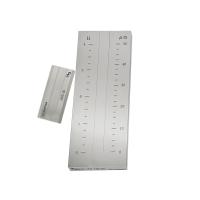
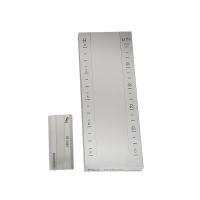
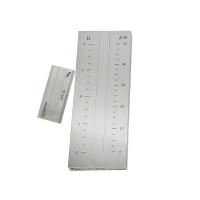
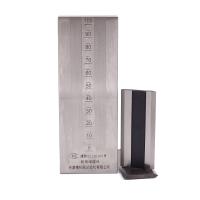
At present, the scraper Fineness Meter is basically used to measure the fineness. The scraper fineness gauge is a polished flat plate with a wedge-shaped groove from zero to several microns deep, and there are scale marks on the edge of the groove to indicate the depth of the groove. When measuring, drop the sample into the deepest part of the groove, then use a scraper with both edges polished to touch the flat plate vertically, pull the paint across the entire length of the groove at an appropriate speed, and then observe along the direction of the incident light at a 30° angle The depth at which the particles in the groove are uniformly exposed, and this thickness represents the fineness of the sample.
![How to measure the fineness of lithium-ion battery slurry [practical knowledge dry goods] with picture 1](http://img.nbchao.com/upload/editor/image/20211016/1634366941843096012.png)
Referring to the national standard "GB/T 6753.1-2007 Determination of Grinding Fineness of Paints, Varnishes and Printing Inks", this article briefly introduces the basic knowledge and operation steps of measuring fineness with a fineness plate.
1. Introduction of scraper Fineness Meter
The Fineness Meter generally consists of a fineness plate and a scraper. The fineness plate is generally made of stainless steel. The upper surface of the steel block should be finely ground or finely ground. There is a given depth (for example, 100μm), the other end is zero, and the scale should be divided according to the regulations in Table 1. The scraper is made of single-edged or double-edged steel sheet. The scraper blade on the long side is straight and arc-shaped. The scraper needs to be checked regularly for wear, damage or deformation. If damage is found, the scraper cannot be used. In a container of soft material. A typical scraper fineness gauge is shown in Figure 1. Lithium-ion battery slurry generally uses a scraper Fineness Meter with a range of 100 μm.
![How to measure the fineness of lithium-ion battery slurry [practical knowledge dry goods] with picture 2](http://img.nbchao.com/upload/editor/image/20211016/1634366374223087496.png)
2. Operation steps of fineness plate measurement
(1) Place the effectively cleaned and dried scraper on a flat, horizontal, non-slip surface;
(2) Drop enough sample into the deepest part of the groove, that is, the part with the largest scale value, and make the sample overflow slightly;
(3) Hold the scraper with the thumb and forefinger of both hands, place the edge of the scraper horizontally on the part of the maximum scale value of the scraper (at the edge of the sample) so that the long side of the scraper is parallel to the wide side of the scraper and perpendicular to the surface of the scraper touch. Within 1~2 seconds, scrape the scraper from the largest scale to the smallest scale;
(4) Immediately after scraping the sample (no more than 5 seconds), make the line of sight and the groove plane form an angle of 20°~30°, observe the uniformly exposed part of the particles in the groove with the light, and record the corresponding scale value.
3. Test result reading
Observe the place where dense grain spots first appear in the sample, especially the position that contains 5-10 grains in a strip spanning 3mm (as shown in Figure 2 and 3), and the scattered points above the dense spots can be ignored. Then determine the scale of the upper limit position of the secondary band, which is the fineness of the test sample. For fineness gauges with different ranges, the reading accuracy is as follows:
(1) The fineness plate with a measuring range of 100 μm has a reading accuracy of 5 μm
(2) The fineness plate with a measuring range of 50 μm has a reading accuracy of 2 μm
(3) The fineness plate with a measuring range of 25 μm has a reading accuracy of 1 μm
Calculate the average of the three measurement results and record the test results with the accuracy of the corresponding range.

- 1Coating fineness of ground - Fineness gauge
- 2Coating fineness test method and influencing factors
- 3Introduction to the function, production process and use method of latex paint Fineness gauge
- 4Fineness Detection of Precious Metal Slurry in Microelectronic Technology with Fineness Meter
- 5Inks Fineness gauge principle results and usage introduction
- 6Basic Principle and Application Analysis of Coating Fineness Scraper
- 7Fineness gauge selection guide notes
- 8Coating Fineness Determination and Its Importance
- 9Detection Steps of Coating Fineness and Operation Method of Ground Gauge