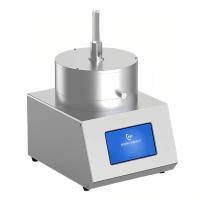
The working principle of the spin coater
A typical glue leveling process includes several steps of glue dropping, high-speed rotation and drying ( solvent volatilization ) .

In the glue dropping step, the photoresist is dripped onto the surface of the substrate, and the photoresist is spread on the substrate to form a thin layer by high-speed rotation, and the excess solvent in the glue layer is removed in the drying step. Two commonly used dispensing methods are static dispensing and dynamic dispensing.
Static dispensing is to simply pour the photoresist onto the center of the stationary substrate surface, and the dispensing volume varies from 1-10ml. The amount of glue dropped should be determined according to the viscosity of the photoresist and the size of the substrate. If the viscosity is relatively high or the substrate is relatively large, it is often necessary to drop more glue to ensure that the entire substrate is coated with glue during the high-speed rotation stage.
The dynamic dispensing method is to dispensing glue while the substrate is rotating at a low speed (usually around 500 rpm). The function of "dynamic" is to make the photoresist spread easily on the substrate and reduce the waste of photoresist. Dynamic dispensing does not require much photoresist to wet (spread to cover) the entire substrate surface. Especially when the wettability of the photoresist or the substrate itself is not good, dynamic dispensing is especially suitable, without pinholes. After dispensing glue, the next step is high-speed rotation. To thin the photoresist layer to the final required film thickness, the rotation speed at this stage is generally 1500-6000 rpm, and the selection of the rotation speed also depends on the performance of the photoresist (including viscosity, solvent volatilization speed, solid content and surface tension, etc.) and the size of the substrate. Fast spin times can range from 10 seconds to several minutes. The rotation speed of the glue and the time of the glue can often determine the thickness of the final film.
Generally speaking, the speed of homogenization is fast, the time is long, and the film thickness is thin. There are many variable factors affecting the homogenization process, and these factors tend to cancel each other out and tend to balance during the homogenization. Therefore, it is better to give enough time to the homogenization process to allow many influencing factors to reach a balance. An important factor in the dispensing process is repeatability. Subtle changes in process parameters will bring about huge differences in film properties, and some variable factors are analyzed below:
spinning speed:
匀胶转速是匀胶过程中重要的因素。基片的转速(rpm)不仅影响到作用于光刻胶的离心力,而且还关系到紧挨着基片表面空气的具有湍动和基片与空气的相对运动速度。光刻胶的最终膜厚通常都由匀胶转速所决定。尤其在高速旋转这个阶段,转速±50rpm这样微小变化就能造成最终膜厚产生10%的偏差。

膜厚在很大程度上是作用于液体光刻胶上﹑方向朝基片边缘的剪刀力与影响光刻胶粘度的干燥(溶剂挥发)速率之间平衡的结果。随着光刻胶中溶剂不断挥发,粘度越来越大,直到基片旋转作用于光刻胶的离心力不再能使光刻胶在基片表面移动。到这个点上,胶膜厚度不会随匀胶时间延长而变薄。所有ANALYSIS(安赛斯(中国)有限公司)的匀胶机规格要求在量程范围内无论选择哪个速度匀胶转速偏差不大于±1rpm。而通常实际偏差是±0.2rpm。而且,所有的控制程序和转速显示的分辨能力都是1rpm。
加速度
匀胶过程中基片的加速度也会对胶膜的性能产生影响。因为在基片旋转的第一阶段,光刻胶就开始干燥(溶剂挥发)了。所以精准控制加速度很重要。在一些匀胶过程中,

光刻胶中50%的溶剂就在匀胶过程开始的几秒钟内挥发掉了。在已经光刻有图形的基片上匀胶,加速度对胶膜质量同样起重要作用。在许多情况下,基片上已经由前面工序留下来的精细图形。因此,在这样的基片上穿越这些图形均匀涂胶是重要的。匀胶过程总是对光刻胶产生离心力,而恰恰是加速度对光刻胶产生扭力(twisting force),这个扭力使光刻胶在已有图形的周围散开,这样就可能以另一种方式用光刻胶覆盖基片上有图形的部分。ANALYSIS(安赛斯(中国)有限公司)匀胶机的加速度可以设定,精度1rpm/秒。在操作时,电机以线性跃升加速(或减速)到最终的匀胶速度。
排风
所有匀胶过程中光刻胶的干燥速度不仅取决于光刻胶的自身性质(如所用溶剂体系的挥发性),而且还取决于匀胶过程中基片周围的空气状况。一块湿布在干燥有风的日子干得快,而在潮湿气候条件下干得慢。光刻胶的干燥速度与此相似,也受周围环境条件的影响。大家都知道,像空气温度、湿度这样的因素对决定胶膜性质有重要的作用。匀胶的时候,减小基片上面的空气的流动,以及因空气流动引起的湍流(turbulence),或者至少保持稳定也是十分重要的。所有ANALYSIS(安赛斯(中国)有限公司)匀胶机都采用“密闭碗”设计。尽管密闭碗实际上并非完全是一个密不透气的环境,在匀胶过程中排风罩能让很小的气流通过,与位于匀胶台旋转头(吸盘)下面的底部排气口想配合,排风罩成为一个排风系统的通道,以达到减小不希望有的随机湍流的目的。这个系统有两大明显的优点:匀胶时光刻胶的干燥速度慢,对环境湿度的敏感性小。干燥(溶剂挥发)速率较慢带来的好处是胶面膜厚均匀性好。匀胶时,在光刻胶被甩向基片边缘的同时,由于溶剂挥发,光刻胶也同时得以干燥。这样会造成光刻胶膜厚沿径向不均匀。因为光刻胶的粘度随基片中心到边缘的距离发生了变化。通过降低溶剂挥发速度就有可能使整个基片表面上光刻胶的粘度保持比较恒定。

干燥速度以及与其相关的最终膜厚也受到环境湿度的影响,相对湿度仅仅几个百分点的变化却可造成膜厚很大的变化。在一个“密闭碗”中匀胶,光刻胶中溶剂挥发,其蒸气被留在碗内,这样掩盖了较小的湿度变化所造成的影响。当匀胶过程结束的时候,打开排风罩取出基片,保持充分排风,排尽溶剂蒸气。
Another advantage of the "closed bowl" design is that the film quality is less sensitive to changes in air flow around the substrate. For example, in a typical clean room there is always a steady vertical laminar flow of air from top to bottom at about 100 feet per minute (equivalent to 30 m/min). There are several factors that affect the local quality of this air stream. Common problems are disturbance (turbulence) and eddy current (eddy current). Small changes in the environment can cause drastic changes in the downdraft. Covering the "bowl" with a smooth-surfaced cover eliminates environmental changes and turbulence in airflow due to the presence of operators and other equipment.
Uniform glue process data chart
The following four graphs represent general trends in the effect of various process parameters on homogenization results. For most photoresists, final film thickness is inversely proportional to dispense speed and dispense time. If the exhaust air volume is too large, the film will dry unevenly due to air turbulence (turbulence), but the film thickness is still proportional to the exhaust air volume to a certain extent.


Common problems of glue homogenization process:
| Problem 1: Air bubbles appear on the surface |  |
| Possible reason: There are air bubbles in the glue when dispensing glue | |
| Faulty or barbed nozzle tip cut | |
| Problem 2: There are radial stripes around |  |
| Possible Causes: | |
| Glue injection speed is too high | |
| Equipment exhaust velocity is too high | |
| Rest time too long before glue application | |
| The speed or acceleration of the homogenizer is set too high | |
| There are small particles left on the surface of the tablet | |
| There are particles in the glue | |
| Problem 3: A swirl pattern appears in the center |  |
| Possible Causes: | |
| Equipment exhaust velocity is too high | |
| The glue liquid deviates from the center of the substrate when spraying glue | |
| Spin time is too long | |
| Acceleration is too high | |
| Problem 4: A halo appears in the center |  |
| Possible Causes: | |
| unsuitable pallet, | |
| Nozzle off center of substrate | |
| Problem 5: The glue is not covered with the substrate |  |
| Possible Causes: | |
| Insufficient amount of glue | |
| Improper homogenization acceleration | |
| Question 6: Pinholes appear |  |
| Possible Causes: | |
| dust in the air | |
| Particles or bubbles are present in the photoresist | |
| Particles on the substrate |
- 1Application of Spin Coater in preparation of Bi1.5MgNb1.5O7 film
- 2Spin Coater selection and classification: a one-stop guide
- 3Automatic Film Applicator and spin coating spin coater: Key technologies and applications in industrial production
- 4Spin coatings spin coaters: principles, applications, functions and maintenance
- 5Comparison of advantages and disadvantages of preparing large area perovskite films by doctor blade Spreader method and spin coating method
- 6Two Methods of Preparative Anti-oxidation polymer Encasement Film
- 7Three Methods of Preparative Unsupported Adhesive Film on Plastic Plate
- 8Five different methods of prepative inks
- 9Working principle and application of spin coater