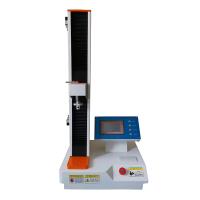
Test method for tensile strength of fabrics
Tensile Strength Test: This is known as a strength test where the load is applied in the direction of the test sample.
The tensile strength test of the fabric is divided into two groups
1. Peel test
2. Tear test
Strip strength test:
Five fabric samples were run parallel to the warp yarns and five parallel to the weft yarns.
Cut the test pieces to 2.5 inches wide and remove the thread from both sides until the width is reduced to 2 inches.
The test length between the jaws should be 8 inches, so you need to allow enough extra length to hold the jaws.
Under suitable conditions, the specimen will be mounted centrally. Safety fastened along the entire width to prevent slipping.
The load is applied uniformly across the width of the specimen until the specimen tears.
If the specimen breaks within 0.25 inches of the line of contact of either pair of jaws under a load less than the average normal break, the results should not be used in the calculations.
Grab strength test:
First, we take the specimen 4"x6".
The specimen is then marked with a pencil 1.5" from the edge of the specimen to assist in clamping the specimen so that the same set of threads is clamped in both jaws.
The two jaws are secured on either side of the specimen from the 1" edge. This means that only the center 1" of the fabric is under pressure.
A gauge length of 3 inches was used and the speed was adjusted to break the sample in 20 ± 3 seconds.
One jaw is fixed and the other jaw is movable.
The movable jaw then begins to move outward until the specimen is torn off.
Tear Strength Test:
Tear Strength: Tear strength is the force required to initiate or continue a tear in a fabric under specified conditions.
Tear Force: Tear force is the average force required to continue a previously initiated tear in the fabric.
Tear resistance: Tear resistance is one of the important properties of textile fabrics. The tear resistance of a fabric indicates its resistance to tearing forces.
Three types of tear tests:
Tongue
Trapezoidal
Elmendorf
Elmendorf Tear Test:
Sample Preparation:
First, we take the specimen (100X 75) mm2.
The template is placed on the specimen and cut as a fig according to the template.
A slit is formed at the middle point of the specimen with an extent of 20 mm.
In the test, Elmendorf continuously tore the fabric a distance of 43mm from the end of the slit to the opposite edge.
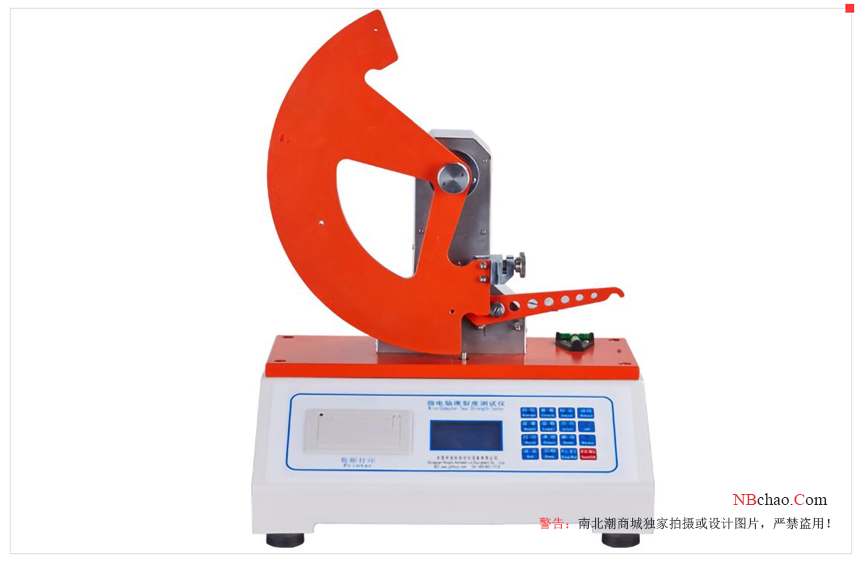
The pendulum principle is used here.
Work program:
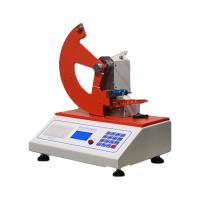
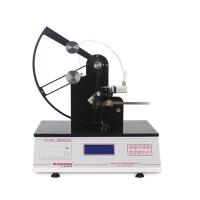
The setup consists of a fan-shaped pendulum carrying a moving sample holder and another holder fixed to the frame.
When the pendulum is in the raised starting position, the specimen is held between the two grips.
Tear begins at the incision of the specimen between the grips.
The pendulum is then released and the specimen is torn as the moving grip moves away from the stationary grip.
Attached to a pointer on the pendulum, the pointer is graduated for direct reading of tearing force.
Bursting Strength: This tearing strength is basically used for knitting, lace, non-woven fabrics, parachute fabrics, filters, sacks and nets, etc. It is the uniformly distributed force applied to a given area of the fabric surface, which is necessary for breaking.
There are two main types of burst strength tests - hydraulic or diaphragm burst and ball burst;
Hydraulic burst Tester:
The pressure in the liquid is exerted in all directions and this phenomenon is exploited in hydraulic burst Testers.
The specimen S is clamped by a ring to a thin flexible rubber diaphragm D which is clamped over a round hole in the upper part of the reservoir.
The liquid used can be water or glycerin.
Hydraulic pressure is increased by a piston driven by a valve or screw, and the diaphragm expands to carry the specimen away.
At some point, the fabric bursts and the pressure is indicated by gauge G.
Since a rubber diaphragm requires a certain amount of pressure to stretch it, this can be corrected by doing a blank test, i.e. noticing the pressure required to inflate the diaphragm to the same amount without the fabric present
-
![Yongxin ZSE-1000 paper Tear Tester 8000mN]()
-
![Yongxin ZSE-1000 Light swing paper Tear Tester 500mN]()
-
![Yongxin ZSE-1000 Standard paper Tear Tester 1000mN]()
-
![PNSHAR PN-BL80F adhesive peel strength Tester]()
-
![YINUO YN-SLY16 Microcomputer Tear Degree Tester 0-1000mN/63 * 50mm]()
-
![PUYUN PY-H611A Interlayer peeling strength Sampler]()
-
![Puyun PY-H610 Tear Degree Tester]() Puyun PY-H610 Tear Degree Tester$ 2076.00
Puyun PY-H610 Tear Degree Tester$ 2076.00 -
![ZHONGNUO ZN-BL microcomputer peel strength Tester]()
-
![SUMSPRING SLD-1000Z Tear Tester, Elmendorf Method]()



- 1Tear Tester of paper strength
- 2What is a peel strength Tester and what is it used for?
- 3What is a stripping test?
- 4Effect of Printing ink on Adhesion Fastness of Composite Films
- 5What is tear strength? How to test fabric tear strength?
- 6What are the principles and test methods of peel strength testing machine?
- 7Brech-Imset Double Tear Tester and Edge Tear Tester Test Method
- 8Test method and principle of LW tearing Tester
- 9Elmandorf single tearing meter test method