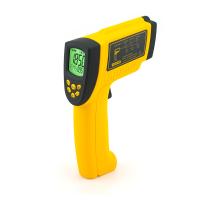
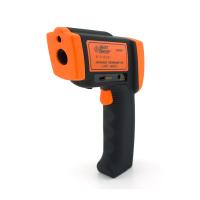
How does emissivity affect infrared thermometers? Emissivity of common substances
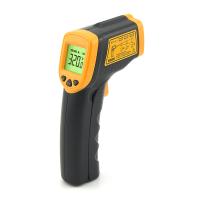
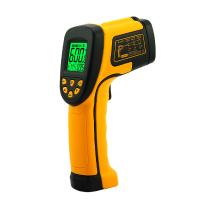
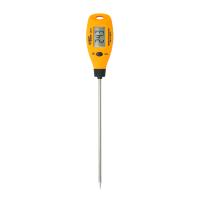
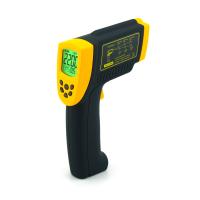
The laser pointer can easily aim at the target and measure the temperature more accurately , making the work faster and more effective. It is a safe non-contact temperature measurement tool. Infrared thermometers are used for food inspection, security inspection, fire inspection, injection molding, painting, ink and diesel engine maintenance, etc.
locate hotspots
Point the meter at the desired test area, then scan the thermometer up and down until the hot spot of the test point is identified.
hint
①Do not use the meter to measure shiny or polished metal surfaces (stainless steel, aluminum, etc.) Refer to: emissivity
② Do not measure the instrument through a transparent surface (such as glass).
③Steam, dust, smoke, etc. will block the infrared rays of the instrument and affect the measurement accuracy.
emissivity
Emissivity describes the property of a material to radiate energy, and most (90%) organic materials and painted or oxidized surfaces have emissivity of 0.95. Measuring shiny metal surfaces may cause inaccurate readings. To make readings correct, cover the surface to be tested with masking tape or black paint. Wait for a period of time for the tape or paint to reach the same temperature as the surface it is covering, then measure the temperature of the tape or painted surface.
| substance | emissivity | substance | emissivity |
| asphalt | 0.90 to 0.98 | Cloth (black) | 0.98 |
| concrete | 0.94 | human skin | 0.98 |
| cement | 0.96 | soap bubbles | 0.75 to 0.80 |
| sand | 0.90. | charcoal (powder) | 0.96 |
| soil | 0.92 to 0.96 | lacquerware | 0.80 to 0.95 |
| water | 0.92 to 0.96 | Lacquerware (matte) | 0.97 |
| ice | 0.96 to 0.98 | Rubber (black) | 0.94 |
| Snow | 0.83 | plastic | 0.85 to 0.95 |
| Glass | 0.90 to 0.95 | wood | 0.9 |
| ceramics | 0.90 to 0.94 | Paper | 0.70 to 0.94 |
| marble | 0.94. | Chromium oxide | 0.81 |
| plaster | 0.80 to 0.90 | Copper oxide | 0.78 |
| stucco | 0.89 to 0.91 | iron oxide | 0.78 to 0.82 |
| brick | 0.93 to 0.96 | textile | 0.9 |
- 1How to Choose an Infrared Thermometer
- 2Technical Principle, Application and Development Trend of Infrared Thermometer
- 3How does an infrared thermometer work?
- 4Non-contact infrared thermometer and contact thermometer
- 5What affects the measurement accuracy of an infrared thermometer?
- 6Industrial high temperature infrared thermometer DT-8889H operating function description
- 7Operation method of 2-in-1 ring laser infrared thermometer
- 8Infrared frontal thermometer DT-8807S how to operate and precautions?
- 9Precautions for infrared thermometers