3 Ways to Measure Surface Tension
Surface and interfacial tension play a key role in several industrial processes including, for example, detergents, coatings, and oil recovery. Surface tension measurements are performed when developing new paint formulations or evaluating the quality of detergents. There are three main methods used to measure equilibrium surface tension and interfacial tension. Two of these methods are based on force tensiometers; Du Noüy rings and Wilhelmy disks, while the third is an optical method; the pendant drop method.
Du Nouy ring
The Du Noüy ring method uses a platinum ring as a probe. The platinum ring is placed on the measuring hook attached to the high-sensitivity balance. The ring is submerged below the interface by moving the platform on which the liquid container is placed. After immersion, the height of the platform decreases and the ring pulls across the interface, bringing about a liquid meniscus. If the container is lowered any further, the meniscus will tear from the ring. Before this event, the volume of the meniscus (and therefore the applied force) passes a maximum and begins to decline before the actual tearing event. Calculations of surface or interfacial tension are based on measurements of maximum force and ring circumference.
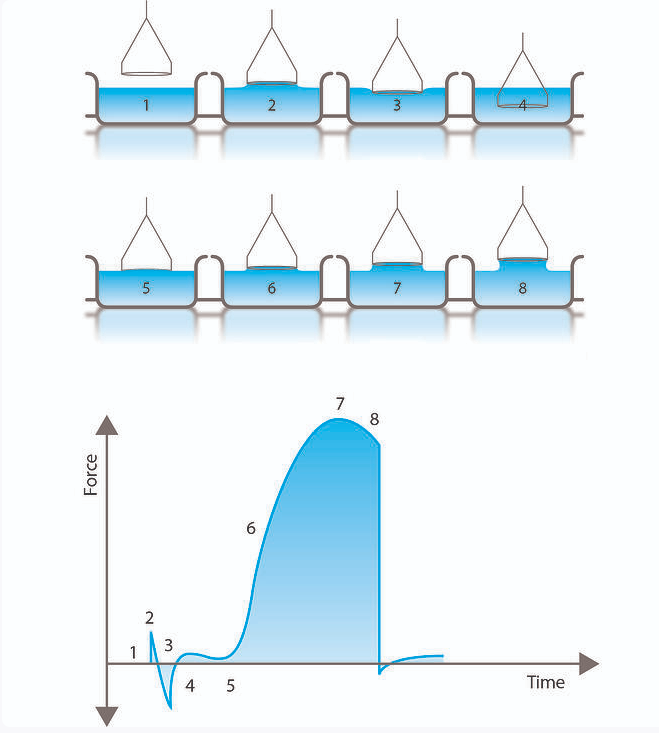
Figure 1. The different phases of the experiment can be identified from the force versus time curves: 1) Initially, the ring is above the interface and the force is zero. 2) The contact interface of the ring has a slight positive force due to the adhesive force between the ring and the surface. 3) The ring needs to be pushed across the interface (a small negative force due to surface tension). 4) The ring breaks through the interface and a small positive force is measured due to the support wire of the ring. 5) When lifting through the interface, the measured force starts to increase. 6) The force keeps increasing. 7) At maximum force. 8) After the maximum value is reached, the force decreases slightly until the lamella ruptures, or the ring is pushed back below the surface.
Wilhelmy plate
The Wilhelmy plate method uses rough platinum plates as probes. The calculations in this technique are based on the perimeter of a fully wetted plate in contact with the liquid. In this method, the position of the probe relative to the surface is important. When the liquid surface comes into contact with the probe, the instrument will detect the exact moment of contact by recording the change in force on the probe. This location is labeled "Zero Immersion Depth". The board is then immersed to a set depth below this value (usually a few millimeters into the interface). When the plate later returns to zero immersion depth, the force is recorded.
Similarly, measurements can be made by replacing the Wilhelmy plates with platinum rods. The measuring principle remains the same, but the small diameter of the probe makes it also possible to measure smaller sample volumes. At the same time, however, the accuracy of the measurements is not as high as with the standard Wilhelmy plate technique.
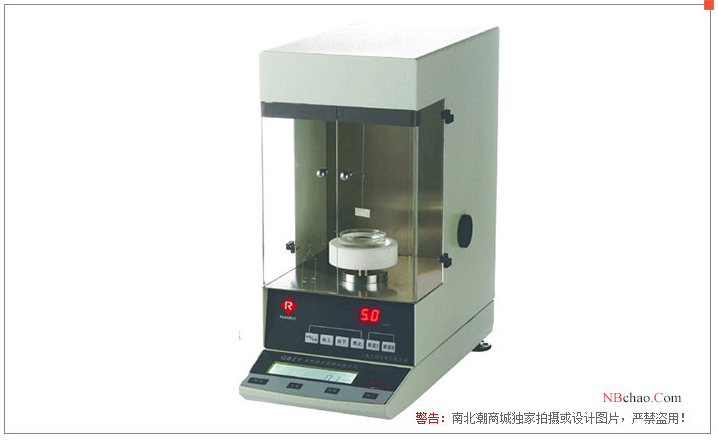
hanging drop method
Surface and interfacial tension measurements can also be performed optically using pendant drop shape analysis. The shape of the droplet suspended on the needle is determined by a balance of forces, including the surface tension of the liquid being studied.
Modern computational methods using iterative approximations allow finding solutions to the Young-Laplace equations. Thus, the surface or interfacial tension between any two immiscible fluids of known density can be determined. For optical tensometry, the size of the droplet is important, it should have a tear or dangling shape.
- 1Water surface tension measurement based on Electronic Balance
- 2Comparison of Liquid Surface/Interfacial Tension Testing Methods: Plate vs. Ring Method
- 3Selection guide for Surface Tensiometers
- 4Application principle and precautions of platinum ring Surface Tensiometer
- 5Coating surface tension and its effects
- 6Coating process surface tension factor
- 7Three commonly used detection methods for surface tension
- 8Ceramic ink-jet surface tension, viscosity and solutions
- 9Determination of interfacial tension and surface tension