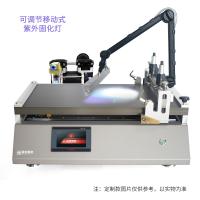
Preparation of Ultrafine Silver Nanowire Transparent Conductive Films by Coating Machine + Wire Rod
1. Preparation of PET substrate
Cut the PET substrate into a rectangle of 12 cmx20 cm, then rinse , rinse the surface dust and other impurities, dry it with a hair dryer, put the PET substrate into a UV ozone cleaning machine, and carry out ultraviolet radiation on the front side Ozone cleaning for 10 minutes, and UV ozone cleaning for 40 minutes on the back side, take it out and put it in a sealed bag for later use.
2. Apply the base cover
1) Set the operating parameters of the automatic coating machine
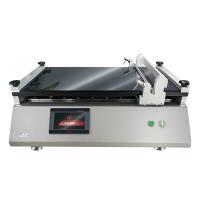
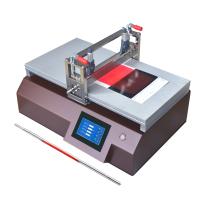
The scraping speed was set at 100 mm/s, and the scraping length was set at 300 mm. After the parameters are set, put a layer of PET substrate on the surface of the automatic film coating machine to increase the height of the coating film. Finally, place in the middle of the automatic film coating machine with the front facing up and turn on the vacuum.
2) Apply the base cover layer
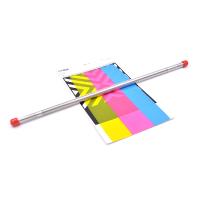
Place the OSP-08 wire rod on the surface of the PET substrate and fix it to form a contact coating. Take a volume of about 0.5 mL of acrylic resin doped with FeSO4 aqueous solution and stretch it evenly on the surface of to form a strip. For a strip with a length of 11 cm, click the start button, so that the wire rod drives the acrylic resin to move forward to form a wet film layer with a wet film thickness of 8 pum.
3) Curing of the underlying covering layer
After taking out the film obtained in the previous step, place it vertically and horizontally for 15-20s, and place it horizontally in a UV curing box for 5 minutes of UV curing with a power density of 80mW/cm2, then take it out for use.
3. Coating ultrafine silver nanowires
1) Set the operating parameters of the automatic coating machine
The scraping speed was set at 120 mm/s, and the scraping length was set at 300 mm. After the parameters are set, put a layer of PET substrate and a thin sponge pad on the surface of the automatic film coating machine, then place a hard mouse pad on the sponge pad, and finally place the PET substrate coated with the bottom layer in the middle of the automatic film coating machine , with the backside up (that is, the side where the underlying cover layer is applied facing down), turn on the vacuum.
2) Coating ultrafine silver nanowires
Place the OSP-25 wire rod on the surface of the PET substrate and fix it. Take the ultra-fine silver nanowire coating solution with a volume of about 1mL and stretch it evenly on the surface of the PET substrate to form a wire with a length of 12 cm. Long strip, click the start button, so that the wire rod drives the ultra-fine silver nanowire coating solution to move forward to form a wet film layer with a wet film thickness of 25pum.
3) Thermal curing of ultrafine silver nanowires
surface (note that the acrylic resin needs to be dropped on the ultrafine silver nanowire network at this time, and cannot be dropped on the blank PET substrate between the wire rod and the ultrafine silver nanowire network), forming a long strip with a length of 11 cm . Click the start button to make the wire rod drive the acrylic resin to move forward to form a wet film layer with a wet film thickness of 3um.
4) Curing of the top cover
After taking out the film obtained in the previous step, place it vertically and horizontally for 15-20s, and place it horizontally in a UV curing box for 5 min of UV curing with a power density of 80 mW/cm2, then take it out for use.Take out the wet film and level it vertically for 10-15s. Place it horizontally in an oven at 60°C, heat-cure it for 5 minutes, and take it out for use.
4. Apply the top overlay
1) Set the operating parameters of the automatic coating machine
The scraping speed was set at 150 mm/s, and the scraping length was set at 300 mm. After the parameters are set, a layer of PET substrate is placed on the surface of the automatic film coating machine to increase the height of the coating film. Finally, the PET substrate coated with the underlying covering layer and ultra-fine silver nanowires is placed in the middle of the automatic film coating machine. With the nanowires coated side up, turn on the vacuum.
2) Apply the top overlay
Place the OSP-03 wire rod on the surface of the PET substrate and fix it to form a contact coating. Take a volume of about 0.5mL acrylic resin doped with FeSO4 aqueous solution and stretch it evenly on the surface of the PET substrate.
- 1Advantages of Bar Spreader in corrosion coating prepative
- 2How Flat Film Applicators Can Build a New Generation of Functional Materials on Fabrics
- 3NVP anode film FAQ and solution
- 4Application of laboratory coater in LED fluorescent film Spreader
- 5Application Technology of Laboratory Film Applicator in Dielectric Thin Film
- 6Comparison of Advantages and Disadvantages of Three Heating modes for Laboratory Film Applicators
- 7Application and selection of laboratory coater in PDMS thin film prepative
- 8Scraping machine selection case: film substrate large size high accuracy scraping solution
- 9Application of Film Applicator in PEM Research and Preparation