Preparation of composite films by spin coating
It is relatively simple to prepare thin films by spin coating, and the specific experimental scheme is divided into the following steps:
(1). Weigh polyvinylidene fluoride (PVDF) powder and dissolve it in a certain amount of N,N-dimethylformamide (DMF) solvent, or a mixed solution of DMF and acetone (DMF acetone=1:1) , and magnetically stirred for 2 hours under the condition of 60C to prepare 6%, 12%, and 15% PVDF solutions respectively. After standing for more than 12 hours, the PVDF solution was filtered, placed in a vacuum Drying Oven, and vacuumed at room temperature for 20 minutes.
(2). Clean the ITO conductive glass. The ITO conductive glass was first ultrasonically cleaned in acetone cleaning solution for 10 minutes, then in ethanol cleaning solution for 10 minutes, and finally in deionized water cleaning solution for 10 minutes, and then rinsed with alcohol. Dry the surface with a nitrogen torch to keep the conductive surface clean.
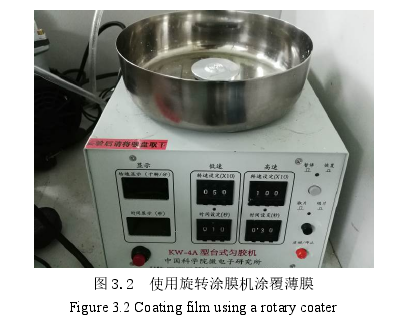
(3). As shown in Figure 3.2, use a rotary coating machine to coat the film, drop about 0.1ml of PVDF solution onto the surface of the conductive glass , first mix the glue at 500rpm for 20s, and then shake it at 1000, 1500, 2000, and 2500rpm respectively glue.
(4). The prepared composite material film is placed in a Drying Oven, dried at 65°C for 1h, and then dried at 80°C for 12h. If a single-layer film is to be prepared, it is directly annealed at 110°C for 1h. If you want to make a multi-layer composite film, you need to drop the solution on the film, dry it in the same way and anneal it at 1109C for 1 hour.
(5). Use a vacuum coating machine to spray the electrodes. Mask the edges of the conductive glass with a stencil, leaving only the center of for metallization. In the relevant test of the thin film, the metal aluminum is sprayed as the electrode. A1 has good electrical conductivity, thermal and chemical properties, and is cheap. The thickness of the sprayed electrode is 200nm.
The process of preparing PVDF film mixed with KNN powder is similar, but the (1) stage of the above experiment has changed:
The polyvinylidene fluoride (PVDF) powder that takes 18g is dissolved in the N of 10m1, in the N,N-dimethylformamide (DMF) solvent, under the condition of 60 ℃ of magnetic stirring 2 hours, the DMF solution of making PVDF, Then the solution was left to stand at room temperature for more than 12 hours, and it was ready for use. A certain amount of piezoelectric ceramic powder was sieved through a 200-mesh standard sieve, and poured into 3ml of DMF. Ceramic volume fractions are 2.5% (KNN: 0.115g), 5% (KNN: 0.236g), 10% (KNN: 0.500g) , 15% (KNN: 0.794g), magnetic force at room temperature (25'C) Stirring for 30 minutes, followed by ultrasonic dispersion
20 minutes, and finally magnetically stirred for more than 1 hour. Next, the above KNN suspension was mixed with the PVDF solution, and magnetically stirred at 60℃. for 2 hours. Then, ultrasonically vibrate for 5 minutes to remove air bubbles in the solution, and then put it in a vacuum chamber to evacuate for 20 minutes.
-
![SETCAS KW-4A Spinning Coater Manual]() SETCAS KW-4A Spinning Coater Manual$ 1255.00
SETCAS KW-4A Spinning Coater Manual$ 1255.00 -
![WENHAO WH-SC-01 Touch screen homogenizer Rotation speed 300~4500RPM]()
- 1Hydrogen fuel cell membrane electrode film preparatory process and performance evaluation method
- 2Application and Experimental Study of Film Coating Adhesive Technology
- 3Film coating thickness measurement
- 4What are the potential applications of diamond and diamond-like carbon films?
- 5What are diamond and diamond-like carbon films?
- 6What is nylon film?
- 7Preparation and Technology of Wear-resistant Transparent Superhydrophobic Films
王薇;周忠华;脱永峰;黄悦 - 《厦门大学学报(自然版)》
- 8How to paint on PVC surface?
- 9Analysis and Countermeasures of Adhesion of UV inks on Film stickers
晓晓 - 《UV 油墨在薄膜不干胶材料上黏着力不良故障分析》