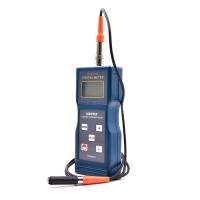
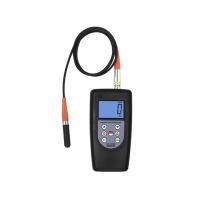
Common precautions for the selection of coating Thickness Gauges
Generally, the measuring range of the coating Thickness Gauge is between 1000 and 2000 microns. For some special thick coatings (such as fireproof coatings), there will be a special large-range thickness measuring instrument, which is generally about 6000 microns, so unless there are special applications , Under normal circumstances, the range of the Thickness Gauge is satisfied, so the range will not be wrongly selected due to unsuitable application.
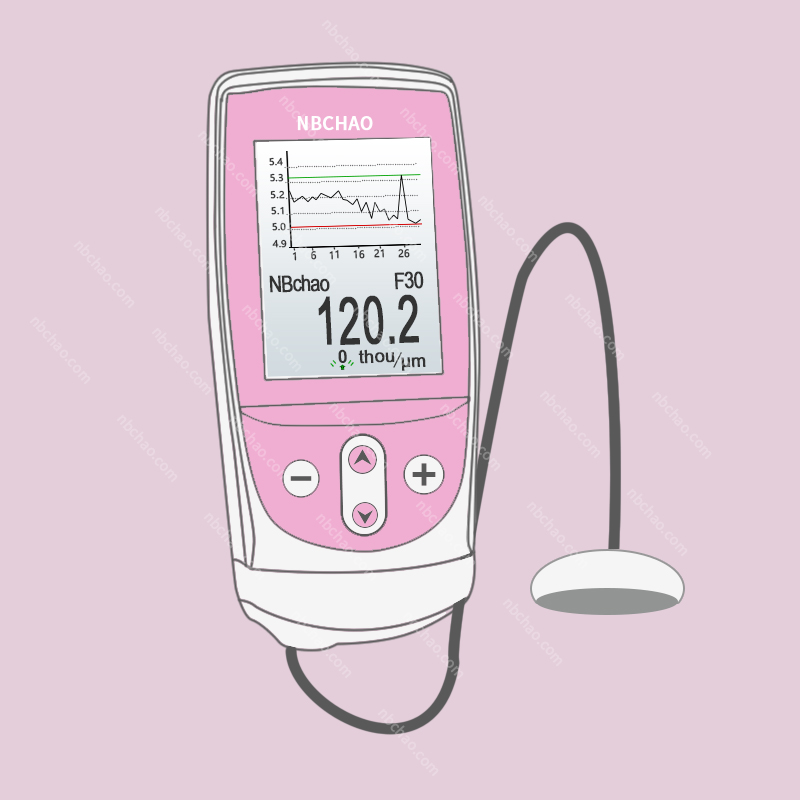
However, we must pay attention to the following special circumstances. Several situations need to be considered:
1. Ultra-thin coating
Many of these are coatings, and the thickness of the film is between a dozen microns to 30 microns, because the Thickness Gauge itself has an error value, and the low-end Thickness Gauge has relatively large fluctuations when measuring 10 microns. To measure accurately, at this time, generally choose a large manufacturer with a smaller range and higher precision.
2. Rough coating
The peaks and troughs of the roughness are very likely to cause errors in the probe measurement. Some Thickness Gauges have probes specially designed for rough environments.
3. High temperature surface
High-temperature surface coating requires a professional high-temperature probe of a coating Thickness Gauge, otherwise the standard probe is very easy to lose its life. Generally, the temperature that the high temperature probe can withstand is around 200-300°C.
4. Coatings with required headroom
The main prominent applications of this type are pipes and inner walls. This type of headroom is low, and it is difficult to achieve accurate measurement with traditional probes. The use of 45° and 90° angle probes can measure this type of coating very well.
5. Underwater coating
Many Thickness Gauges are not only not waterproof for the main body, but even the probe is not waterproof. This is definitely not applicable. The probes of some manufacturers have realized underwater measurement, and the probe line can be extended to five or six meters, which is very convenient.
6. Small parts
The contactable area of this surface is small, and ordinary probes cannot completely cover it. It is necessary to use a relatively small probe. Typical applications are parts such as screws.
7. Surface environment
Since the surface of the spherical or curved surface is not flat, the probe cannot be perpendicular to the coating surface when it is in contact, and the measured data is of course inaccurate. For this type of method, a small probe can be selected according to the sixth point.
North and South Tide Mall




- 1Nondestructive measurement Coating thickness
- 2Principle, application and selection of traffic coatings Coating Thickness Gauge
- 3Principle, Application and Selection of Eddy current Coating Thickness Gauge
- 4Principle, Application and Type Selection of Electronic Coating Thickness Gauge
- 5Explore the principle, application and selection of phosphating layer Coating Thickness Gauge
- 6Principle, Application and Type Selection Analysis of Chrome Coating Thickness Gauge
- 7Principle, Application and Selection of Coating Thickness Gauge for inner wall of small pipe
- 8Basic principle and application scenario of steel Coating Thickness Gauge
- 9Principle and Application Analysis of Coating Thickness Gauge