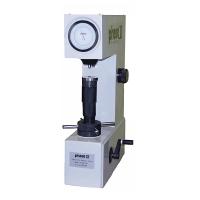
What is Rockwell Hardness?
What does the Rockwell hardness test mean?
The Rockwell hardness test is a commonly used hardness test method. It is used on all metals except where the surface condition and metal structure can vary greatly.
This test measures the depth of indentation caused by the load or force on a specific indenter.
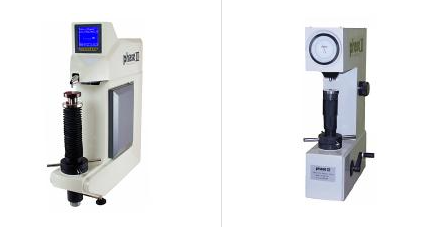
Rockwell hardness test
Rockwell hardness testing is primarily performed with a test force, often referred to as a small load or preload. This is applied to a specific sample with the help of an indenter. This reflects the reference, or zero, done. After the secondary loading step, additional loads are applied to achieve the necessary test loads.
After applying force, stop for a predetermined period of time to allow elastic recovery. Then, the main load undergoes release and the resulting position is measured against the preload position. The difference in depth indentation is also measured between the values of main load and preload. The obtained distance is then converted to a hardness number.
There are many scales represented by a single letter, which utilize various indenters or loads. The result looks like "HRA", where A is considered a ratio. Essentially, harder substances are indicated by higher letters.
The most widely used indenter is the diamond cone, which can measure the hardness of carbides and steels at 120 degrees. Other materials, especially softer ones, are measured using tungsten carbide rounds. The test force and indenter together make up the Rockwell scale.
The main advantage of the Rockwell hardness test is that it can directly display the hardness value. This avoids tedious calculations that may be encountered with other techniques used to measure hardness. This method is commonly used in metallurgy and engineering. This test is widely used because it:
reliability
speed
resolution
robustness
Small indentation area
For accurate readings, the thickness of the test material should be 10 times the depth of the indentation. Readings should also occur on vertical or flat surfaces, as convex surfaces may cause lower readings.
In this case, a convex correction factor can be used.