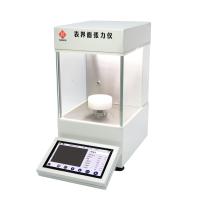
What is the wetting of surface tension?
Put a liquid on a flat, horizontal solid surface, and it either gets wet and runs off, or gets wet to form a hemispherical drop. An intermediate state is also possible where the liquid neither recedes nor advances, but remains stationary. The angle formed by a droplet or liquid edge with a solid plane is called the contact angle (Figure 1.4).
Non-wetting conditions exist when the contact angle exceeds 0°, ie, the angle is measurable. A liquid's intramolecular attraction is greater than its attraction to a solid surface. The surface tension value of a liquid is higher than the surface energy of a solid. Wetting conditions occur when the contact angle is 0°. The edge of the liquid keeps going, even though it may be slow for highly viscous materials. In this case, the intermolecular (solid-liquid) attraction is greater. The surface energy of a solid is higher than the surface tension of a liquid.
Measuring contact angle is a simple technique to determine the relative difference between two surface tensions. A high contact angle indicates a large deviation, while a small angle indicates that the two values are close, but not equal.
One can estimate the surface tension of a liquid by applying a droplet to a smooth surface of known value until just when wetting occurs, indicating that the two surface tensions are equal. Conversely, the surface energy of a solid can be estimated by applying a standard surface tension to a droplet of a liquid until wetting is achieved. Surface tension kits can be made from simple mixtures used to test surfaces. Table 1.5 provides the formulas.
Low energy surfaces are difficult to wet and will not perform well with coatings, paints and prints. Standard surface tension kits are available to estimate the surface energy of plastics to be decorated.
Contamination is suspected if a particular plastic shows values much lower than those reported in Table 1.4. Mold release agents, unless specifically manufactured for trim materials, can greatly reduce the surface energy of plastic parts, making them uncoatable.

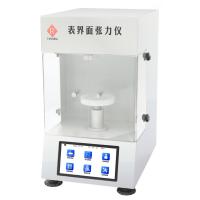


- 1Water surface tension measurement based on Electronic Balance
- 2Working principle of mechanical liquid meter interfacial tensIon Meter
- 3Comparison of Liquid Surface/Interfacial Tension Testing Methods: Plate vs. Ring Method
- 4Selection guide for Surface Tensiometers
- 5Application principle and precautions of platinum ring Surface Tensiometer
- 6Coating surface tension and its effects
- 7Coating process surface tension factor
- 8Three commonly used detection methods for surface tension
- 9Ceramic ink-jet surface tension, viscosity and solutions