Types of Vacuum Pumps
In recent years, a new type of Vacuum Pump has been developed that can achieve from atmospheric pressure to high vacuum with only one pump, but generally speaking, in order to obtain high vacuum, ultra-high vacuum and extremely high vacuum, multiple Vacuum Pumps are connected in series to complete Pumping task. Therefore, it is very important for users to correctly understand the type of pump to choose an economical and suitable Vacuum Pump. The following paragraphs are brief descriptions of the types of Vacuum Pumps. (The diagrams after the paragraphs are to make it easier for users to better understand the paragraphs.)
Air pump
The gas delivery pump is a Vacuum Pump that can continuously suck and discharge gas to achieve the purpose of pumping. There are basically two types of pumps of this type: variable displacement Vacuum Pumps and Momentum transfer pumps.
variable capacity Vacuum Pump
A Vacuum Pump that uses periodic changes in the volume of the pump chamber to complete the suction and exhaust process, and the gas is discharged before being compressed. The pump is also divided into two types: double pump and rotary vane pump.
Duplex Vacuum Pump: It is a device that uses the reciprocating motion of the piston in the pump chamber to suck, compress and discharge gas. Therefore, it is also called a piston Vacuum Pump.
Rotary vane Vacuum Pump: It is a device that uses the piston in the pump as a cavity for rotating motion to inhale, compress and discharge gas. It is also divided into the following forms:
Oil-sealed Vacuum Pump: usually with gas ballast, so it is also called gas ballast Vacuum Pump.
Dry screw Vacuum Pump: It is a sealed variable capacity Vacuum Pump without oil or any other liquid substances.
Liquid ring Vacuum Pump: a multi-blade motor is mounted eccentrically in the pump casing. As it spins, it throws liquid (usually oil or water) into the pump casing, creating concentric rings of liquid inside the pump casing. The ring forms several small volumes that vary periodically with the rotor blades.
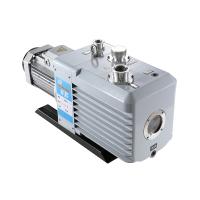
Sliding vane rotary Vacuum Pump: It has the advantages of compact structure, small volume, light weight, low noise and small vibration. Therefore, it is widely used as the front line of diffusion pumps. In addition, it is more suitable for precision instrument matching and laboratory use.
Roots Vacuum Pump: It is a rotary variable volume Vacuum Pump. It can be used in a wide pressure range with the backing pump. It has a large pumping speed and is insensitive to dust and water vapor contained in the suction. Widely used in metallurgy, chemical industry, food, electronics and electronic coating and other fields.
Momentum transfer pump
The pump relies on high-speed rotating blades or high-speed jets to transfer momentum to gas or gas molecules, so that the gas is continuously transported from the pump inlet to the outlet. It can be divided into the following categories:
Molecular Vacuum Pump: It is a Vacuum Pump that relies on high-speed rotors to bring energy to gas molecules for compression and discharge.
Jet Vacuum Pump: It is a momentum transfer pump that uses the high-speed jet pressure generated by the Venturi effect to transport the gas to the outlet. This is suitable for working in viscous stagnant and transitional flow conditions.
Diffusion pump: a Vacuum Pump that uses low-pressure high-speed steam flow (oil or mercury vapor) as the working medium.
Diffusion jet pump: It is a momentum pump with single-stage or multi-stage nozzles that has the characteristics of a diffusion pump. Oil booster pumps belong to this form.
Ion transfer pump: It is a Vacuum Pump that transfers ionized gas to the outlet under the action of an electromagnetic field or an electric field.
trap pump
It is a Vacuum Pump that absorbs or condenses gas molecules on the inner surface of the pump, thereby reducing the number of gas molecules in the container to achieve the purpose of vacuuming. There are several forms:
Adsorption pump: It is a trapping Vacuum Pump that mainly relies on physical adsorption of large surface area adsorbents (such as porous substances) to pump air.
Getter pump: is a Vacuum Pump that uses a chemical combination of getters to capture gas. Typically, getters resemble metals or alloys, in bulk or as deposited fresh films. Sublimation pumps are of this type.
Suction ion pump: through the action of electromagnetic field or electric field, the ionized gas is adsorbed on the surface of the suction material to achieve the purpose of pumping.
Cryopump: A Vacuum Pump that traps gas on a cryogenic surface.

-
![RONGHUA 2XZ-25B DC Rotary Vane Vacuumpump 25L/S]()
-
![TQC AB3676 Vacuum Pump]() TQC AB3676 Vacuum Pump$ 1247.00
TQC AB3676 Vacuum Pump$ 1247.00 -
![Qiwei XZ-6 Oil Free Diaphragm Vacuumpump 60L/MIN]()
-
![Qiwei XZ-2 oil-free diaphragm Vacuumpump]()
-
![Qiwei XZ-3 oil-free diaphragm Vacuumpump 35L/MIN]()
-
![Qiwei XZ-1 oil-free diaphragm Vacuumpump 0.8 kg/cm ²]()