How to choose the right infrared thermometer?
How to choose the right infrared thermometer? The first thing to consider is performance indicators, such as temperature range, spot size, operating wavelength, measurement accuracy, response time, etc. Environmental and operating conditions are also taken into consideration, such as ambient temperature, windows, display and output, protective accessories, and other factors, including convenience, maintenance and calibration performance, and price, etc., can also affect the choice of infrared thermometer.
temperature range
Temperature range is one of the important performance indicators of thermometers. For example, ATO products cover the range of -50°C to +1650°C, but this is not what infrared thermometer models can do. Each type of infrared thermometer has its specific temperature range, such as -50°C to +380°C, -50°C~1150°C, etc. Therefore, the temperature range measured by the user needs to be considered accurate and comprehensive, neither too narrow nor too wide. According to the law of black body radiation, the change of radiant energy caused by temperature in the short wavelength band of the spectrum will exceed the change of radiant energy caused by emissivity error. Therefore, it is recommended to choose short wave when measuring temperature.
target size
Infrared thermometers can be divided into single-color thermometers and two-color thermometers (radiation Colorimeters) according to the principle. For monochromatic thermometers, when measuring temperature, the target area to be measured should fill the field of view of the thermometer. It is recommended that the measured target size exceed 50% of the field of view size. If the target size is smaller than the field of view, it will cause erroneous temperature readings. For a two-color thermometer, the temperature is determined by the ratio of radiant energy in two separate bands. Under these conditions, a two-color thermometer is the better choice. The target is small and in motion or vibration; sometimes the target moves within the field of view, or may move partly out of view.
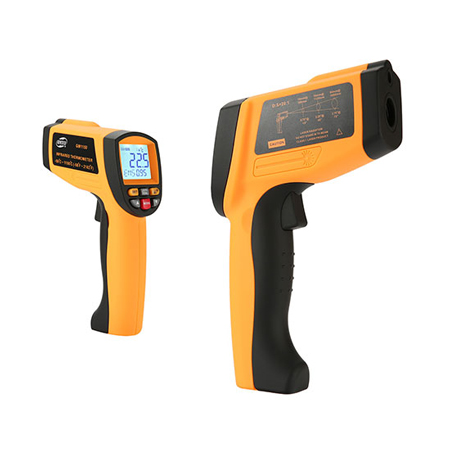
optical resolution
The optical resolution is determined by the ratio of D to S (D refers to the distance between the infrared thermometer and the target; S refers to the diameter of the measured spot). If the infrared thermometer needs to be installed far from the target due to environmental constraints, but a small target is to be measured, a pyrometer with high optical resolution should be selected. The higher the optical resolution, i.e. the higher the D:S ratio, the more expensive the thermometer will be.
wavelength range
The emissivity and surface properties of the target material determine the spectral response, or wavelength, of the infrared thermometer. In the high temperature region, the best wavelength for measuring metal materials is near infrared, with a wavelength of 0.18-1.0 μm. Additional temperature regions are available at 1.6μm, 2.2μm and 3.9μm wavelengths. Because certain materials are transparent at specific wavelengths, infrared energy will pass through these materials, so a specific wavelength should be chosen for this material. For example, the internal temperature of the measuring glass is selected as 10 μm, 2.2 μm and 3.9 μm (the glass to be tested is very thick, otherwise it will pass); the internal temperature of the measuring glass is selected as 5.0 μm; the lower measurement area is preferably 8-14 μm.
Response time
Response time indicates the response speed of the infrared thermometer to the measured temperature change. It is defined as the time required to reach 95% energy of the final reading and it is related to the time constant of the photoDetector, signal processing circuit and display system. The new infrared thermometer has a response time of up to 1 millisecond. This is much faster than contact temperature measurement methods. If the moving speed of the target is fast or when measuring a target that heats up rapidly, a fast-response infrared thermometer should be selected. Otherwise, sufficient signal response will not be obtained, reducing measurement accuracy. However, not all applications require a fast-response infrared thermometer. For thermal inertia in static or thermal processes of interest, the requirement on the response time of the thermometer can be relaxed. Therefore, the response time of the infrared thermometer should be selected to match the situation of the target.
Signal processing function
Due to the difference between discrete processes (such as parts production) and continuous processes, infrared thermometers are required to have multiple signal processing functions (such as peak hold, valley hold, average value). For example, when measuring the temperature of a bottle on a conveyor belt, a peak hold is required to send an output signal of its temperature to the controller.
environmental conditions
Environmental conditions have a great influence on the measurement results of infrared thermometers. Otherwise it will affect the temperature measurement accuracy. When there is high temperature, dust, smoke and steam, accessories such as protective cover, water cooling, air cooling system, and air purifier can be used to solve the environmental impact and protect the thermometer from accurate temperature measurement. When reducing smoke, dust, or other particulate matter in noise, electromagnetic fields, vibration, or inaccessible environments or other harsh conditions, fiber optic dual-color thermometers are a better choice. Under noise, electromagnetic field, vibration and inaccessible environmental conditions, or other harsh conditions, fiber optic colorimetric thermometers should be selected.
