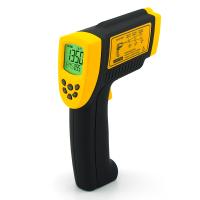
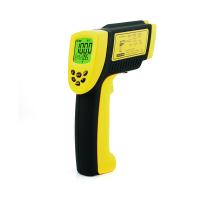
What affects the measurement accuracy of an infrared thermometer?
Since infrared temperature measurement technology has been widely used in industries and other fields, higher requirements are placed on measurement accuracy. Non-contact infrared thermometers are becoming more and more perfect in function and technology, but there are still some factors that affect their accuracy. So, what are the factors that affect the measurement accuracy of infrared thermometers?
measuring angle
In order to ensure accurate measurement, try to make the infrared thermometer follow the surface normal direction of the measured object (perpendicular to the target surface) during measurement. If the normal direction of the instrument cannot be guaranteed, it should be measured at an angle of 45 degrees to the normal direction, otherwise the display value of the infrared thermometer will be low.
ambient temperature
Infrared thermometers should be used in strict accordance with the ambient temperature specified in the instrument technical indicators. Otherwise, exceeding this range will increase the measurement error of the infrared thermometer and even damage the infrared thermometer. When the ambient temperature is high, air-cooled, water-cooled devices or heat protection jackets can be used. The heat protection cover can further ensure the normal operation of the infrared thermometer in an environment of 200 degrees.
When a handheld infrared thermometer or temperature gun is used from one environment to another with a large temperature difference, the accuracy of the instrument will be temporarily reduced. In order to obtain good measurement results, the infrared temperature gun should be placed on the job site for a period of time (at least 30 minutes is recommended) to allow the temperature of the instrument to balance with the ambient temperature before use.
air quality
Pollutants such as smog and dust in the air and unclean lenses will make the infrared thermometer unable to receive enough infrared energy to meet the measurement accuracy, thereby increasing the measurement error of the instrument. So you suggest to keep the lens clean, the blower will help keep the lens from getting dirty.
electromagnetic interference
Infrared thermometers should be kept as far away as possible from potential sources of electrical interference, such as electrical equipment with large load changes. The output and input of the online instrument should be connected to the shielded wire, and ensure that the shielded wire is well grounded. In high interference environments, external rigid protective conduits are more effective than flexible conduits. Also, do not lead AC power from other equipment into the same conduit.

When using an infrared thermometer, as long as you pay attention to the measurement angle, ambient temperature, electromagnetic interference and other issues, you can get high-precision data and avoid unnecessary troubles.
Field of view and target size
It should be ensured that the target enters the field of view of the instrument measurement, and the smaller the target, the closer it is. In addition, it is recommended to make the target size more than twice the light spot in the field of view to reduce the error in the actual measurement.
When there are other high-temperature objects, light sources or solar radiation around the measured object, these radiations will directly or indirectly enter the measurement optical path, causing measurement errors. In order to overcome the influence of environmental radiation and prevent environmental radiation from entering the optical path directly, the field of view of the instrument is covered with the measured object as much as possible. The indirect interference of environmental radiation can be eliminated by shielding.

- 1How to Choose an Infrared Thermometer
- 2How does an infrared thermometer work?
- 3Non-contact infrared thermometer and contact thermometer
- 4Operation method of 2-in-1 ring laser infrared thermometer
- 5Infrared frontal thermometer DT-8807S how to operate and precautions?
- 6How does emissivity affect infrared thermometers? Emissivity of common substances
- 7How to choose a high-quality infrared thermometer?
- 8Importance of Infrared thermometers in the Glass Industry
- 9What is a radiant thermometer (also known as an Infrared thermometer)?