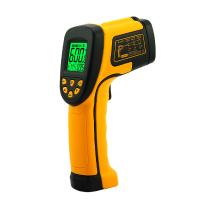
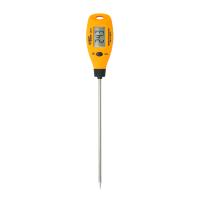
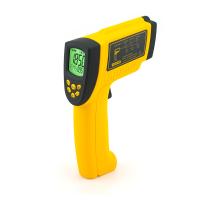
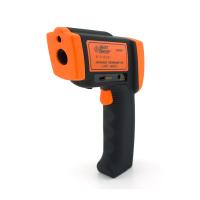
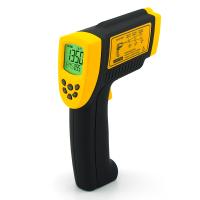
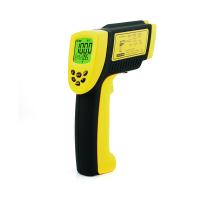
Non-contact infrared thermometer and contact thermometer
Infrared temperature measurement technology plays an important role in production, product quality control and monitoring, online fault diagnosis and safety protection, and energy saving. Compared with contact temperature measurement, infrared temperature measurement has the advantages of fast response time, non-contact, safe use, and long service life. Non-contact infrared thermometers involve three series of portable, online and scanning thermometers, equipped with various accessories and computer software. In addition, each series has different types and specifications. Among these thermometers of various specifications, it is very important for users to choose the correct model of infrared thermometer.
What is the difference between a non-contact infrared thermometer and a contact thermometer?
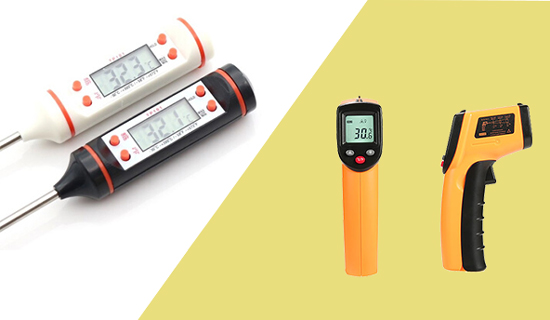
Non-contact infrared thermometer
Non-contact temperature measurement has no effect on objects.
The non-contact infrared thermometer detects the surface temperature of objects.
Fast response, can measure moving objects and transient temperature.
Non-contact infrared thermometers have a wide range of measurements.
It has the characteristics of high measurement accuracy and small resolution.
It can measure temperature in a small area.
It can measure the temperature of point, line and surface at the same time.
Measure absolute and relative temperatures.
contact thermometer
Contact temperature measurement affects the temperature field of the measured object.
Contact thermometers are not suitable for measuring transient temperatures.
It is not suitable for measuring moving objects.
Insufficient measurement width, consumables.
Not suitable for measuring hazardous situations such as toxic or high pressure.
From the perspective of application benefits, non-contact infrared thermometers are better than contact thermometers. Considering the cost performance, it is recommended to use a non-contact infrared thermometer. Although the price of non-contact thermometers is higher than that of contact thermometers, the loss of non-contact thermometers is small, saving manpower, material resources, and financial resources.
- 1How to Choose an Infrared Thermometer
- 2How does an infrared thermometer work?
- 3What affects the measurement accuracy of an infrared thermometer?
- 4Operation method of 2-in-1 ring laser infrared thermometer
- 5Infrared frontal thermometer DT-8807S how to operate and precautions?
- 6How does emissivity affect infrared thermometers? Emissivity of common substances
- 7How to choose a high-quality infrared thermometer?
- 8Importance of Infrared thermometers in the Glass Industry
- 9What is a radiant thermometer (also known as an Infrared thermometer)?