What is the volume solids in paint?
What is the Volume Solids in Paint?
Every coating consists of resins, pigments, additives such as stabilizers, defoamers and thickeners, and solvents.
After the paint is applied to the surface, the solvent evaporates, leaving only a residual dry solid as a comprehensive coat. The solids contained in the coating mixture can be expressed as a volume percent of the total composition. For example, if a can of paint is made up of half solvent, the paint can be considered 50% solids. The logic is as follows, if 100 microns of wet paint is applied to a surface, the remaining dry paint thickness will be 50 microns.
Calculate Volume Solids
The equation can be expressed as: % volume solids = dry film thickness x 100/wet film thickness.
Knowing this equation is useful because knowing the volume solids value can help you calculate the theoretical spread rate, the wet film thickness to achieve the desired dry film thickness, and the final wet-to-dry thickness ratio after solvent evaporation. Most paint tables include the former volume solids calculation; however, the above variables can be calculated using the following equation.
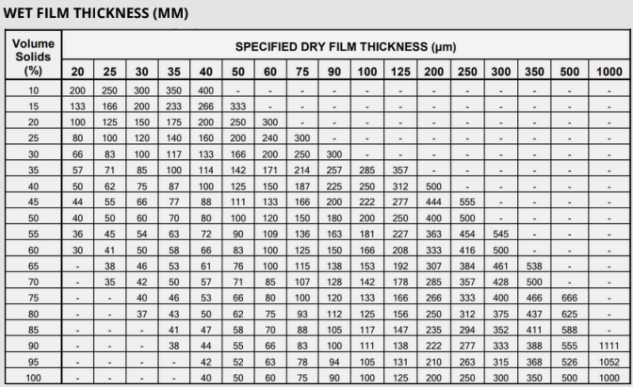
Calculate Wet Film Thickness
Wet film thickness = dry film thickness x 100/% volume solids.
- 1Volume solids of paintings and related calculations
- 2Car body paints gloss detection
- 3Some basics about paint
- 4Paint rheology and its function
- 5Thixotropy - the viscosity of inks and paints
- 6Some knowledge of paint
- 7Analysis and solution of primer brushing defects
- 8New technology for automobile painting construction----flawed putty scraping method
- 9New technology for automobile painting construction--partial putty scraping method