Effect of Printing ink on Adhesion Fastness of Composite Films
Composite film materials are formed by compounding different single-layer film materials through adhesives, so as to maximize the excellent performance of each single-layer film and meet the quality requirements of the packaged product. Taking aluminum-plastic composite film PET/Al/PE as an example, the three single-layer film materials play different roles in the composite film. PET film is used as the printing layer, Al is mainly used as the barrier layer, and PE film is the heat-sealing layer. Due to defects such as creases and pinholes on the Al surface, PET and PE films also protect the Al layer. If the interlayer composite fastness is low and easy to peel off, the protective effect of the plastic film layer on the aluminum foil layer will be weakened. When it is squeezed and rubbed, the aluminum foil is easily damaged, which affects the overall barrier performance of the composite film material. In addition, low composite fastness will also affect the physical properties of the entire package, such as impact resistance, puncture resistance, etc. Therefore, appropriate composite fastness is the premise to ensure that the performance of the composite film material reaches the expected performance.
There are many factors that affect the composite fastness of composite membrane materials, such as the type of adhesive, the ratio of each group, the amount of glue, composite process parameters, ink, etc. Effect of different color inks on composite fastness.
Adhesion fastness is generally characterized by peel strength. In this paper, the peel strength of the samples is tested according to ASTM D1876 Standard Test Method for Peel Resistance of Adhesives
In this test, a plastic composite film composed of two layers of film is selected as the test sample. The surface of the sample contains three printing areas of inks of different colors.
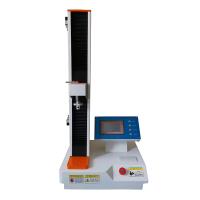
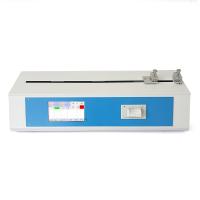
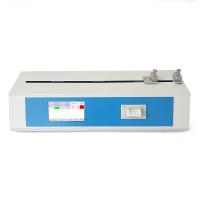
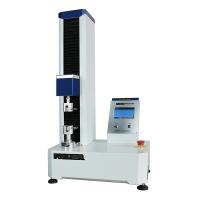
In this paper, an automatic Tensile Testing Machine was used to test the peel strength of the samples.
In this paper, the peel strength of different color printing areas on the sample surface was tested and compared, and the influence of different inks on the composite fastness of the sample was analyzed. The force required to peel the composite layer per unit width of the sample is the peel strength. During the test, the upper and lower clamps of the instrument respectively hold the two ends of the peeled part of the sample, and the upper clamp pulls the sample upwards to peel it off. The force value and displacement changes during the peeling process are monitored in real time by the load cell and displacement sensor on the upper fixture, and then the peeling strength of the sample is obtained
(1) Sampling. In the same direction, 5 specimens with a width of 15.0 mm and a length of at least 10 cm are cut in different colors on the sample surface.
(2) Condition adjustment. Place the cut sample in an environment of 23±2°C and 45% to 55% for 4 hours.
(3) Pre-peeled. Strip approximately 3 cm from one end of each sample.
(4) Set parameters. Set parameters in the control software of the test instrument, such as test speed (300 mm/min), sample width, sample name and other parameter information.
(5) Clamp the sample. Take one of the samples, and install the two layers of material peeled from the pre-stripped part in the upper and lower clamps of the instrument, so that the longitudinal axis of the peeled part is aligned with the centerline of the two clamps. Click the "Test" option, and the upper gripper moves up to peel the sample at the set speed.
The peel strength of samples in different color areas measured in this test is the average value of the test results of 5 samples in each area. The peel strength of the unprinted area, that is, the transparent area, is 1.036 n/15mm, that of the white printed area is 0.887 n/15mm, and that of the yellow printed area is 0.571 n/15mm.
Factors such as printing process, ink quality, and compatibility with adhesives will all affect the composite fastness of the printed area of the composite film material. In this test, the peel strength of plastic composite film samples in different color areas was tested. The test operation is simple, the instrument is intelligent, and the force value during the test can be clearly and intuitively displayed. The test results show that the composite fastness of the unprinted area is recommended, followed by the white printed area and the yellow printed area. This phenomenon may be related to the different compatibility of inks and adhesives of different colors.


- 1What is a peel strength Tester and what is it used for?
- 2What is a stripping test?
- 3Test method for tensile strength of fabrics
- 4What are the principles and test methods of peel strength testing machine?
- 5What performance tests must be performed on the protective film?
- 6How to test the peel strength of pressure sensitive adhesive products? [three methods]