Four key stages of spin coating
There are four distinct stages in the spin coating process. Stage 3 (flow control) and stage 4 (evaporation control) are the two stages that have a greater impact on coating thickness.
Phase 1: Depositing the coating fluid onto the wafer or substrate
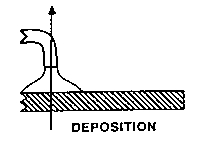
This can be done with a nozzle that pours the coating solution out, or it can be sprayed onto the surface, etc. Typically, this dispensing stage provides a significant excess of coating solution compared to the amount required for the coating thickness. For many solutions, it is often beneficial to dispense through sub-micron filters to remove particles that could cause defects. Another potentially important question is whether the solution fully wets the surface during this dispensing phase. If not, it may result in incomplete coverage.
Stage 2: The substrate is accelerated to its final desired rotational speed
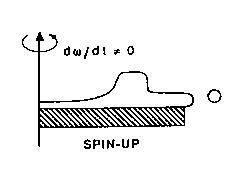
This stage is usually characterized by a vigorous expulsion of fluid from the wafer surface by a rotational motion. Due to the initial depth of the fluid at the surface of the wafer, helical vortices may briefly appear during this phase; these are formed due to the torsional motion caused by the inertia exerted on top of the fluid layer, while the wafer below spins faster and faster. The fluid was thin enough to fully co-rotate with the wafer, and any sign of fluid thickness differences disappeared. The wafer reaches its required velocity, and the fluid is thin enough that the viscous shear resistance just balances the rotational acceleration.
Phase III: When the substrate is rotating at a constant rate and fluid viscous forces dominate the fluid dilution behavior
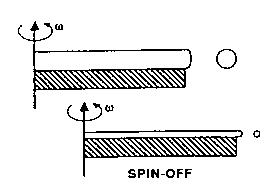
This stage is characterized by a gradual thinning of the fluid. Fluid dilution is usually very uniform, although with solutions containing volatile solvents, interference color "shedding" can often be seen and gradually slows down as the coating thickness decreases. Edge effects often occur because a fluid flows uniformly outward, but requires droplets to form at the edge to be thrown off. Therefore, depending on surface tension, viscosity, spin rate, etc., there may be a small difference in coating thickness around the edge of the wafer at the end. A mathematical treatment of flow behavior shows that if the liquid exhibits a Newtonian viscosity (i.e. is linear) and if the fluid thickness is initially uniform (albeit fairly thick) across the wafer,
Stage Four: When the substrate is rotating at a constant rate and solvent evaporation dominates the coating thinning behavior
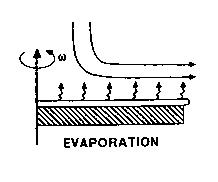
As the previous stage progresses, the fluid thickness reaches a point where the viscosity effect produces only a relatively small net fluid flow. At this point, evaporation of any volatile solvent species will be the dominant process occurring in the coating. In fact, the coating is effectively "gelling" at this point, because when these solvents are removed, the viscosity of the remaining solution may rise - effectively freezing the coating in place.
After the spin has stopped, many applications require heat treatment or "firing" of the coating (such as "spin-on-glass" or sol-gel coatings). Photoresists, on the other hand, usually go through additional processes depending on the desired application/use.
Clearly, stages 3 and 4 describe two processes (viscous flow and evaporation) that need to always occur simultaneously. However, at the engineering level, viscous flow effects dominate at an early stage, while evaporation processes dominate at a later stage.


- 1Application of Spin Coater in preparation of Bi1.5MgNb1.5O7 film
- 2Spin Coater selection and classification: a one-stop guide
- 3Automatic Film Applicator and spin coating spin coater: Key technologies and applications in industrial production
- 4Spin coatings spin coaters: principles, applications, functions and maintenance
- 5Advantages and disadvantages of spin coating process and ideal use
- 6What is spin coating?
- 7Common defects in spin coating of homogenizer
- 8What are the common problems of spin coating experiment?
- 9Spin-on cleaning and specific cleaning steps