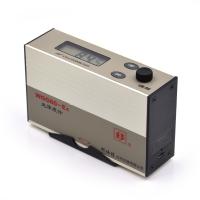
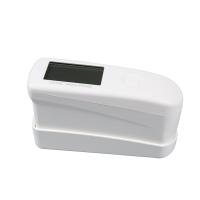
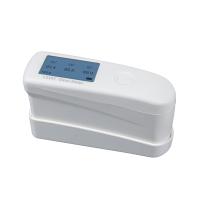
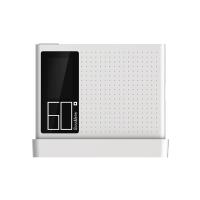
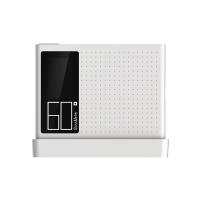
Briefly describe the selection skills of Gloss meter
To choose a Glossiness Meter, you first need a flat surface of approximately 2 "x 0.5" (50 x 10mm) to properly position the Glossiness Meter on the surface.
Your product must now be judged by its glossiness. Most products fall into the semi-glossiness range. Some are matte and designed to have very low glossiness, while others such as metal or automotive finishes are very high. There are three types that cover the entire glossiness range, namely 20 degree, 60 degree and 85 degree Glossiness Meters. However, certain industries present different angles. These industries are: Paper, Ceramics, Film and Vinyl. Some customers make a range of products from very gloss to matte and then you need a universal Glossiness Meter to measure all three angles, or you might only make products from half gloss to very high gloss instead of you need DUAL 20-60 degree Glossiness Meter.
Low glossiness - 85 °
To improve resolution with low glossiness, a grazing angle of 85 ° is used for surface measurement. This angle is recommended for surfaces smaller than 10GU for measurement at 60 °. This angle also has a larger measurement point to average out differences in glossiness on textured or slightly uneven surfaces.
Medium or half glossiness - 60 ° - General Geometry
It must be remembered that all glossiness levels can be measured using a standard Geometry of 60 °. This 60 degree angle is used as a reference angle for all products. So why choose another angle from Miscellaneous? Because for extremely high glossiness, one can get better measurement results with complementary angles of 85 ° or 20 °, which are usually used for low and high glossiness levels, respectively.
High glossiness - 20 °
Geometry at an acute angle of 20 ° increases the resolution of high gloss surfaces. Surfaces measuring 70 GU and above at a standard angle of 60 ° are often measured using this geometric shape. The 20 ° angle is more sensitive to haze effects that affect surface appearance. The different glossiness of the two samples is shown more clearly in the 20 ° reading.
45 ° Glossiness Meter
45 degree Glossiness Meter is mainly used in Ceramics and film production industry.
75 ° Glossiness Meter
75 degree Glossiness Meters are mainly used in Paper and Vinyl production industries.

- 1Application of Glossmeter in paper surface gloss detection
- 2Glossmeter for paints film gloss detection
- 3Application of Glossmeter in wood gloss detection
- 4Application of Glossmeter in furniture paints gloss detection
- 5How to detect enamel gloss with Glossmeter?
- 6Several gloss meters bought by customers in the plastic pipe fittings industry
- 7Cotton gloss test of gloss meter application case
宋钧才 - 《《棉花的光泽及其测定》》
- 8What are the gloss meters that meet the GB/T9966 standard?
- 9Which gloss meter can test samples of curved surfaces?
-
![KSJ WGG60-E4 Gloss meter built-in lithium battery]()
-
![CHINA LS195 Portable Glossmeter Cost-effective Gloss Meter 60 °/200GU]()
-
![CHINA LS197 three-angle Glossmeter 20 °/60 °/85 ° multi-angle measurement]()
-
![DONGRU DR61S Glossmeter 0-200Gs]() DONGRU DR61S Glossmeter 0-200Gs$ 314.00
DONGRU DR61S Glossmeter 0-200Gs$ 314.00 -
![CHNSPEC DG60 MAX single angle gloss meter 2000GU/60 °]()
-
![CHNSPEC G60Pro single angle gloss meter Measurement verification Glossmeter]()