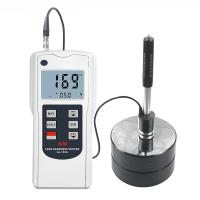
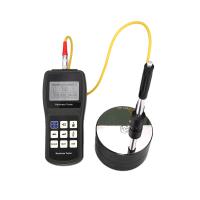
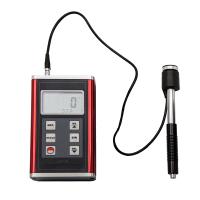
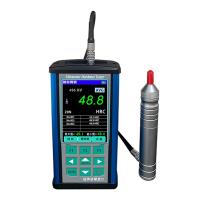
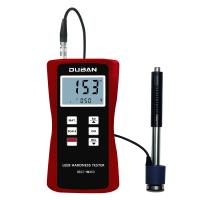
What factors affect the test accuracy, error and repeatability of the Leeb Hardness Tester?
Errors caused by data conversion
The error when converting the Leeb hardness to other hardness includes two aspects: one is the measurement error of the Leeb hardness itself, which involves the dispersion of the test according to the method and the measurement error of multiple Leeb Hardness Testers of the same type. On the other hand, there is an error in comparing hardness measured by different hardness testing methods, which is due to no clear physical relationship between one of the various hardness testing methods and is affected by unreliable measurements in mutual comparison.
Errors caused by special materials
The conversion table stored in the Hardness Tester may differ from the following steel grades:
All austenitic steels
Heat resistant tool steels and Lediblitt chrome steels (tool steels) are hard materials which lead to an increased modulus of elasticity and thus a lower L value. Such steels should be tested in cross section
Local cooling and hardening can lead to high L values
Due to the influence of the magnetic field, magnetic steel will have a lower L value.
Case hardened steels have a soft matrix which will reduce the L value. When the hardened layer is larger than 0.8mm (0.2mm for C-type impact device), the L value will not be affected.
Gear detection error
Generally speaking, due to the small tooth surface, the test error is relatively large. In this regard, users can design corresponding tooling according to the situation, which will help reduce errors.
Effects of Material Elasticity and Plasticity
In addition to hardness and strength, the Leeb value is also related to the modulus of elasticity. The hardness value is a characteristic parameter of material hardness and plasticity, because the composition of both needs to be determined together.
In the elastic part, it is obviously affected by the E modulus. In this regard, when materials have the same static hardness but different E values, the material with the lower E value has a larger L value.
Error caused by hot rolling direction
When the workpiece to be tested is formed by the hot rolling process, if the test direction is consistent with the rolling direction, the test value will be very low due to the large elastic modulus E, so the test direction should be perpendicular to the hot rolling direction. For example, when measuring the hardness of a cylindrical section, the test is performed in the radial direction. (Generally speaking, the hot rolling direction of the cylinder is axial).
Effect of sample weight, roughness and thickness
The magnetism of the test piece should be less than 300 Gauss
Influence of other factors
When measuring the hardness of pipe fittings, pay attention: pipe fittings should be firmly supported, the test point should be close to the support point and parallel to the support force, the pipe wall should be thin, and an appropriate core should be placed inside the pipe.
The above-mentioned factors affecting the test accuracy, error and repeatability of the Leeb Hardness Tester should be considered.
-
![Leeb Hardness Tester DHT-400Dplus]() Leeb Hardness Tester DHT-400Dplus$ 1938.00
Leeb Hardness Tester DHT-400Dplus$ 1938.00 -
![Leeb Hardness Tester DHT-400D Deguang Electronics]()
-
![Leeb Hardness Tester DHT-200D Deguang Electronics]()
-
![Leeb Hardness Tester DHT-100Dplus]() Leeb Hardness Tester DHT-100Dplus$ 1312.00
Leeb Hardness Tester DHT-100Dplus$ 1312.00 -
![SADT HARTIP1600 Leeb Hardness Tester]()
-
![SADT HTP1700 Leeb Hardness Tester]()
-
![SADT HARTIP1800 Leeb Hardness Tester +/- 0.3% @HL]()
-
![SADT HTP1900 Pen Leeb Hardness Tester G type]()
-
![SADT HARTIP2000 Leeb Hardness Tester]()

- 1Read the Leeb Hardness Tester in one article
- 2Leeb Hardness Tester different hardness system difference
- 3What products is the Leeb Hardness Tester with D probe suitable for measuring?
- 4Factors Affecting the Accuracy of Leeb Hardness Tester Testing
- 5Leeb Hardness Tester measurement requirements
- 6Factors Affecting the Test Accuracy of Leeb Hardness Tester
- 7What are the measurement requirements for a Leeb Hardness Tester?
- 8What is hardness testing? What types are there?
- 9Requirements for Casting Hardness in American Standard ASTM and Selection of Sclerometer
-
![Leeb Hardness Tester AMITTARI AL-150A split Leeb Hardness Tester]()
-
![PRLH150 Leeb Hardness Tester]() PRLH150 Leeb Hardness Tester$ 259.00
PRLH150 Leeb Hardness Tester$ 259.00 -
![Hypertherm LSY-W Leeb Hardness Tester]()
-
![KAIRDA NDT271 Ultrasonic hardness gauge display]()
-
![DUBAN DB22-HM455 Leeb Hardness Tester]()
-
![DUBAN DB22-HM450 Leeb Hardness Tester]()