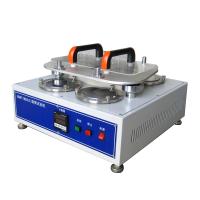
Test method for pilling resistance of fabrics
ICI pilling box method
Principles of testing
From the fabric to be tested, take three pieces of each square sample with a certain size along the warp direction and weft direction. Among them, two samples need to be sewn face-to-face into a tube, which is first placed on the polyurethane sample tube with the front facing outward. They are then tumbled together in a cork-lined "9 x 9 x 9" box, with the Test Chamber set to flip at 3,600 rpm to meet consumer demands. Finally, the test piece is removed and compared with the original or standard form in the evaluation box. In addition, the degree of pilling can be classified into five grades using the above-mentioned criteria. The worst is level one, the better is level five. A fabric can be considered a half-ply when the result is halfway between two adjacent layers. The three commonly used test standards are IWS TM 152, GB/T 4802.3 and ISO 12945-1. Using this method, it is possible to simulate pilling when the textile rubs against itself or when it comes into contact with other fabrics. This test method is applicable to all types of fabrics. It is mainly suitable for knitted sweaters in the domestic market or exported to the European market.
Martindale abrasion and pilling method
Test Principle
Take out three pairs of circular samples from the tested textile and put them into the upper and lower clamping devices respectively. Then the samples rub against each other (as shown in Fig. 3), according to the Liza Ru curve trajectory friction theory. Finally, after a certain number of spins, it is compared to the original or standard form in the rating box. In addition, the degree of pilling can be classified into five grades using the above-mentioned criteria. The worst is level one, the better is level five. A textile can be considered a half-ply when the result is halfway between two adjacent layers. This method is also suitable for all types of fabrics, but is mainly used for woven fabrics. It basically simulates pilling when the fabric itself rubs against each other more frequently. Commonly used testing standards are ISO 12945-2, GB/T 4802.2, IWS TM 196 and ASTM D4970. But few buyers adopt American standard ASTM D4970. Fabrics considered a Class 3.5 are commercially acceptable.
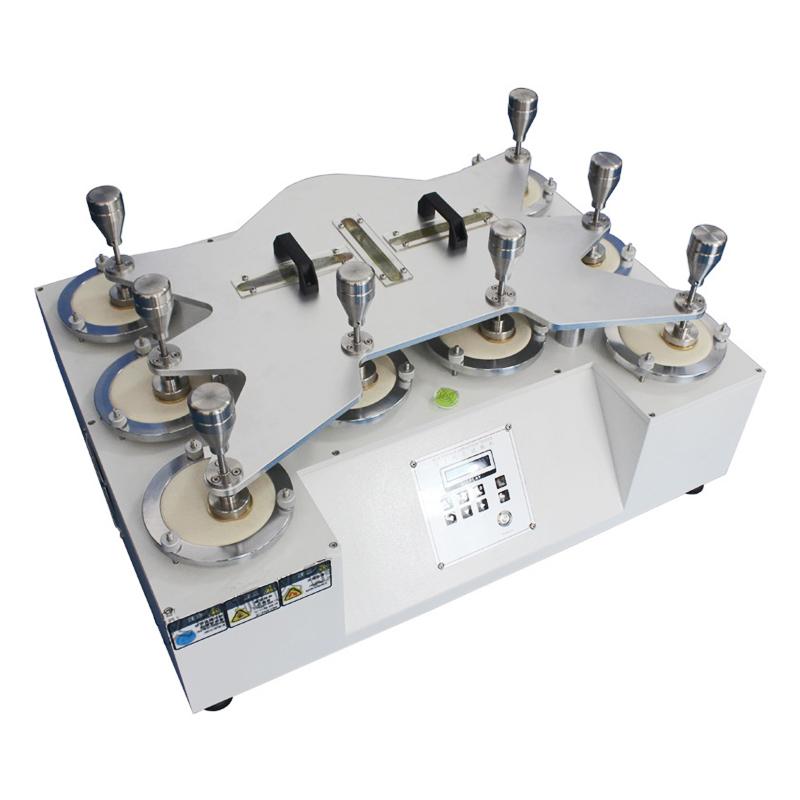
random tumbling pilling method
Test Principle
First, take three square test pieces from the area in the 45° direction of the test piece. Then seal them sides with glue and dry them before putting them in a drum with a small amount of lint crumbs (lint crumbs are not required if applying the JIS L 1076 D3 method) as shown in picture 4 at about 1200 rpm Turn 30 minutes (60 minutes for some customers). Finally, compare it to the standard form in the rating box. In addition, the degree of pilling can be classified into five grades using the above-mentioned criteria. The worst is level one, the better is level five. A fabric can be considered a half-ply when the result is halfway between two adjacent layers. It basically simulates pilling as the fabric itself rubs more frequently against each other, other things and fibers. This method is mainly used to test the pilling resistance of textiles in the US market.
It mainly simulates the high-frequency friction generated by the fabric itself and the friction with the outside world, as well as the pilling problem involving external fibers. This method is used to test the pilling resistance of most fabrics exported to the United States, and there are some other commonly used standards, such as ASTM D3512, JIS L 1076 D3 method, CAN/CGSB-4.2 NO.51.2, etc. Fabrics considered a Class 3.5 are commercially acceptable.
elastic gasket method
Test Principle
Take three circular samples from the tested sample, place them on the sample holder, and fix them with rubber rings. The sample rubs against the elastic pad under slight pressure, as shown in Figure 5. It is mainly used to simulate the pilling of the fabric when it rubs against other objects. This method is not widely used. Some buyers choose this method to test the pilling resistance of woven fabrics exported to the US market. They often choose to spin the specimen at 300 rpm. The test standard used is ASTM D3514. Using the above criteria, the degree of pilling can be classified into five grades. The worst is level one, the better is level five. A structure can be considered a half-layer when the result is in the middle between two adjacent layers.
circular trajectory method
Test Principle
Take five circular samples from the sample to be tested and place them on the sample holder. Under constant pressure, the fabric sample and nylon will fluff according to the trajectory of circular motion, and then pilling by relative friction with the standard fabric (as shown in Figure 6). Also, select the appropriate parameter category from the table below. The rubbing process needs to be repeated several times. Then according to the above criteria, the degree of pilling can be divided into five grades. Level one is the worst, level five is better. When the result is between two adjacent levels, it can be evaluated as a half level. This method is applicable to low elastic filament woven fabrics, knitted fabrics and other pure or blended chemical fiber fabrics. GB/T 4802.1 test standard applicable to the domestic market.