Some knowledge about the UV-Vis spectrum
UV-Vis spectroscopy can cover the near-infrared region of the electromagnetic spectrum, and UV-Vis spectrometers typically span the spectral range of 190-1,100 nm.
Typically, the property actually measured in UV-Vis spectroscopy is the transmittance of light through the material or the reflectance of the material. The sample is illuminated by a light source - this can be monochromatic or broadband, depending on the information required (see Light sources for spectroscopy). The light T transmitted through the sample and the light R reflected by the sample is then collected by a Detector and compared to a reference. The absorption spectrum A can then be calculated by:

Often, either T or R can be assumed to be zero - for example, if the known material is mounted on a substrate with zero transmission in the spectral region of interest - so only one property needs to be measured.
In addition to energy levels, UV-Vis spectroscopy can also provide information about sample thickness or concentration via the Beer-Lambert law. The transmittance T of a sample through a material of thickness d is given by:

where I0 and I are the intensity of light before and after passing through the material, respectively, and α(λ) is the absorption coefficient of the material. This quantity is material specific and wavelength dependent (λ). It is related to the wavelength-dependent absorption cross section σ(λ), which gives the probability that a photon of wavelength λ will be absorbed by the material, usually in cm2, by:

where N is the number of absorbed molecules per unit volume. If the absorption cross section of a material is known, its concentration can be calculated.
Fluorescence Spectroscopy
Fluorescence spectroscopy relies on the opposite process -- it studies the photon emission of materials. This also provides information about the possible electronic transitions of the material.
Typically, the sample is excited by a monochromatic source; for example, a continuous wave (CW) laser diode. The wavelength of the excitation source is usually in the UV/blue region of the EM spectrum to ensure that the energy of the excitation photon is higher than that of the photon to be emitted. Emissions from the sample are then detected by a spectrometer, which outputs the data as a function of wavelength. Filters are often used to block the excitation light from reaching the Detector. This can be an optical filter - eg a long pass filter - or a spatial filter.
It is important that the sample has non-zero absorption at the excitation wavelength, otherwise no emission will occur.
Raman spectroscopy
Raman spectroscopy is commonly used to determine the vibrational transitions of molecules and is often used by chemists and pharmacists as an identification method. It relies on the inelastic scattering of photons by molecules, which causes the molecules to gain vibrational energy and the photons to lose vibrational energy.
This energy (wavelength) shift of photons is called Raman shift. Typically, an infrared laser is used as the source of photons, and Raman spectroscopy shows intensity (proportional to the number of molecules) versus displacement, with displacement measured in cm-1 relative to the laser wavelength. From this, the structure, composition and concentration of the sample in question can be determined.

-
![Yoke V729 Scanning Visible Spectrophotometer Light spectrum bandwidth 1.8nm]()
-
![T3200 Ultraviolet-visible Spectrophotometer Light spectrum bandwidth 2nm]()
-
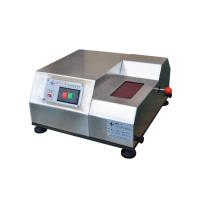
![YUZHOU MY-1 Light spectrum belt grinding prototype, stainless steel shell, belt adjustment device]()
-
![YUZHOU GMP-2-300 Light spectrum grinding machine, double disc, stepless speed regulation, with vacuum device]()
-
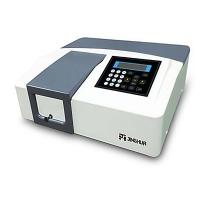
![JINGHUA UV1800 UV-Visible Spectrophotometer Light spectrum bandwidth 1.7nm]()
-
![CREATE CX-9900 Light spectrum analyzer, grating focal length 400mm]()
-
![CREATE CX-9800T Light spectrum analyzer Wavelength range 160-800nm]()
-
![CREATE CX-9800L Light spectrum analyzer Wavelength range 160-800nm]()
-
![CREATE CX-9600T Light spectrum analyzer]() CREATE CX-9600T Light spectrum analyzer$ 19650.00
CREATE CX-9600T Light spectrum analyzer$ 19650.00