Thermal shock tensile test
Thermal Shock Pull Test Overview:
Test SMD Pad Adhesion
Evaluation Pad PCB Shrinkage Cavity
Testing Solder Balls and Flip Chip Bumps
Evaluate welding consumables and process variables
Destructive, non-destructive and fatigue testing
Tested according to IPC-9708 standard
Thermal bump pull and thermal pin pull tests are used as a method to evaluate cohesive adhesion under SMD device pads to test for dimples, interfaces and material failures.
The new pad shrinkage standard, IPC-9708, defines thermal bump pull as a method for evaluating the susceptibility of printed board assembly materials and designs to cohesive dielectric faults beneath surface mount technology connection pads.
A common failure mode in lead-free assemblies is pad cratering, which typically occurs after assembly and is caused by dislodged contact pads on the PCB or package substrate. Often, failures result from overstress conditions caused by manufacturing, testing, and handling. Proper design, material selection, and stress limitation are required to limit such failures.
Since such failures are mechanical in nature, they are not necessarily detected by ICT or other functional electrical tests. Thermal bump pull testing can be used to characterize these failures and determine proper process, material and setup parameters.
The principle of thermal bump testing is to position the copper pin so that it touches the solder bump under test. A test is then performed in which the pin temperature is raised according to the defined temperature profile created. At the reflow point of the solder, the pin drops to the desired level, ensuring a good solder joint. The pins are then clamped and the solder is cooled until the specified temperature is reached, then a pull test is performed automatically, recording force-time, force-distance and energy values.
-
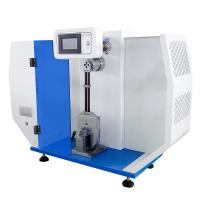
![YOUKE YK3652 Impact Tester 1J/2J/4J/5J]() YOUKE YK3652 Impact Tester 1J/2J/4J/5J$ 1230.00
YOUKE YK3652 Impact Tester 1J/2J/4J/5J$ 1230.00 -
![CHINA ZY-BC Thin Film Pendulum Impact Meter]()
-
![HORIZON XLB-30 Impact Tester Plastic film, Impact test]()
-
![HORIZON XLB-30 Impact Tester Plastic film, Impact test]()