How many driving methods are there for Tensile Testing Machines?
What is a pull Tester?
Tensile testing machine is also called material testing machine. It is mainly used for testing the mechanical properties of various materials such as static load, tension, compression, bending, shearing, tearing, and peeling. It is suitable for plastic plates, pipes, profiles, plastic films, rubber, steel, fabrics, etc. Testing of mechanical properties of materials. It is an indispensable testing machine for material development, physical performance testing, teaching research, quality control, etc. Tensile testing machine fixture is an important part of the instrument, different materials require different fixtures, which is an important factor for smooth test accuracy and accuracy of test results.
Driving method of Tensile Testing Machine
Hydraulic Tensile Testing Machine
The hydraulic Tensile Testing Machine is driven by the hydraulic cylinder moving up and down to move the fixture up and down to realize various functions of the Tensile Testing Machine. The advantage is that a higher strength tensile test can be done, but the disadvantage is that the control accuracy is not high and it is not hygienic. Mainly used in metal materials, bridge bearings, large plates, building materials, composite materials and other industries. Its load is generally above 300KN (30T).
Working principle: The motor drives the oil pump to rotate, the oil pump absorbs oil, and converts mechanical energy into hydraulic oil pressure energy. The hydraulic valve realizes the adjustment of direction, pressure and flow through the integrated block, and transmits it to the hydraulic mechanical cylinder or oil motor through the external pipeline, so as to control the change of the hydraulic mechanical direction, the magnitude and speed of the force, and promote the hydraulic mechanical work.
The hydraulic Tensile Testing Machine is limited by the configuration of the oil source, and the test speed is low.
Compared with Tensile Testing Machines, small tonnage (<300kN) has low overall cost performance and poor scalability.
The servo valve has high requirements on the filtration accuracy of the hydraulic oil of the oil source, and the hydraulic oil needs to be replaced regularly.
The hydraulic connection pipes and joints are prone to oil leakage, and the oil source is noisy.
The hydraulic oil source needs to be equipped with a cooling system (air-cooled or water-cooled), which consumes a lot of energy.
The hydraulic Tensile Testing Machine has very high requirements on the foundation, especially the force value of the machine is large, the foundation needs to be prepared according to the drawings provided by the testing machine manufacturer, and the whole machine takes up a lot of space.
Hydraulic drive, strong power, more reliable and stable when doing large-tonnage material mechanics tests.
Mechanical Tensile Testing Machine
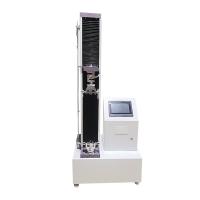
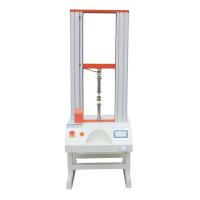
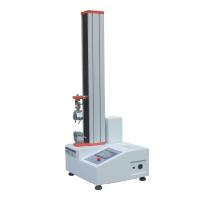
The mechanical Tensile Testing Machine is mainly driven by the rotation of the screw screw of the motor, and the rotation of the screw drives the fixture up and down to realize the functions of the Tensile Testing Machine, such as tension, compression, peeling, tearing, shearing, and three-point bending. The advantage is high precision control.
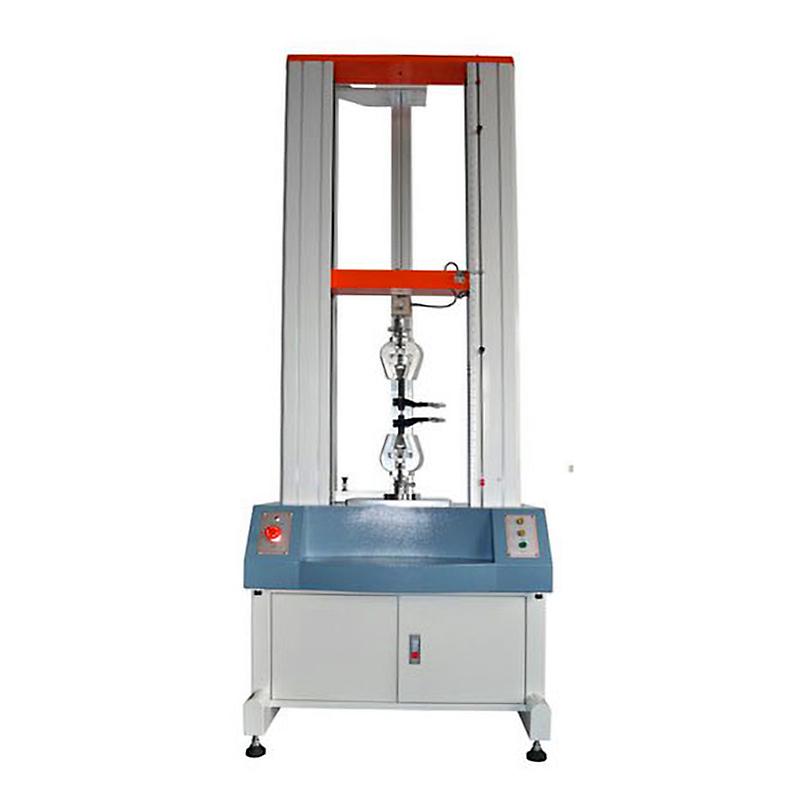
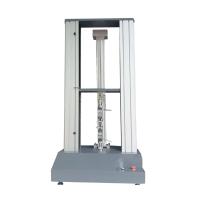
Single-rod structure or door structure mechanical Tensile Testing Machine host, mainly suitable for tensile testing of rubber, plastic, textile, geotextile, waterproof material, wire and cable, net rope, metal wire, metal bar, metal plate and other materials, adding accessories Bending, tearing, peeling and other tests can be done.
Servo motor drive, compact structure, high energy utilization efficiency, convenient use and maintenance, low noise, stable and reliable.
It can realize three closed-loop controls of load control, strain control and displacement control.
The force measurement range is wide, between 0.4% and 100% of the full scale, and the force measurement accuracy can reach 0.5 grade.
The test speed range is adjustable, the test speed is 0.001mm/min-1000mm/min, and the test stroke can be determined according to the needs, which is more flexible.
Flexible test methods: models with a test range below 300kN can freely choose and replace test fixtures, and can expand external sensors and corresponding fixtures to meet different types of material mechanical tests (such as tension, compression, bending, peeling, tearing, etc.) , shear, tensile and torsion tests).
A high-temperature oven, high-low temperature chamber or other environmental chambers can be added to conduct environmental simulation tests.
Large tonnage is more expensive to manufacture.
-
![CHINA NBC-1024-2 Tensile Tester 5T]() CHINA NBC-1024-2 Tensile Tester 5T$ 6635.00
CHINA NBC-1024-2 Tensile Tester 5T$ 6635.00 -
![Lugong STX5000 Digital Display Single Arm Tensile Tester Microcomputer-controlled Electronic Universal Testing Machine 5000N]()
-
![Lugong STX2000 Digital Display Single Arm Tensile Tester Microcontrol Electronic Universal Testing Machine 2000N]()
-
![Lugong STX500 Digital Display Single Arm Tensile Tester Microcomputer-controlled Electronic Universal Testing Machine 500N]()
-
![Lugong STX200 Digital Display Single Arm Tensile Tester Microcontrol Electronic Universal Testing Machine]()
-
![Lugong STX100 Digital Display Single Arm Tensile Tester Microcomputer-controlled Electronic Universal Testing Machine]()
-
![SHUCHANG SC-LL-20KN Double column tensile machine, computer servo system Universal Testing Machine]()
-
![DUBAN UTTM7-DB25-207FM-100N Universal Tensile Tester Range +/- 98N]()
-
![DUBAN UTTM7-DB25-207FM-50N Tensile Tester Range +/- 49N]()


- 1Tensile machine application in various industries
- 2Technical analysis of key parameters of Tensile machine: Scientific selection from force measurement accuracy to Power system
- 3Tensile machine purchasing guide [dry version]
- 4Talking about the performance test of epoxy resin film coated on PET
- 5ASTM D5019 Single-layer roofing film reinforced CSM board (chlorosulfonated polyethylene (PE)) standard interpretation
- 6Common problems and solutions in tensile testing
- 7What is tensile strength testing and which products can be tested?
- 8Factors Affecting the Performance and Accuracy of Tensile Testing Machines
- 9Classification of Tensile Testing Machines
-
![Patek Jushi LY-7012C Tensile Tester 1000KG]()
-
![BaidaJUSHI LY-7012A Small Tensile Testing Machine 200KG]()
-
![CHINA NBC-1024-2 Tensile Tester 5T]() CHINA NBC-1024-2 Tensile Tester 5T$ 6635.00
CHINA NBC-1024-2 Tensile Tester 5T$ 6635.00 -
![CHINA NBC-6820 Ring type initial tacking machine Tensile Tester]()
-
![CHINA NBC-1023-1 Computerized Double Column Tensile Testing Machine]()
-
![CHINA NBC-1021 Touch screen single column Tensile Strength Tester 10KG]()