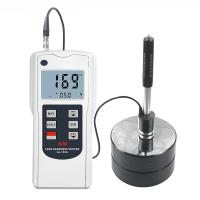
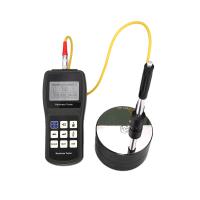
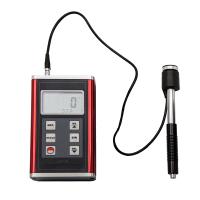
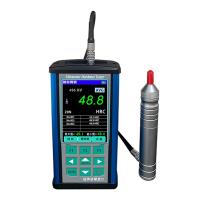
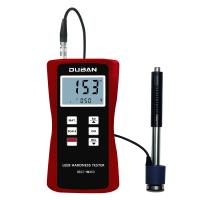
Leeb Hardness Tester measurement requirements
Abstract:
里氏硬度计测量样品时,需要遵循一系列要求以确保测试准确性。首先,测试表面应光滑、无氧化皮,且表面粗糙度需符合标准。样品必须具有足够的质量和刚度,以防测试过程中发生位移或反弹。样品的最小厚度应符合规定,同时,若样品有表面硬化层,其深度也应符合标准。对于不同曲率的试样,如凹面、凸面、圆柱面和球面,其表面曲率半径也应满足要求。此外,样品不应具有磁性,且各测量点之间的距离应大于3至4毫米,以避免重复测试导致的误差和传感器寿命缩短。
Requirements for the sample surface
The test surface should have metallic luster, no scale and other dirt, and the surface roughness should meet the following requirements:

Specimen Weight Requirements
Specimens need to be of sufficient mass and stiffness to ensure no displacement or rebound during reconstruction. The quality should meet the following requirements:

Specimen Thickness Requirements
The sample should have sufficient thickness, and the minimum thickness should meet the following requirements:

The sample has a surface hardened layer, and the depth of the hardened layer should meet the following requirements:

For concave, convex, cylindrical and spherical specimens, the surface radius of curvature shall meet the following requirements:

Samples should not be magnetic.
The distance between each measurement point should be greater than 3-4mm, and the test cannot be repeated at the same point, otherwise a large error will be caused. At the same time, the service life of the sensor is shortened.

Products required
-
![Leeb Hardness Tester DHT-400Dplus]() Leeb Hardness Tester DHT-400Dplus$ 1938.00
Leeb Hardness Tester DHT-400Dplus$ 1938.00 -
![Leeb Hardness Tester DHT-400D Deguang Electronics]()
-
![Leeb Hardness Tester DHT-200D Deguang Electronics]()
-
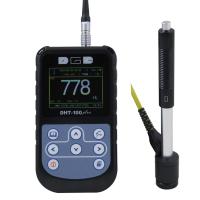
![Leeb Hardness Tester DHT-100Dplus]() Leeb Hardness Tester DHT-100Dplus$ 1312.00
Leeb Hardness Tester DHT-100Dplus$ 1312.00 -
![SADT HARTIP1600 Leeb Hardness Tester]()
-
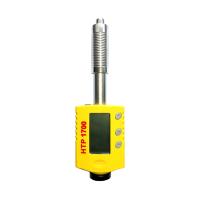
![SADT HTP1700 Leeb Hardness Tester]()
-
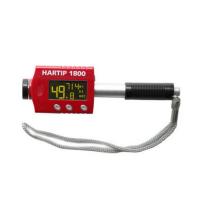
![SADT HARTIP1800 Leeb Hardness Tester +/- 0.3% @HL]()
-
![SADT HTP1900 Pen Leeb Hardness Tester G type]()
-
![SADT HARTIP2000 Leeb Hardness Tester]()

Relevant knowledge
- 1Read the Leeb Hardness Tester in one article
- 2Leeb Hardness Tester different hardness system difference
- 3What products is the Leeb Hardness Tester with D probe suitable for measuring?
- 4Factors Affecting the Accuracy of Leeb Hardness Tester Testing
- 5Factors Affecting the Test Accuracy of Leeb Hardness Tester
- 6What are the measurement requirements for a Leeb Hardness Tester?
- 7What factors affect the test accuracy, error and repeatability of the Leeb Hardness Tester?
- 8What is hardness testing? What types are there?
- 9Requirements for Casting Hardness in American Standard ASTM and Selection of Sclerometer
Guess you like it
-
![Leeb Hardness Tester AMITTARI AL-150A split Leeb Hardness Tester]()
-
![PRLH150 Leeb Hardness Tester]() PRLH150 Leeb Hardness Tester$ 259.00
PRLH150 Leeb Hardness Tester$ 259.00 -
![Hypertherm LSY-W Leeb Hardness Tester]()
-
![KAIRDA NDT271 Ultrasonic hardness gauge display]()
-
![DUBAN DB22-HM455 Leeb Hardness Tester]()
-
![DUBAN DB22-HM450 Leeb Hardness Tester]()