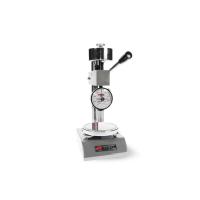
Basic knowledge of hardness testing
How to measure which item hardness, a hardness test is required to determine the hardness level. Hardness test is a simple and easy test method in mechanical performance test. In order to replace some mechanical property tests with hardness tests, a more accurate conversion relationship between hardness and strength is required in production. Practice has proved that among the various hardness values of metal materials, there is an approximate correspondence between the hardness value and the strength value. Because the hardness value is determined by the initial plastic deformation resistance and continuous plastic deformation resistance, the higher the material strength, the higher the plastic deformation resistance and the higher the hardness value. It can be seen that hardness is not a simple physical quantity,
In the steel industry, the code name for metal hardness is H. According to different hardness testing methods, commonly used expressions include Brinell (HB), Rockwell (HRC), Vickers (HV), Leeb (HL) hardness, among which HB and HRC are more commonly used. Brinell hardness (HB), Rockwell hardness (HRA, HRB, HRC), Vickers hardness (HV), the value indicates the ability of the material surface to resist the indentation of hard objects. Leeb hardness (HL) and Shore hardness (HS) belong to the rebound hardness test, and their values represent the elastic deformation work of the metal.
Rockwell hardness
Rockwell hardness was proposed by SP Rockwell in 1921, and it is the hardness value measured by a Rockwell Hardness Tester for metal materials. The value has no units and is indicated only by the code "HR". The measurement method is to press the steel ball or diamond indenter vertically into the surface of the material to be tested under the specified external load to produce an indentation. For the depth of the dent, the Rockwell hardness calculation formula HR=(KH)/C can be used to calculate the Rockwell hardness. The Rockwell hardness value is displayed on the dial of the Hardness Tester and can be read directly. Rockwell hardness is an index of hardness value determined by the depth of indentation plastic deformation. The hardness unit is 0.002 mm. When HB>450 or the sample is too small, the Brinell hardness test cannot be used, but the Rockwell hardness measurement is used. It uses a diamond cone with a vertex angle of 120° or a steel ball with a diameter of 1.59mm and 3.18mm to press into the surface of the tested material under a certain load, and obtains the hardness of the material from the depth. indentation. According to the hardness of the test material, it is represented by three different scales:
HRA: It is the hardness measured with a 60kg load and a diamond cone indenter. For materials with extremely high hardness (such as cemented carbide, etc.).
HRB: is the hardness obtained with a 100kg load and a hardened steel ball with a diameter of 1.58mm. For materials with lower hardness (such as annealed steel, cast iron, etc.).
HRC: It is the hardness obtained by using a 150kg load and a diamond cone indenter, and is used for materials with higher hardness (such as hardened steel, etc.).

Brinell hardness
Brinell hardness (HB) is generally used when the material is soft, such as non-ferrous metals and steel before heat treatment or after annealing. Rockwell hardness (HRC) is generally used for materials with higher hardness, such as hardness after heat treatment.
Brinell hardness (HB) is a test load of a certain size. A hardened steel ball or carbide ball of a certain diameter is pressed into the metal surface to be tested, and kept for a specified time, and then unloaded to measure the indentation on the surface to be tested. The Brinell hardness value is the quotient of the load divided by the surface area of the indented sphere. General: A hardened steel ball of a certain size is pressed into the surface of the material with a certain load and kept for a period of time. After the load is removed, the ratio of the load to the area of the indentation is the Brinell hardness value (HB), and the unit is kgf/mm2 (N/mm2). The test load and test steel ball diameter should be determined according to the actual performance of the material.
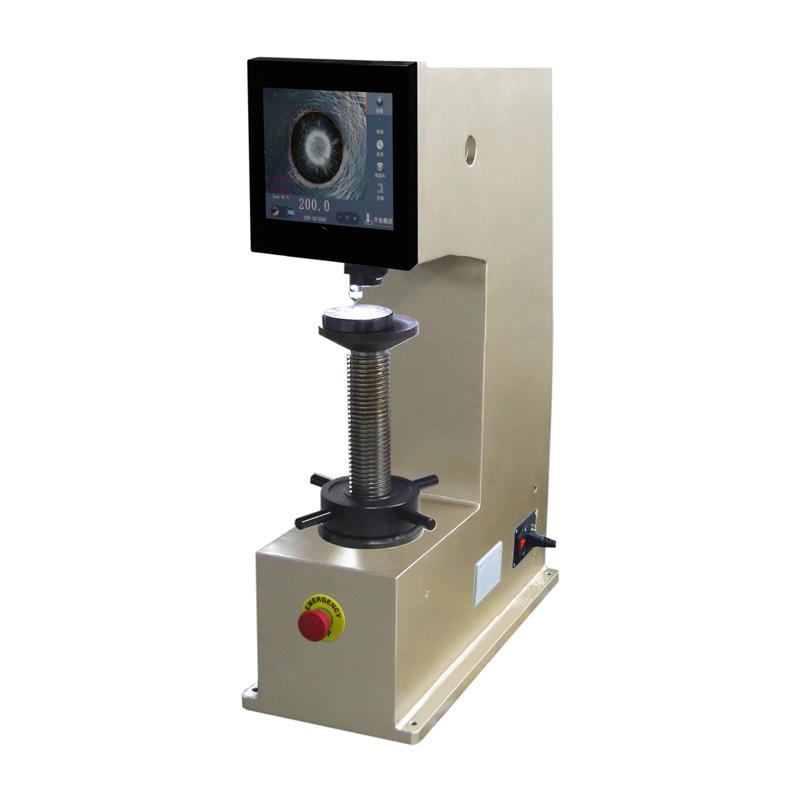
Vickers hardness
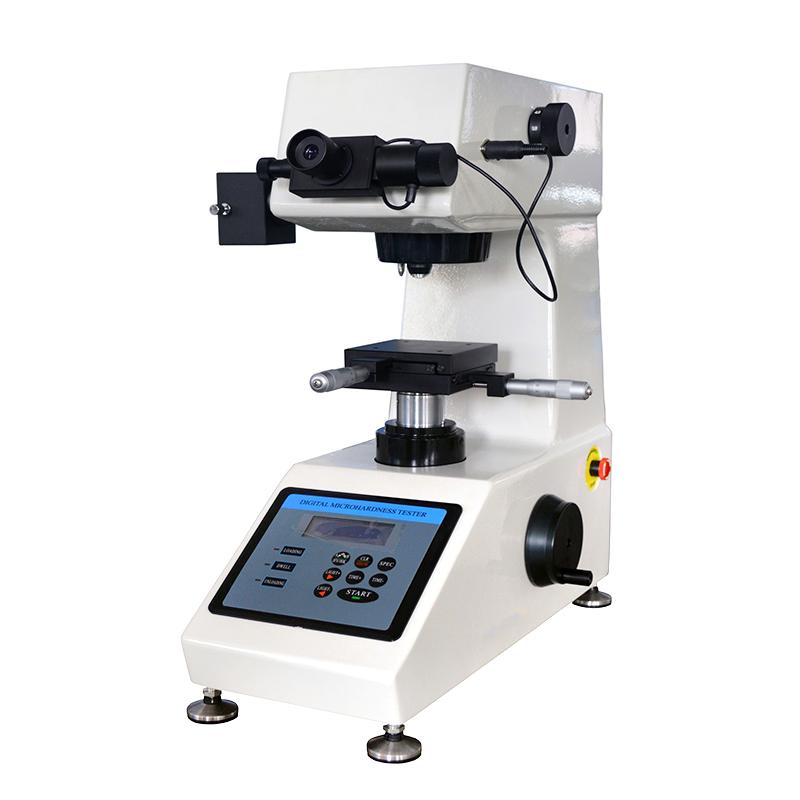
The Vickers hardness test method was proposed by RLSmith and CESandland in 1925. The British company Vickers-Armstrong (Vickers-Armstrong) trial-produced the first Hardness Tester tested in this way. Compared with Brinell and Rockwell hardness tests, the Vickers hardness test has a wider measurement range and covers almost all materials from softer materials to super hard materials.
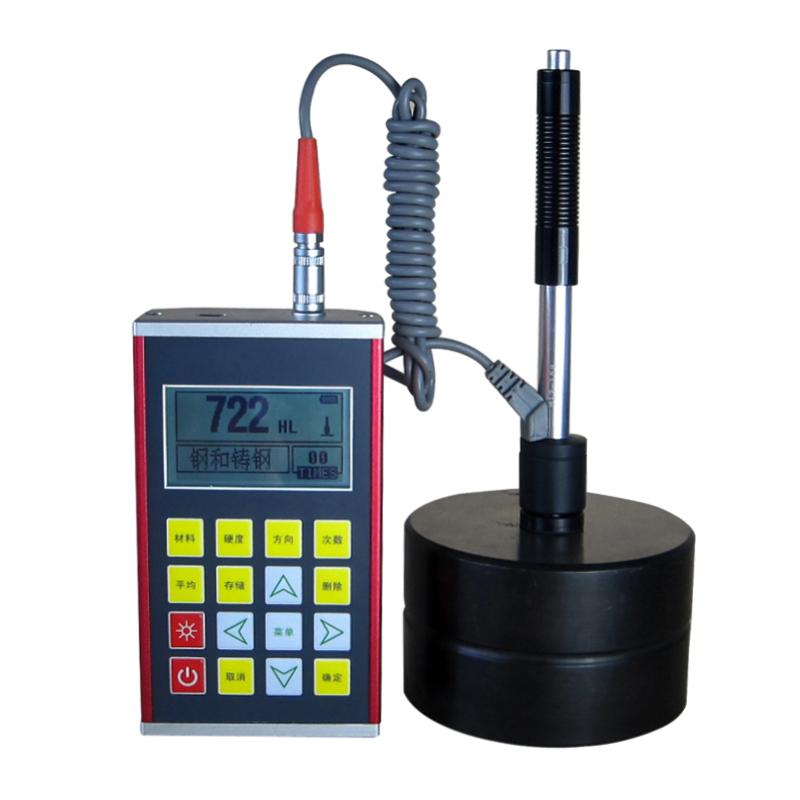
Leeb hardness
The Leeb hardness is expressed in HL. The Leeb hardness testing technology is to use an impact body of a certain quality equipped with a carbide ball head to impact the surface of the test piece under a certain force, and then rebound. Due to the different hardness of the material, the rebound speed after impact is also different. The impact device is fitted with permanent magnet material. When the impact body moves up and down, its peripheral coil induces an electromagnetic signal proportional to the speed, and then converts it into a Leeb hardness value through an electronic circuit.

Shore hardness
Abbreviated as HS. A measure of the hardness of a material. It was first proposed by the British coast (Albert F. Shore).
The elastic rebound method is used to drop the striker from a certain height to the surface of the material to be tested and rebound. A striker is a small cone with a pointed point, usually set with diamonds. The test value is 1000x the return speed of the collision pin/the initial speed of the collision pin (that is, the speed ratio before and after the collision is multiplied by 1000)
Barcol hardness
Barcol hardness (referred to as Barcol hardness), long ago in the United States, a hard steel indenter with a certain shape was pressed into the surface of the sample under the action of a standard spring test force, and the hardness of the material was determined by the following formula. The indentation depth of the indenter . Defines the Barcol hardness unit per pressing 0.0076mm. The Barcol hardness unit is expressed in HBa. It is proposed by Barber-Colman that it is a widely used hardness category in modern international.

Knoop Hardness
Knoop hardness is a hardness measured in absolute value, which is mainly used in processing. Generally speaking, the Knoop hardness of diamond is 7000~8000 kg/mm2
Webster hardness
Press a hard steel indenter of a certain shape into the surface of the sample under the action of a standard spring test force, and use the indentation depth of the indenter to determine the hardness of the material. The indentation depth of 0.01mm is defined as a Webster hardness unit. The Webster hardness unit is expressed as HW.



- 1Which hardness test is suitable for stainless steel?
- 2Types of common coating material performance test methods
- 3What is the importance of surface hardness testing?
- 4What is hardness testing? What types are there?
- 5Paint Hardness Test
- 6Test methods for coating powders
- 7Hardness testing for hard film applications
Carestream Tollcoating
- 8Hardness testing of hard coated films
- 9Hardness inspection of coating