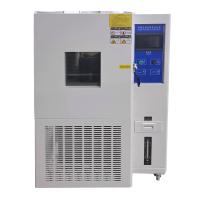
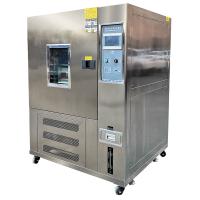
How does relative humidity affect the performance of the temperature and humidity Test Chamber?
With the development of industry and information technology, environmental testing has increasingly become an important means for various scientific research institutes and factories to test product quality. As one of the important supporting equipment for environmental test research, the temperature and humidity Test Chamber is more and more widely used. In the previous literature and standard specifications, there have been many discussions on the main technical parameters of the humidity Test Chamber, such as temperature and humidity deviation, fluctuation, temperature rise and fall rate, and wind speed, but less research on uniformity.
Influencing factors
1. Cavity structure
Due to the different structure of the inner wall of the temperature and humidity Test Chamber, the temperature and humidity of each part of the inner wall of the Test Chamber are also different, which affects the heat convection of the working room, resulting in differences in the uniformity and deviation of the internal temperature and humidity.
2. Heat load
Lighting and heat loads placed inside some Test Chambers or test specimens that affect the overall internal heat convection can affect the uniformity of internal temperature and humidity. According to relevant standards, by default, the temperature and humidity uniformity of the temperature and humidity Test Chamber should be measured under no-load conditions.
3. Heat transfer
Due to the different heat transfer coefficients of the front, rear, left, upper, and lower sides of the inner wall of the Test Chamber, and there are detection holes, threading holes and test holes on the side of some chamber walls, heat dissipation and heat transfer will occur in some parts of the Test Chamber, resulting in The internal temperature is uneven, resulting in uneven convective heat transfer from the radiation of the box wall, which greatly affects the temperature uniformity.
4. Heat radiation
The design of the space and internal structure of the Test Chamber, such as the placement of the heating pipe, the design of the air duct, power and position, etc., is difficult to achieve a uniform and symmetrical standard, which will inevitably lead to uneven temperature and humidity in the chamber.
5. The location and volume of the test sample
Unreasonable placement of the sample or too large a sample volume will hinder indoor air thermal convection, thereby affecting the uniformity of temperature and humidity. For example, placing samples close to the inner wall or side of the air duct can seriously affect the thermal circulation in the chamber, resulting in uneven temperature and humidity. According to the requirements of the test standard, for the test of the heat dissipation sample: the volume of the heat dissipation sample is at most 1/5 of the volume of the Test Chamber.
6. Sealing
The sealing of the cavity and the door is not strict. For example, when the sealing strip is damaged or the door leaks air, it will affect the temperature and humidity uniformity in the temperature and humidity Test Chamber.
7. Wind speed
Generally speaking, during the environmental test, the wind speed in the temperature and Humidity Chamber should not exceed 1.7m/s. If the wind speed is too high, it will accelerate the heat exchange between the surface of the test piece and the indoor flowing air, and it will also accelerate the evaporation of water in the wet ball gauze, which is not conducive to the test and inaccurate humidity measurement. Therefore, during the test, the smaller the wind speed, the better. However, in order to ensure the uniformity of temperature and humidity in the Test Chamber, it is necessary to circulate the air in the Test Chamber. During the no-load test, the average wind speed in the box is 0.6-0.8 m/s.
8. Control precision
After the Test Chamber reaches the set temperature and humidity point, due to the uneven heat dissipation, there will be certain fluctuations in a short period of time. By improving the control accuracy of the Test Chamber and reducing temperature fluctuations, temperature deviations can be reduced. For high-Temperature Test Chambers, the temperature fluctuation can be reduced by continuously adjusting the heating power through PID; Heating power to balance excess cooling capacity.
Metrological characteristics
The measurement characteristics of the temperature and humidity Test Chamber mainly include temperature and humidity deviation, temperature and humidity fluctuation and temperature and humidity uniformity.
1. Deviation
The deviation of the temperature and humidity Test Chamber refers to the difference between the average temperature and humidity displayed when the environmental test equipment reaches a steady state and the average temperature and humidity actually measured in the center of the working space.
2. Fluctuation
The fluctuation of the temperature and humidity Test Chamber means that within 30 minutes after setting the temperature (humidity) value, 1/2 of the difference between the maximum value and the minimum value of the temperature (humidity) at the center point of the working space reaches stability.
3. Uniform
The uniformity of the temperature and humidity Test Chamber is defined as the arithmetic mean of the difference between the highest and lowest temperature (humidity) values of each test within 30 minutes after the set temperature (humidity) value reaches stability.
correlation test
According to the experimental data, when the temperature in the temperature and humidity Test Chamber is constant and the relative humidity increases, the corresponding temperature and humidity uniformity and volatility will be greatly improved. The main reason is that air is a poor conductor of heat. Generally speaking, when the moisture content is low and the temperature is low, the thermal conductivity of the object is small, the thermal conductivity of the solid is greater than that of the liquid, and the thermal conductivity of the liquid is greater than that of the object. gas. This difference is mainly due to the different molecular spacing in different states. For air, the greater the relative humidity, that is, at the same temperature and pressure, the greater the ratio of the mass of water vapor in humid air to the mass of water vapor in saturated air, the greater the moisture in the air, and the greater the thermal conductivity. When the wind speed is constant, the indoor thermal circulation and convection are better, which greatly improves the uniformity and fluctuation of indoor temperature and humidity.
in conclusion
In the daily calibration work, it is found that the temperature and humidity fluctuation and uniformity of the same temperature and humidity Test Chamber under high humidity are better than those under low humidity. It is suggested that the greater the relative humidity, the greater the moisture in the air and the greater the thermal conductivity, thereby improving the thermal cycle in the cavity, so relevant verification experiments were designed and carried out.
- 1GB/T 10586-2006 Detailed explanation: Core technical indicators and acceptance specifications for damp heat Test Chamber
- 2Damp heat testing chamber FAQ and solutions
- 3Humidity cabinet test equipment
- 4Talking about the performance test of epoxy resin film coated on PET
- 5Damp heat testing chamber and low-Temperature Test Chamber
- 6What are the reasons why the high-low temperature alternating heating and Humidity Chamber cannot be thermostatic?
- 7What are the requirements for the installation site of the low/high Temperature Test Chamber?
- 8The working principle of the three major systems of Humidity Chamber
- 9Application of Constant Temperature and Humidity Chamber in Lithium Battery