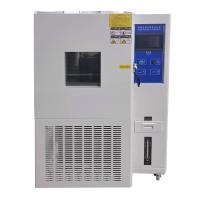
Working Principle of Electronic Expansion Valve in Constant Temperature and Humidity Test Chamber
As an electronic control component, the electronic expansion valve in the constant temperature and humidity laboratory adjustment system has the characteristics of high precision, fast action, accurate action, and obvious energy-saving effect. It can realize optimal control of the system and is widely used in environmental test equipment. But do you know how it works? Do you know its design function? Then it analyzes the working principle and design function of the electronic expansion valve in the constant temperature and humidity Test Chamber.
The driving method of the electronic expansion valve is to calculate the parameters collected by the sensor after the controller is constant, send adjustment instructions to the drive board, and the drive board outputs electrical signals to the electronic expansion valve to drive the action of the electronic expansion valve. The electronic expansion valve takes only a few seconds from fully closed to fully open, with fast response and quick action without excessive static heating. In addition, its opening and closing state and speed can be manually set to regulate and control the amount of liquid refrigerant entering the evaporator well. For example, when performing a 60-degree single-temperature test, the electronic expansion valve can be adjusted to reduce its opening to an appropriate value. At the same time, the cooling capacity is relatively small, and the balanced heating capacity can also be reduced, thereby reducing both cooling and heating energy consumption, and achieving energy saving effects.
At this time, rely on applying different voltages (0~12V) to heat the bimetallic sheet, so that the bimetallic sheet will expand to different degrees, and drive the valve needle to rise and fall. It has obvious disadvantages and has not been used in the future.
The expansion valve, also known as the throttle valve, is the main component of the refrigeration system of the constant temperature and humidity laboratory. It is installed at the entrance of the evaporator and is the dividing point between the high pressure and low pressure of the refrigeration system. Its function is to throttle and decompress the high-pressure liquid refrigerant from the receiver, adjust and control the amount of liquid refrigerant entering the evaporator, so that it can adapt to the change of refrigeration load, and at the same time prevent the compressor from being impacted by the fluid (that is, not The evaporated liquid refrigerant is compressed after entering the compressor, which is easy to damage the compressor valve) and the abnormal superheating of the steam at the outlet of the evaporator.




- 1GB/T 10586-2006 Detailed explanation: Core technical indicators and acceptance specifications for damp heat Test Chamber
- 2Humidity chamber core components dismantling: how to select compressors/Sensors
- 3Inaccurate lab data? 90% of people ignore Test Chamber calibrating issues
- 4Chip high-low temperature heat and humidity performance test
- 5Application of Humidity Chamber in building materials and flooring industry
- 6Principle, application and selection of programmable Humidity Chamber for die casting
- 7Humidity Humidity Chamber principle, application and selection
- 8Principle, application and selection of field effect transistor programmable Humidity Chamber
- 9Principle, application and selection of luggage Humidity Chamber