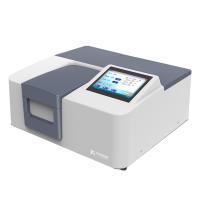
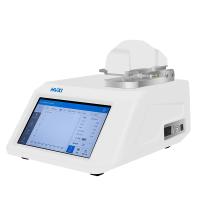
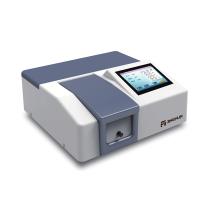
The main components of the UV Spectrophotometer
Spectrophotometers allow the evaluation of light absorbed, transmitted or reflected by a material (whether solid or liquid) for each wavelength.
Transmission is the fraction or percentage of incident light that passes through a sample at a given wavelength. Through the measurement of transmittance, we can know whether the material transmits ultraviolet rays, the transparency of visible light, the color in translucent materials, etc.
Absorbance, on the other hand - also known as transmitted optical density or optical density (OD) - is the amount of light absorbed by a material. This magnitude is logarithmically related to the transmittance. Absorbance is often used to relate the concentration of a certain type of analyte of interest via the Mabert-Beer law.
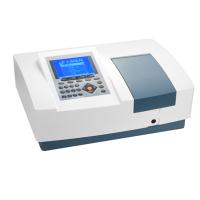
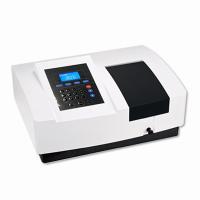
Measurements of these magnitudes are made with a Spectrophotometer . These devices mainly have 3 components: illumination system, monochromator and Detector.
Main Parts of a Spectrophotometer
Lighting system
The system can consist of different light sources. Spectrophotometers typically have hydrogen or deuterium sources for the ultraviolet spectral region and tungsten sources for the visible and near infrared spectral regions. The light source for marking the spectral range of the device can range from 200nm to 2500nm. UV-Vis Spectrophotometer s typically cover the wavelength range from 200nm to 900nm, including ultraviolet, visible and near infrared.
monochrome
This component splits the spectrum of illumination to provide energy beams of specific wavelengths. In this way, tasks that require precise separation of different wavelengths can be performed. So, for example, if using a different compound that has a characteristic absorbance at 340nm, the monochromator needs to accurately separate this wavelength from the others, so make sure that the device is working at 340nm and not 342nm.
Wavelength calibration is performed on this part of the equipment, especially when the wavelength is critical or affects the measurements being made. This type of calibration checks for the difference between the wavelength measured by the device and the wavelength of a reference standard used. Different wavelength points can be calibrated across the entire device range, from 200nm to 2500nm.
Detectors and Recorders
The Detector is responsible for converting the signal (photons) it receives into an electrical signal so that, depending on its intensity, it can be recorded by a system that provides values for transmittance and absorbance or outer diameter.
Knowing the exact values of absorbance and transmittance at each wavelength is also a key aspect, as it allows comparison of spectra of different materials or solutions of different concentrations.
Detector calibration or absorbance and transmittance scales allow understanding of device deviations in these values. This is important because, for example, when measuring the absorbance of a material at 50 nm, the device may indicate that the material absorbs at those nm as 2 OD, when the actual value may be 2.3 OD. The absorbance value calibration of the device needs to be known in order to make the measurement.
Perform absorbance calibration at all necessary wavelengths. For each wavelength, a different absorbance value is measured. Then, evaluate the difference between the device measurement and the certified value of the standard used.
Other Evaluable Parameters: Diffuse or Stray Light
and the linearity of the photometric scale
Stray light is radiation that can reach the Detector at unwanted wavelengths. This type of radiation can cause significant errors in absorbance readings and thus deviations from the Lambert-Beer law.
The linearity of a photometric scale includes determining the ability of the device to measure absorbance based on the concentration of different solutions. Linearity can be analyzed by the correlation coefficient of the concentration-based absorbance calibration curve.

- 1Application of Flame Atomic Absorption Spectrophotometry in Detection of Food Talc Powder
- 2Talking about the performance test of epoxy resin film coated on PET
- 3Spectrophotometer principle, structure and application do you know geometry?
- 4Principle, characteristics and application of ultraviolet Spectrophotometer
- 5Spectrophotometer Color Measurement Fundamentals
- 6Differences between visible, ultraviolet-visible, infrared, fluorescent and atomic absorption Spectrophotometer s
- 7Detection of nicotine content by Spectrophotometer
- 8How to detect the color difference of fluorescent color-changing materials?
- 9Liquid color difference detection solution
-
![YueFeng 752N Ultraviolet-visible Spectrophotometer]()
-
![YueFeng 721 Single beam of light Visible Spectrophotometer Test Transmittance/Absorbance]()
-
![JINGHUA H300 Dual beam of light Spectrophotometer Wavelength range 190nm-1100nm]()
-
![HUXI Nano-900 UV-Visible, ultra-micro Spectrophotometer Light spectrum instrument]()
-
![JINGHUA JH752 Benchtop UV-Visible Spectrophotometer Bandwidth 4nm]()
-
![YUEFENG FP6428 Flame photometer Na/Ca]() YUEFENG FP6428 Flame photometer Na/Ca$ 1450.00
YUEFENG FP6428 Flame photometer Na/Ca$ 1450.00