Opacity calibration
As an optical property, the measurement of opacity is often useful in environmental applications, where opacity is related to the emission of gases into the atmosphere, mainly due to the combustion of diesel engines in vehicles.
Precisely for this reason, the control of gases emitted by diesel-engined vehicles is carried out at vehicle technical testing centers using opacity meters. These devices measure the amount of visible light absorbed or scattered by smoke or gas columns. So, an opacity meter has a light source that emits a specific wavelength and a Detector that records the amount of light that passes through the smoke or gas column, or equivalently, the amount of light that it does not absorb or scatter. The distance between the light source and the Detector is called the optical path length or effective optical path.
Transmittance Meter Settings
Light source: The light source used in a translucency meter is usually an incandescent lamp or a green LED with a spectral emission peak between 550nm and 570nm.
Detector: This component is responsible for recording the radiation arriving after passing through the plume. The Detector needs to have a spectral response similar to the photopic curve of the human eye, with a maximum between 550nm and 570nm.
measured variable
Opacity
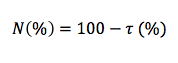
Opacity (N) is defined as a function of transmission and is related to the amount of light reaching the Detector. This optical property is assessed spectroscopically, that is, opacity is measured based on wavelength.
Absorption coefficient
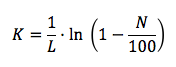
The absorption coefficient (K) is defined by the Lambert-Beer law, which is related to opacity (N) and effective optical length (L). The latter is a characteristic of the transmittance meter and depends on the size of each piece of equipment.
Transmittance meter calibration
To calibrate an opacity meter, it is necessary to use an opacity filter calibrated by an accredited laboratory whose spectral opacity value is known. The absorption coefficient and its uncertainty can be calculated from the opacity and effective optical length values.
For the calibration of the opacity meter, it is recommended to use a set of different filters with different opacity values, eg: 10%, 30%, 50% and 80%. Also, it is convenient to calibrate the filter in the 550nm to 570nm range, since opacity is wavelength dependent and opacity meters use wavelengths in this range.
If you have a good understanding of the characteristics of the light meter, and you are sure that the type of light is an LED, you can calibrate the filter only at the emission point of the LED. In this way, for example, if you have an opacity meter with an LED light source emitting at 560nm, you can calibrate the filter only at 560nm and have an indeterminate opacity value at 560nm.
- 1Hiding power/transparency measurement
- 2How to detect the opacity of rigid plastics?
- 3What percentage of opacity must a garbage bag have?
- 4What is the opacity of paper?
- 5What properties should letterpress printing paper be tested for? What are the specific requirements?
- 6Properties of organic coatings
- 7Gloss meter measurement meaning and working principle
- 8Leneta Transparency Chart Introduction Overseas Translation