How does dew point temperature affect the coating process?
dew point
Under certain temperature conditions, after the air with a certain relative humidity is gradually cooled, the relative humidity will continue to increase. When the air is cooled to water vapor saturation (at this time the relative humidity reaches 100%), the water vapor begins to condense, and the temperature at this time is the dew point of the air. The temperature at which water vapor condenses into dew is called the dew point temperature. The relative humidity of the air near the dew point temperature on the surface of the steel plate is 100%. In this case, water vapor does not evaporate from the surface. In fact, the water vapor condenses into dew on the surface of the steel plate.
At 25C (77F), the relative humidity will reach 100% when the relative humidity of 70% of the air drops to 18C (64F), which is the dew point. If the relative humidity is 50% at 25°C (77°F), it will reach 100% when the air drops to 13°C (55°F). This means that at the same temperature, when the relative humidity is lower, the dew point temperature is lower.
Dew point is a key factor to consider throughout the painting process.
When blasting steel surfaces, the dew point can cause rust on the blasted steel surface, and the moisture film between coats can lead to early failure of the coating. To prevent this, a dew point/surface temperature safety factor has been determined. Blast cleaning and painting should be performed when the surface temperature is at least 3C (5°F) above the dew point.
Although it is stipulated that the relative humidity is not more than 85% during coating, it cannot guarantee that there is no water vapor on the coating substrate. For example, for a ship's ballast Water Tank, if the outside of the bulkhead is underwater and the temperature of the steel plate is lower than the atmospheric temperature inside the tank, condensation will form on the bulkhead. Therefore, the safety of coating can only be guaranteed if the relative humidity is controlled below 85%. ISO8502-4 "Condensation Possibility Evaluation" stipulates the corresponding requirements for the climate environment control in the coating process. It includes measurement of temperature and relative humidity, and calculation of dew point temperature.
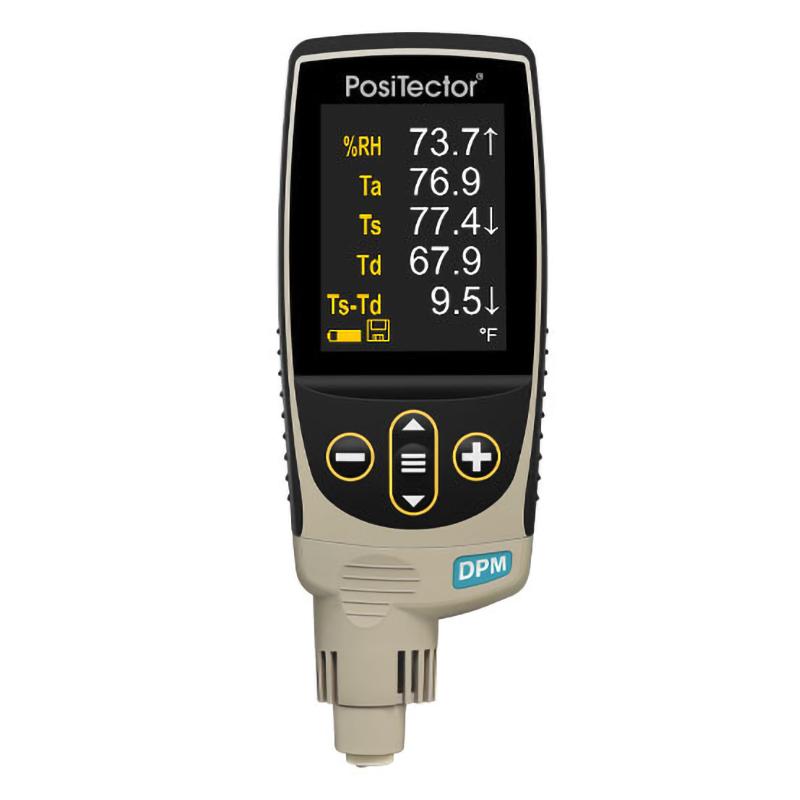
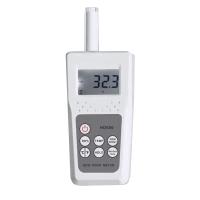
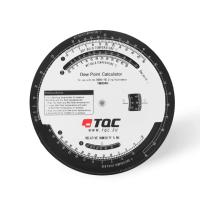
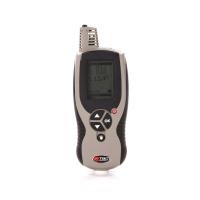
To calculate the dew point temperature, first measure the air temperature and relative humidity, then consult a chart to know the corresponding dew point temperature, which is then compared to the measured substrate temperature to determine whether the coating is safe. Some excellent electronic instruments can directly measure air temperature, relative humidity, and substrate temperature and instantly calculate the corresponding dew point temperature. For example, the air temperature measured with a chain hygrometer is 14C and the humidity temperature is 12.5C. The table shows that the relative humidity is 84%, and the dew point is 11C; at this time, the steel plate temperature is 15C, so the steel plate temperature is 4C higher than the dew point temperature, which should just meet the corresponding requirements, that is, the relative humidity is lower than 85%, and the steel plate temperature is higher than the dew point temperature 3C or more.
-
![TSINGTAO TOKY HD600B integrated dew point meter humidity/temperature/wet bulb temperature/dewpoint temperature]()
-
![TSINGTAO TOKY HD600-B take-over dew point meter humidity/temperature/wet bulb temperature/dewpoint temperature]()
-
![Topco HD600 dewpoint meter, humidity, temperature wet-bulb temperature dewpoint temperature]()
-
![TQC TM0040 dew point calculator]() TQC TM0040 dew point calculator$ 233.00
TQC TM0040 dew point calculator$ 233.00 -
![TQC DC7100 dew point instrument coating environment Measurement Instrument, Humidity dew point detection]()

- 1How to non-destructively test the water content of concrete slabs?
- 2Handheld Dew Point Meter DT-8321 Operation Instructions
- 3Measurement of outdoor climate conditions
- 4Remote monitoring of dew point instrument under environment conditions
-
![LANDTEK HT-1292D portable dew point instrument dewpoint temperature -40~40 ℃]()
-
![TSINGTAO TOKY HD600B integrated dew point meter humidity/temperature/wet bulb temperature/dewpoint temperature]()
-
![TSINGTAO TOKY HD600-B take-over dew point meter humidity/temperature/wet bulb temperature/dewpoint temperature]()
-
![AMITTARI AH-192D Humidity dew point Tester, temperature/Humidity/dew point]()
-
![LANDTEK HT-6292 dew point meter]() LANDTEK HT-6292 dew point meter$ 267.00
LANDTEK HT-6292 dew point meter$ 267.00 -
![LANDTEK HT6292 dew point measurement gas temperature/Relative Humidity/dew point]()