Why pinhole leak point testing for anti-corrosion coatings? What standards are used?
Pinholes and holiday spots are often found on the inner walls of storage tanks, marine chemical tanks, power plant desulfurization devices, buried pipelines, and seawater pipelines.
The purpose of detecting leaks is to find discontinuities such as cracks and pinholes in the coating film. Correcting these deficiencies is especially important for components such as storage tanks used for soaked and buried pipelines.

The match shall indicate which parts of the part should be subjected to the holiday detection test. Coatings should be fully cured prior to testing.
Bubbles of residual solvent are a weak link that the Detector will break to form a hollow white spot. But in some cases, such as baked phenolic varnishes, the user will choose to test the coating before curing so that any repaired coating will effectively bond to the underlying coating. After testing, the coating should be re-examined.
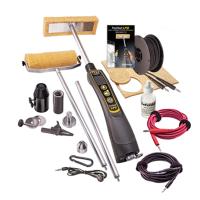
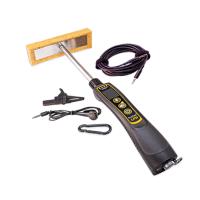
Holiday and pinhole Detectors can generally be classified into the following three types:
1. Low sponge type;
2. DC high voltage type;
3. AC high voltage type
The following standards should be used for detection of leakage points
A. ACE-RP 0188-90 Recommended Method for Testing Film Discontinuities (Holiday Points) of Novel Protective Coatings on Conductive Substrates.
b. ASTM-D5162 Test Method for Discontinuities (Holiday Points) in Films of Nonconductive Protective Coatings on Metallic Substrates.
c. NASE-RP04-A recommended detection method for peeling off point of 250~760 pm (10~30 mil) thick melt-adhesive epoxy pipeline exterior wall coating.

- 1Coating Leakage and Pinholes
托马斯·贝利
- 2Causes and treatment methods of coated pinholes
- 3Common paint film defects and solutions of container coatings
- 4Graphene electric heating film performance testing instrument scheme
- 5Common problems and solutions of electrodeposition paint film
- 6Common problems and causes of water diluted resin coatings
- 7Why are there pores on the surface of the powder coating?
- 8Leakage detection on coated steel and concrete substrates
- 9How does Holiday Detector work in coating leak detection control?