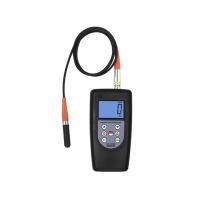
How does the split coating Thickness Gauge measure the thickness of the three-proof paint of the aluminum LED lamp? [Video Demonstration]
overview
Is the Thickness Gauge you usually use a coating Thickness Gauge or an ultrasonic Thickness Gauge? Is the material magnetic or non-magnetic? And whether it contains nickel? What are the estimated film thickness and accuracy requirements?
When choosing a Thickness Gauge, will you be confused by this series of questions? Today, Xiaochao will take you to use a coating Thickness Gauge to test the thickness of samples sent by customers. If you have a need for model selection, you can find Beichao Technology to help you with one-stop service.
Experimental equipment
| name | Principle/Material | Thickness range | features |
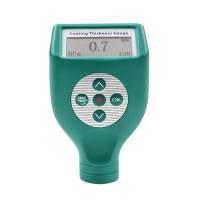
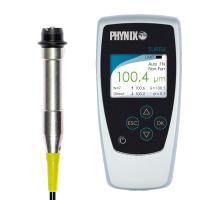
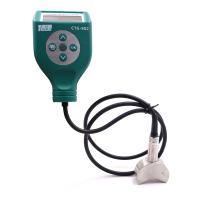
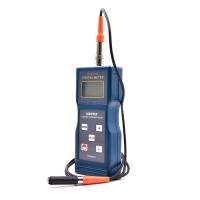
| Split coating Thickness Gauge, also known as non-ferrous paint Thickness Gauge | Eddy current principle | 0~1500μm | The measurement of different materials can be realized by changing the probe; multi-language conversion; can store 2000 thickness measurement values; standard N1.5 probe. |
| led lights | Aluminum, white paint, transparent conformal paint, etc. |
experiment procedure
Before the measurement, the Thickness Gauge needs to be zeroed and calibrated before it can be put into use. Otherwise, the measurement results will be deviated.
The experiment is based on the average value of three measurements.
| 1 o'clock | 2:00 | 3 points | average value | |
| first measurement | 35.0 | 36.2 | 37.2 | 36.1 |
| second measurement | 28.3 | 27.4 | 25.2 | 27.0 |
| third measurement | 29.3 | 27.7 | 28.3 | 28.4 |
The experiment is over. I believe you have a basic understanding of the measurement of the coating Thickness Gauge. If you still don’t understand, you can go to NBCHAO customer service for communication.
video demo
If you don't know much about the experiment, you can watch the explanation of the following video carefully.
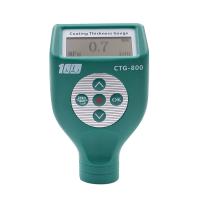

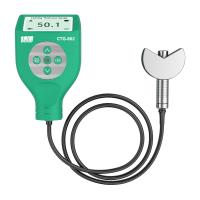

- 1Nondestructive measurement Coating thickness
- 2Principle, application and selection of traffic coatings Coating Thickness Gauge
- 3Principle, Application and Selection of Eddy current Coating Thickness Gauge
- 4Principle, Application and Type Selection of Electronic Coating Thickness Gauge
- 5Explore the principle, application and selection of phosphating layer Coating Thickness Gauge
- 6Principle, Application and Type Selection Analysis of Chrome Coating Thickness Gauge
- 7Principle, Application and Selection of Coating Thickness Gauge for inner wall of small pipe
- 8Basic principle and application scenario of steel Coating Thickness Gauge
- 9Principle and Application Analysis of Coating Thickness Gauge