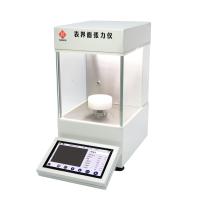
The working principle, application and operation steps of surface tensIon Meter
Surface tension is the tension that develops on the surface of a liquid due to the attractive forces between liquid molecules. It is determined by the balance of surface energy and volume of liquid molecules. Liquid surface tension is an important factor in many liquid physical properties (such as surface shape, resting air bubbles, pipetting, etc.). It can be proved by relatively simple experiments, for example, filling a liquid in a high-grade container, when the surface of the liquid is compressed, it will bounce back, indicating that it has tension.
A tensiometer is an instrument used to measure the surface tension of liquids. It usually consists of a lightweight suspended object (such as a pellet or glass capillary) and a measuring unit (such as a force gauge or electronic sensor). The surface tension of a liquid is the internal force on the surface of a liquid that makes it stretch and keeps suspended objects at a certain distance from it. Surface tensiometers can be used in biology, chemistry, material science and other fields to study surface phenomena and related physical properties.
working principle
The principle of operation of the tensiometer is based on the law of surface tension, which states that the surface tension of a liquid is directly proportional to the distance between the suspended object and the surface. Therefore, when the distance between the suspended object and the surface of the liquid changes, the tensiometer can measure the surface tension by measuring this change in distance.
Specifically, a tensiometer includes a measuring unit, such as a force gauge or an electronic sensor, that detects changes in the position of a suspended object. When the surface tension of a liquid acts on a suspended object, it causes a change in the position of the suspended object. The measuring unit measures surface tension by detecting changes in position. According to the law of surface tension, the measured surface tension value is proportional to the distance between the suspended object and the liquid surface, therefore, the surface tensIon Meter can accurately measure the surface tension.

Operating points
The steps routinely involved in operating a Surface Tensiometer are as follows:
Prepare the sample: Prepare a bottle containing the liquid sample.
Install the instrument: install the Surface Tensiometer, install the measuring unit above the container, and place the suspended object on the liquid surface.
Setting parameters: Set the measurement parameters of the instrument, such as the sensitivity of the measurement unit, measurement duration, etc.
Start Measurement: Turn on the instrument and start measurement. During the measurement, the measuring unit detects the position change of the suspended object and calculates the surface tension value by the law of surface tension.
End measurement: After the measurement is completed, you can view the measurement results of the instrument.
Note: The specific operation method may vary depending on the instrument model, please refer to the instrument manual. At the same time, liquid samples may affect the measurement results of the Surface Tensiometer, so please ensure the quality and stability of the samples.
- 1Water surface tension measurement based on Electronic Balance
- 2Working principle of mechanical liquid meter interfacial tensIon Meter
- 3Comparison of Liquid Surface/Interfacial Tension Testing Methods: Plate vs. Ring Method
- 4Selection guide for Surface Tensiometers
- 5Application principle and precautions of platinum ring Surface Tensiometer
- 6Coating surface tension and its effects
- 7Coating process surface tension factor
- 8Three commonly used detection methods for surface tension
- 9Ceramic ink-jet surface tension, viscosity and solutions