
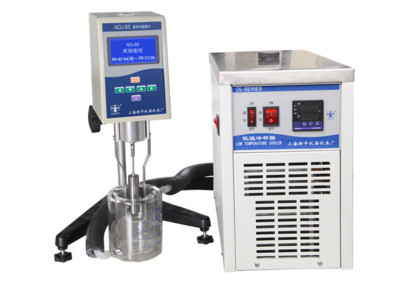
CNSHP DL-SERIES Refrigeration Cycler Temperature range: 5~ 50 ℃ Temperature control accuracy : +/- 0.1 ℃
hengping DL-SERIES Refrigeration circulatorSPEC
hengping DL-SERIES Refrigeration circulatorDetails
hengping DL-SERIES Refrigeration circulatorPacking list
- SKU
- NB010328
- Temperature range
- 5~50℃
- Temperature Resolution
- 0.1℃
- Tank Volume
- 1L
- Temperature control mode
- Microcomputer temperature control. PID adjustment. Pt100 temperature measurement
- Circular mode
- Internal/external circulation
- Total Power
- 550W
- Power supply Voltage
- 220V±10%,50Hz
- Dimensions
- 425*210*315mm
- Flow rate of pump
- 4L/min
- Temperature control Accuracy
- ±0.1℃
- refrigeration method
- Compressor refrigeration
Introduction
The new DL series refrigeration circulator cools the circulating medium in the machine through compressor refrigeration, controls the temperature, and sends it out to the user's equipment through the Circulating Chiller, taking away the heat generated by the user's equipment. This machine has many advantages such as fast constant temperature speed, constant temperature, small size, low noise, easy operation, etc., and is a cost-effective product. Ideal for use in small lab benches or in fume hoods.
Features
· New exterior design
Small size (425*210*315mm), space-saving, easy to operate
· Matching products are available
Small laboratory instruments such as small Abbe refractometer, 2L rotary evaporator, Surface Tensiometer, Rotational Viscometer, etc
· High temperature control accuracy
The accuracy is up to ±0.1°C, and the thermostatic system adopts single-chip microcomputer temperature control and PID self-tuning control technology to ensure high-precision temperature control in the whole range.
· More efficient
The Circulating Chiller circulates the constant temperature liquid to the outside and establishes a closed second temperature field.
· Expertise
The compressor adopts good fully enclosed technology, which has fast refrigeration speed and low noise. The measured temperature and the set temperature are displayed independently, which is convenient for operation.
· High level of security
It has a sensor fault protection function. It has the function of upper and lower temperature protection.
Application
The new DL series cryogenic circulation cooler is widely used in bioengineering, food, chemical, metallurgy, petroleum and other fields. Provide users with a high-precision, controlled, and temperature-uniform constant temperature source. It is a product required by research institutes, colleges and universities, factory laboratories, and quality inspection departments.
Chemistry and biology: atomic absorption, ICP, ICP-MS, nuclear magnetic resonance, rotary evaporator, CCD, biological fermenter, chemical reactor (synthesizer), etc.
Materials: electron microscopy, X-ray diffraction, X-ray fluorescence, magnetron sputtering, vacuum coating machine, molecular beam epitaxy, ICP etching, various semiconductor equipment, fatigue testing machine, chemical deposition system, atomic deposition system, etc.
Physics: lasers (various models), magnetic fields, various molecular pumps, and various water-cooled equipment, including those used in the materials field.
**: Low magnetic field nuclear magnetic resonance, superconducting magnetic resonance, linear accelerator, CT, X-ray machine, etc.