
Three-angle Glossmeter JFL-B206085 (portable three-angle ordinary type) JFL
SE JFL-B206085 (Portable three-angle ordinary type)

-
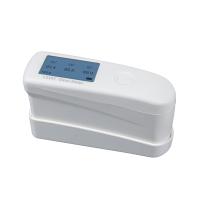 CHINA LS197 three-angle Glossmeter 20 °/60 °/85 ° multi-angle measurement$ 491.00SE
 -
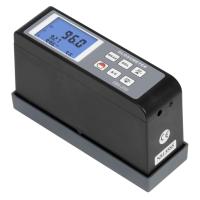 LANDTEK GM-200 20 °/60 °/85 ° Glossiness Meter$ 364.00SE
 -
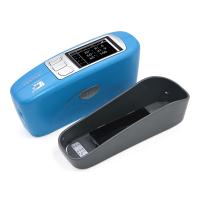 CHNSPEC CS-380 three-angle gloss meter 20 °/60 ° and 85 °$ 651.00SE
 -
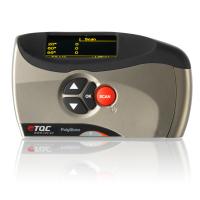 Netherlands TQC GL0030 Gloss Meter 20 °/60 °/85 ° Three-angle high-precision Glossiness Testing Instrument$ 6078.00SE
 -
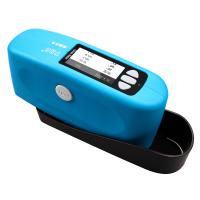 IWAVE WG68 Glossmeter 20 °/60 °/85 ° for paints, plastic, leather, paper, automotive, metal, etc$ 635.00SE





JFL JFL-B206085 (Portable three-angle ordinary type) GlossMeterSPEC
JFL JFL-B206085 (Portable three-angle ordinary type) GlossMeterDetails
JFL JFL-B206085 (Portable three-angle ordinary type) GlossMeterPacking list
- SKU
- NB001296
- Geometry
- 20°/60°/85°
- Measurement range
- 0~199.9GU
- Measuring Areas
- 10*11mm(20°);10*20mm(60°);7*24mm(85°)
- Error of indication
- ±1.2GU
- Division Value
- 0.1GU
- Standards
- ISO-2813、ASTM-D2457、GB9754、GB9966、GB8807
- Operating language
- Chinese
- Dimensions
- 138*36*82mm
- Weight
- 400g
- Power
- One AA battery
- Stability
- ±0.4GU
- Measurement port size
- 16*48mm
- Application
- Paint, Coatings, Printing ink, Plastic, Pottery and porcelain, Stone, Paper, Metal

Introduction
JFL JFL-B206085 three-angle gloss meter is a general-purpose gloss meter with three measuring angles of 20 degrees, 60 degrees and 85 degrees. It can measure high, medium and low gloss at the same time. The measuring aperture is a rectangular window of 16x48mm. The JFL-B206085 three-angle gloss meter uses a No. 5 battery as the power supply. It has multiple measurement angles. It is very convenient for field operations and places without power supply. It is suitable for coatings, paints, paints, plastics, ceramics, stone materials, and paper. , metal and other surface gloss measurement, widely used, easy to carry.
operation method
1) Turn on the switch of the JFL-B206085 three-angle gloss meter, and press the button that needs to test the angle.
2) Calibration: Open the standard plate box, take out the black glass standard plate and put its bright side up on a flat table, align the "inverted triangle ▽ " mark in the center of the JFL-B206085 three-angle gloss meter to the groove In the center of the side, adjust the adjusting knob so that the reading of the JFL-B206085 three-angle gloss meter indicates the nominal value of the black glass standard plate (see the corresponding angle data ).
3) Calibration: Use the calibrated JFL-B206085 three-angle gloss meter to measure the white ceramic plate (position the center of the gloss meter with the "inverted triangle ▽" mark aligned with the center of the inner edge of the groove), and the displayed value of the corresponding angle should not be It is greater than the nominal value of the white ceramic standard plate ±1.2 gloss units, otherwise check the surface cleanliness of the black and white standard plate, or the JFL-B206085 three-angle gloss meter is faulty. If the three-angle gloss meter is working properly, this work does not need to be done frequently.
4) Measurement: Use the calibrated JFL-B206085 three-angle gloss meter to measure the tested sample.
5) When switching between different angles for measurement, please recalibrate according to the above 2-4 steps.
Product Structure
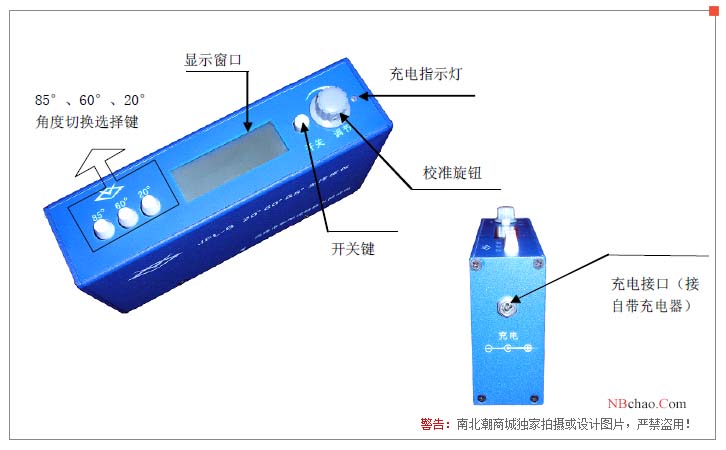
Precautions for product use
1. The standard plate should be kept clean, because the dirty standard plate will cause measurement errors.
2. Optical instruments should be protected from moisture to avoid mildew on the lens. Strong vibration should be avoided, and strong light should not shine directly on the window.
3. The battery life will be affected by power loss. When the display shows the Voltage of "-" under power, it should be charged in time.
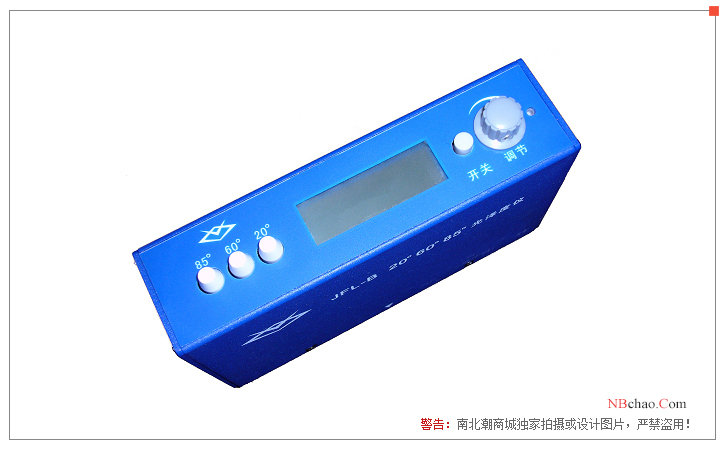
Pictures
- 1GB/T 9754-2025《Paints and varnishes—Determination of gloss value at 20°、60°and 85°》
- 2GB/T 23454-2025《Stone plate for vanity and countertop and windowsill》
- 3GB/T 13217.2-2024《Test method for gloss of ink》
- 4ISO 《Paper and board - Measurement of specular gloss - Part 3: 20° gloss with a converging beam, TAPPI method (Second Edition)》
- 5HG/T 2006-2022《Thermosetting and thermoplastic powder coatings》
- 6GB/T 42789-2023《Test method for gloss of silicon wafer》
- 7GB/T 11420-1989《Measurement of specular gloss of vitreous and porcelain enamels》
- 8GB/T 13448-2019《Test methods for prepainted steel sheet and strip》
- 9GB/T 33568-2017《Evaluation of degradation of coatings on exterior wood》
- 10HG/T 2006-2006《Thermosetting powder coatings》