
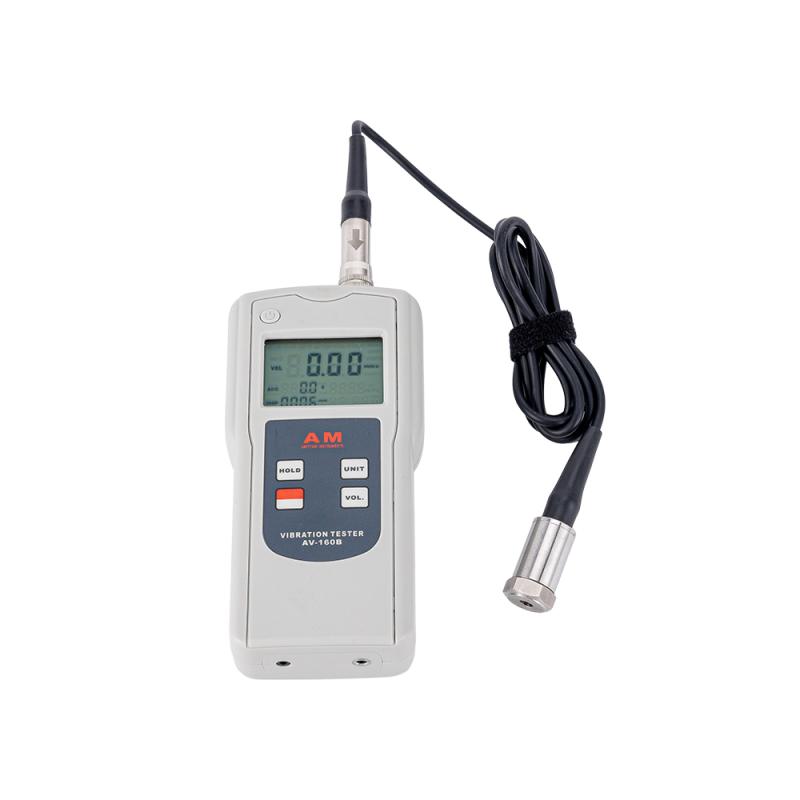
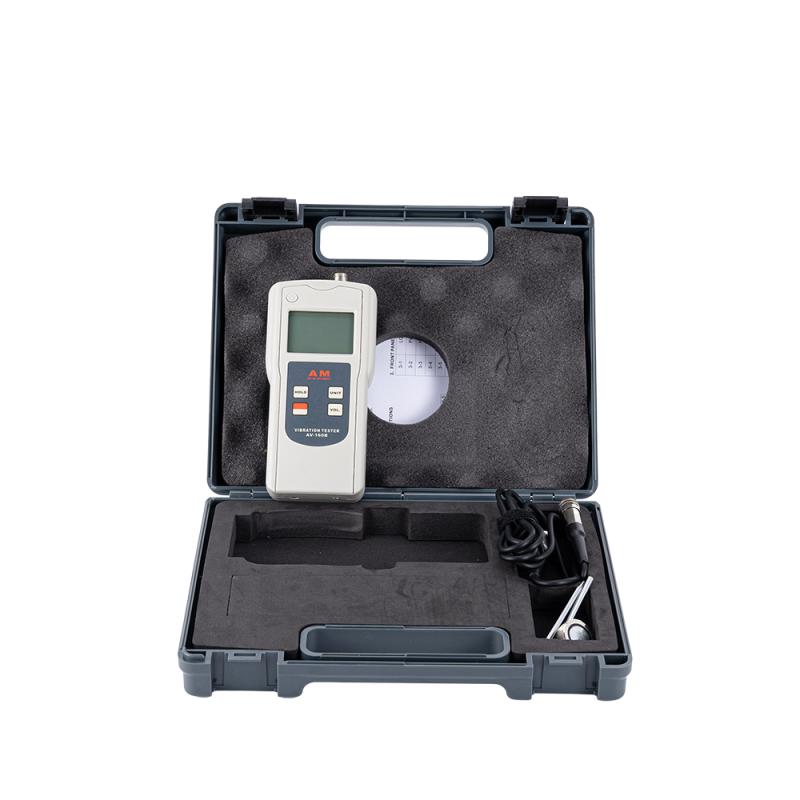

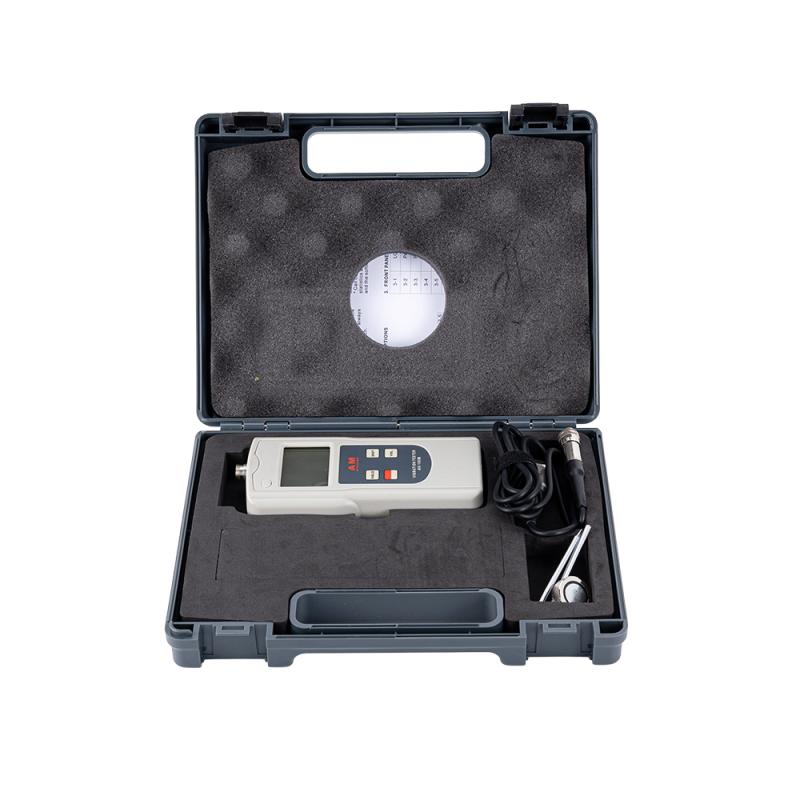

Vibrator AMITTARI AV-160B displays three parameters of "Displacement", "Speed" and "Acceleration"
SE AV-160B

-
 3D three-axis vibration instrument AMITTARI AV-160D simultaneous measurement of three-axis or single-axis vibration parameters$ 663.00SE
 -
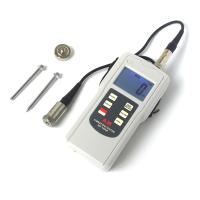 Vibrometer AMITTARI AV-160A detects imbalances and deviations in moving machinery$ 373.00SE
 -
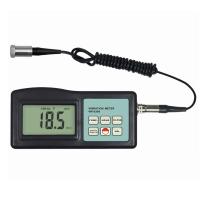 LANDTEK VM6360 Vibration Meter Frequency up to 10Hz~ 10KHz$ 431.00SE



AMITTARI AV-160B VibratorSPEC
AMITTARI AV-160B VibratorDetails
AMITTARI AV-160B VibratorPacking list

- SKU
- NB001480
- display
- 4-Position 18mm LCD display
- Sensors Type
- Piezoelectric Vibration Sensors
- Accuracy
- ± (5% n + 2) words
- Displacement Measurement range
- 0.001~4.000mm
- Speed Measurement range
- 0.1~400mm/s
- Acceleration Measurement range
- 0.1~400.0m/s²
- Displacement frequency range
- 10Hz~1KHz
- Speed frequency range
- 10Hz~1KHz
- Acceleration frequency range
- 10Hz~10KHz
- Operating Temperature
- 0~50℃
- Relative Humidity
- <90% RH
- output
- 2.0V AC load resistance 10k
- Dimensions
- 140*70*30mm
- Power
- 4X1.5vAAA (UM-4) AA battery
- Weight
- About 130g (without battery)
- Optional accessories
- Headphones, USB data cable, RS-232C cable and software

Overview of AV-160B Vibration Meter
AMITTARI AV-160B Vibration Meter is a portable digital display vibrometer. Different from AV-160A, AV-160B Vibration Meter can simultaneously display three measurement parameters of "displacement", "velocity" and "acceleration". Likewise, it can be applied to periodic motion measurements to detect imbalances and deviations in moving machinery. AV-160B Vibration Meter is specially designed for on-site measurement of various mechanical vibrations in order to provide data for quality control, running time and prior equipment maintenance. In addition, the AV-160B vibratIon Meter uses a high-performance accelerometer to achieve accurate and reproducible measurements.
Features
* Can display "displacement", "velocity" and "acceleration" three measurement parameters at the same time.
* Conforms to international standard ISO2954 for periodical motion measurement to detect imbalance and deviation of moving machinery.
* Designed for on-site measurement of various mechanical vibrations to provide data for quality control, running time and prior equipment maintenance.
* Use high-performance accelerometers to achieve accurate and repeatable measurements.
* Convert to vibration signal with piezoelectric acceleration sensor.
* AV-160B Vibration Meter has bearing condition measurement function.
* Liquid crystal LCD display, light weight, and simple operation, easy to use.
* Wide frequency range, in the acceleration mode, the frequency can reach 10-10KHz.
* AV-160B Vibration Meter has AC signal output, which is convenient for auscultation and recording.
* Optional earphones can be used as a stethoscope.
* Using optional RS-232c software and cables, it can communicate with PC computer to realize functions such as printing and statistics.
AV-160B functional structure diagram

AV-160B display picture


Operating procedures
1) Connect the piezo sensor to the AV-160B Vibration Meter and rotate it until it locks.
2) Use the magnetic suction seat to fix the piezoelectric sensor on the point to be measured. Make sure that the fixed surface is flat and clean. If possible, please install it directly with screws.
3) Press the power button lightly to turn on the power; three measurement parameters are displayed at the same time.
Machine vibration classification selection table
| Vibration intensity | Applicable machine category | |||
| Vibration velocity V rms (mm/s) | I | II | III | IV |
| 0~0.28 | A | A | A | A |
| 0.28~0.45 | ||||
| 0.45~0.71 | ||||
| 0.71~1.12 | B | |||
| 1.12~1.8 | B | |||
| 1.8~2.8 | C | B | ||
| 2.8~4.5 | C | B | ||
| 4.5~7.1 | D. | C | ||
| 7.1~11.2 | D. | C | ||
| 11.2~18 | D. | |||
| 18~28 | D. | |||
| 28~45 | ||||
| >45 | ||||
Note: (1) Class I is a small motor (motor less than 15kw, etc.); Class II is a medium-sized machine (motor 15kw~75kw, etc.); Class III is a large prime mover (hard foundation); Class IV is a large prime mover ( Elastic base)
(2) A / B / C / D are vibration levels; A is good, B is satisfactory, C is not satisfactory, and D is not allowed. The measured speed (RMS) values shall be in three orthogonal directions of the bearing housing.