
HYLOLOGY HYL-1001 Powder comprehensive characteristic Tester, multi-functional powder physical characteristic Tester
SE HYL-1001



hylology HYL-1001 Powder comprehensive characteristic TesterSPEC
hylology HYL-1001 Powder comprehensive characteristic TesterDetails
hylology HYL-1001 Powder comprehensive characteristic TesterPacking list

- SKU
- NB015262
- Tap Density
- Metal powder: amplitude 3mm, vibration frequency 300 rpm
- Tap Density
- Carl index: amplitude 3mm, 14mm, vibration frequency 300 rpm
- Loose Density
- Natural stacking method: funnel outflow pore diameter 12.7mm, measuringflask Volume 100ml, height 115mm
- Loose Density
- Funnel method: funnel outflow aperture 2.5mm and 5.0mm, measuringflask Volume 25ml, height 25mm
- Loose Density
- Carl index: funnel outflow pore diameter 50mm measuringflask Volume 100ml, height 30mm
- angle of repose
- Receiver 80mm, powder drop height 75mm
- collapse angle
- Impact hammer Mass 110g, Impact distance 150mm
- Flat angle (spatula angle)
- Board width 22mm, liftable, Impact hammer can fall freely at 150mm, protractor
- dispersion
- Receiver 100mm, channel 100mm, spreader 50mm, spreader control valve
- Hall Flow velocity
- Standard material 50g, 40 +/- 0.5 seconds to complete, funnel outflow aperture 2.5mm
- difference angle
- The difference between the angle of repose and the angle of collapse is called the difference angle. The larger the difference angle, the stronger the flowability and jet flow of the powder.
- degree of compression
- The ratio of the difference between the Vibration Density and the Loose Density of the same sample to the Vibration Density is the degree of compression. The degree of compression is also called the compression ratio. The smaller the degree of compression, the better the flowability of the powder.
- Degree of agglutination
- Vibration mechanism, sieve
- Homogeneity
- It is another manifestation of the agglomeration degree of the powder. When the agglomeration degree of the powder cannot be measured, the homogeneity degree is used to express the size of the mutual agglomeration force of the powder.
- Flowability index
- The flowability index is the Weighted sum of the indices of angle of repose, degree of compression, plate angle, homogeneity and degree of agglomeration.
- Jet index
- Jet fluidity index is the index of flowability index, collapse angle, difference angle and dispersion.
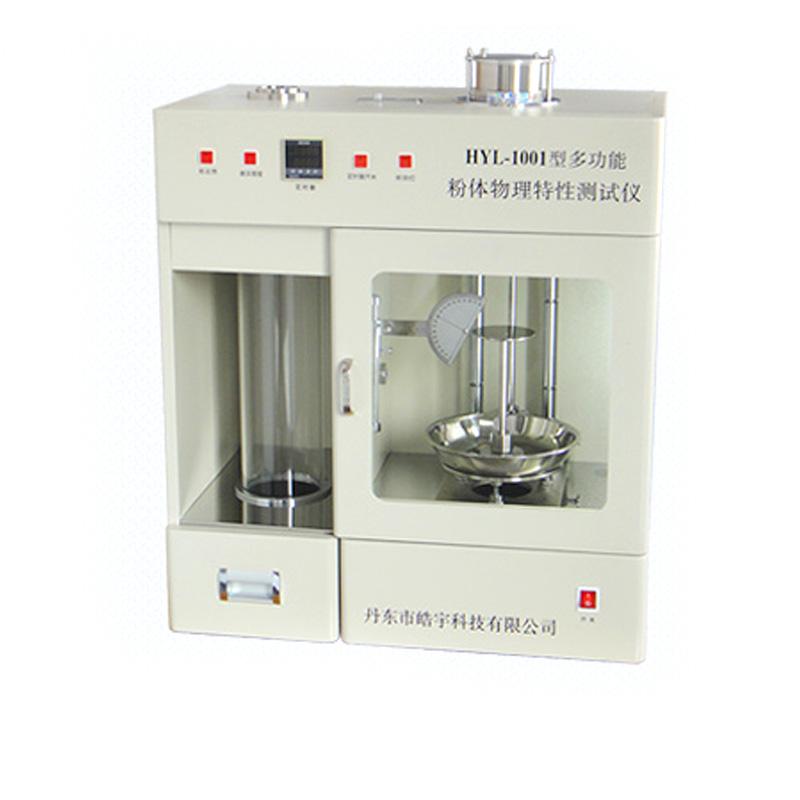
Introduction
ãThe HYL-1001 multifunctional powder physical property Tester (or powder comprehensive property Tester) is based on the requirements of the American ASTM D6393-99 standard (Standard Test Method for BulkSolids Characterization by Carr Indices) and refers to Chinese national standard GB/T 5162-2006/ ISO 3953:1993 (Determination of tap density of metal powder), GB/T 1482-2010 (Determination of flowability of metal powder using standard funnel method), GB/T 1479.1-2010 (Metal powder looseness Packing density - funnel method), GB/T 16913.3-2008 (Determination of bulk density by natural accumulation method), a testing instrument developed to evaluate the comprehensive physical properties of powders.
ããBecause powder is a two-phase system whether it is in a static state or a flowing state. The characteristics of the particles themselves and the friction between particles will produce some special flow characteristics. Studying these characteristics is of great significance to powder processing, transportation, packaging, storage and other aspects. The characteristics of this instrument are that it has multiple uses, flexible and diverse measurement conditions, easy operation, good repeatability, and is suitable for multiple standards. The successful development of this instrument provides a new means for the widespread testing of comprehensive properties of powders in scientific research, industrial production and other fields.
ããThe instrument can directly test parameters including the tap density, bulk (packing) density, angle of repose, collapse angle, flat plate angle, dispersion and other parameters of the powder. Through the calculation of the above test data, the difference angle, compression degree, voids can be obtained Rate, uniformity, agglutination and other indicators, and the Karl index parameters such as fluidity index and jet flow index can also be obtained through the table lookup of the above parameters.

Features
The HYL-1001 multi-functional powder physical properties Tester is made of 304 stainless steel to prevent the rust of the device from affecting the accuracy of the test. The instrument has a new Hall flow meter function. The vibration amplitude of the tap density is adjustable from 1mm to 15mm. During the vibration process, the vibration component rotates at a small angle to ensure the uniformity of the material. Three measuring cylinders with different volumes can be used for testing to deal with different samples. Different discharging funnels and measuring cups are equipped for different test items to ensure the accuracy of each test item.
Definition of measurement and calculation items
1. Tap density: Tap density refers to the density after the powder is filled in a specific container and the container is vibrated under certain conditions to destroy the gaps in the powder and make the powder in a tightly packed state. Generally, The tap density of powder is less than the true density of individual particles in the powder.
ããHYL-1001 multifunctional powder physical property Tester provides the tap density measurement method specified in the American ASTM D6393-99 standard (Carr Index) and the national standard (Metal Powder Tap Density Measurement) GB/T 5162-2006 / Method for determination of tap density specified in ISO 3953:1993.
ãã2. Bulk density: Bulk density refers to the density of powder after it naturally fills a specific container under specified conditions. When testing bulk density, no additional external forces such as vibration should be applied. This mark is important for the design of storage containers and packaging bags.
ããThe HYL-1001 multifunctional powder physical property Tester provides three different standard measurement methods: A
ãã) Bulk density measurement method specified in the American ASTM D6393-99 standard (Carr index);
ããB) National standard GB 1479-2010 (Bulk density of metal powder - funnel method);
ããC) Bulk density determination method specified in GB/T 16913.3-2008 (Determination of bulk density by natural accumulation method).
ãã3. Angle of repose: The maximum angle between the free surface of the powder accumulation layer and the horizontal plane in a static equilibrium state is called the angle of repose. It is formed by making the powder naturally fall to a specific platform in a specific way. The angle of repose has the greatest influence on the fluidity of powder. The smaller the angle of repose, the better the fluidity of powder. The angle of repose is also called the angle of repose, natural slope angle, etc.
ããThe HYL-1001 multifunctional powder physical property Tester provides the measurement method specified in the American ASTM D6393-99 standard (Carr Index).
ãã4. Collapse angle: After the accumulated powder whose angle of repose is measured is given a certain impact force to cause its surface to collapse, the bottom angle of the remaining powder cone is called the collapse angle.
ããThe HYL-1001 multifunctional powder physical property Tester provides the measurement method specified in the American ASTM D6393-99 standard (Carr Index).
ãã5. Plate angle (spatula angle): Lift the plate buried in the powder vertically upward, and the average angle between the free surface (slope) of the powder on the plate and the plate and the angle after being vibrated called the plate angle. In the actual measurement process, the plate angle is expressed by the average of the angle after the plate is lifted and the angle at which the unstable powder is removed after the plate is impacted. The smaller the plate angle, the stronger the fluidity of the powder. Generally, the plate angle is greater than the angle of repose.
ããThe HYL-1001 multifunctional powder physical property Tester provides the measurement method specified in the American ASTM D6393-99 standard (Carr Index).
ãã6. Dispersion: It measures the ability of powder to disperse, jet or fluidize in all directions, which is called dispersion. The measurement method is to drop a 10-gram sample from a certain height and measure the percentage of the sample outside the receiving tray to the total sample. The degree of dispersion is related to the dispersion, floating and splashing properties of the sample. If the dispersion exceeds 50%, the sample has a strong tendency to splash.
ããThe HYL-1001 multifunctional powder physical property Tester provides the measurement method specified in the American ASTM D6393-99 standard (Carr Index).
ãã7. Hall flow meter: HYL-1001 multifunctional powder physical property Tester is designed and produced in accordance with the provisions of the national standard GB 1482-84. This device is suitable for measuring the fluidity of metal powders using the standard funnel method. This device can be used for any powder that can flow freely through a standard funnel with a hole diameter of 2.5mm.
ãã8. Difference angle: The difference between the angle of repose and the angle of collapse is called the difference angle. The larger the difference angle, the stronger the fluidity and jet flow of the powder.
ãã9. Degree of compression: The ratio of the difference between the tap density and bulk density of the same sample to the tap density is the degree of compression. The degree of compression is also called the compression ratio. The smaller the degree of compression, the better the fluidity of the powder.
ã 10. Porosity: Porosity refers to the percentage of voids in the powder to the entire powder volume. The void ratio varies due to factors such as the particle shape, arrangement structure, and particle size of the powder. When the particles are spherical, the powder void rate is about 40%; when the particles are ultrafine or irregularly shaped, the powder void rate is 70-80% or higher.
ã 11. Aggregation degree: Aggregation degree is the mutual cohesion displayed on the surface of powder particles. Generally, the degree of aggregation of dry powder is small.
ã 12. Homogeneity: It is another form of expression of powder agglomeration. When the agglomeration of powder cannot be measured, homogeneity is used to express the mutual cohesion of powders.
ã 13. Liquidity index: The calculation method of liquidity index was determined by the British Carr in the 1960s. After measuring a large amount of powder, he used a method similar to comprehensive bisection in fuzzy mathematics to fuzzy quantify qualitative concepts. Simply put, the fluidity index is the weighted sum of the angle of repose, compression, flat plate angle, uniformity, aggregation and other indexes.
ã 14. Jet flow index: It is an index that measures the difficulty of powder materials generating dust, and it is also a method of measuring the difficulty of powder being liquefied by gas. Powder with strong jet flow is easy to generate dust and is also easy to be liquefied. The jet flow index is an index of four physical indexes: fluidity index, collapse angle, difference angle, and dispersion degree.
4. Main technical indicators of HYL-1001 multifunctional powder physical properties Tester
- 1Angle of repose meter is what? How to select? Powder flowability detection core equipment full analysis
- 2Summary of test methods for powder resting angle
- 1GB/T 5061-1998《Metallic powders--Determination of apparent den-sity--Part 3:Oscillating funnel method》
- 2GB/T 6609.25-2004《Chemical analysismethods and determination of physical performance of alumina--Determination of untamped density》
- 3GB/T 40380.1-2021《Metallic powders—Determination of apparent density and flow rate at elevated temperatures—Part 1: Determination of apparent density at elevated temperatures》
- 4GB/T 11986-1989《Surface active agents--Powders and Granules--Measurement of the angle of repose》
- 5GB/T 1479.3-2017《Metallic powders-Determination of apparent density-Part 3: Oscillating funnel method》
- 6GB/T 1479.1-2011《Metallic powders - Determination of apparent density - Part 1: funnal method》
- 7GB/T 1479.2-2011《Metallic powders - Determination of apparent density - Part 2: Scott volumeter method》
- 8GB/T 5162-2006《Metallic powders - Determination of tap density》
- 9GB/T 31057.2-2018《Granular materials—Physical properties—Part 2: Determination of tap density》
- 10GB/T 5162-2021《Metallic powders—Determination of tap density》