
SMTMF MHRSS-150-Z Automatic Rockwell Hardness Tester
 MHRSS-150-Z

SMTMF MHRSS-150-Z Automatic Rockwell Hardness TesterSPEC
SMTMF MHRSS-150-Z Automatic Rockwell Hardness TesterDetails
SMTMF MHRSS-150-Z Automatic Rockwell Hardness TesterPacking list
- SKU
- NB015566
- initial test force
- 3kgf、10kgf
- main test force
- 15kgf、30kgf、45kgf、60kgf、100kgf、150kgf
- Surface rockwell hardness
- HR15N、HR30N、HR45N、HR15T、HR30T、HR45T、HR15W、HR30W、HR45W、HR15X、HR30X、HR45X、HR15Y、HR30Y、HE45Y
- rockwell hardness
- HRA、HRB、HRC、HRD、HRE、HRF、HRG、HRH、HRK、HRL、HRM、HRP、HRR、HRS、HRV
- LCD display
- Rockwell Ruler, Hardness Value, Force Value Linear dispersion, Depth Linear dispersion, Total test force, Maximum indentation depth, indentation permanent variable, Temperature, Humidity, Operating state, Load holding time, Upper and lower limit setting values GO/NG indication, etc
- add and uninstall method
- Ultra High Response Speed Closed Loop Load Control Technology (Loading, Loading, Unloading)
- Ruler selection
- Touch screen selection
- Ruler conversion
- HR、HB、HV
- Load time
- 0~99s
- Interface
- Built-in printer, RS232 interface
- execution standard
- ASTM E18、ISO6508、GB/T230.2
- Allowable specimen height
- 300mm
- Specimen placement
- Outer surface placement
- Power Supply
- 110/220V AC、60~50Hz
Introduction
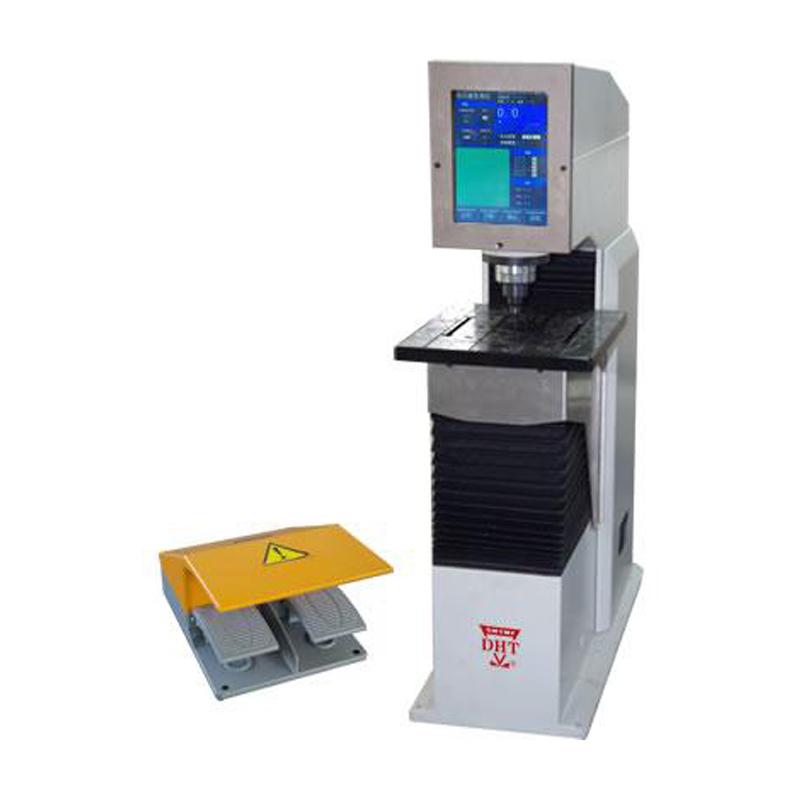
Shanghai Aolong Xingdi Testing Equipment Co., Ltd. newly launched "Aolongxin" large platform automatic Rockwell Hardness Tester MHRS-150-Z, using international professional closed-loop sensor control technology, to achieve fully automatic control and hardness testing process. The loading system adopts a high-precision force value sensor and a central controller to form a closed-loop loop to realize the whole process of microsecond tracking and control of afterburner.
THE BATHYMETRY SYSTEM USES A HIGH-PRECISION DISPLACEMENT SENSOR, WHICH RESULTS IN A MINIMUM HARDNESS VALUE WITH A RESOLUTION OF 0.1 HR. The position of the indenter is fixed, and the hardness test is carried out by the movement up and down the platform. The overall movement of the large platform eliminates the gap generated when the lead screw is lifted, greatly improves the accuracy and repeatability of the test, and also increases the stability and efficiency of the machine. The new foot switch function, one-button measurement, saves a lot of manpower, and is convenient for on-site use.
Features
●Comply with ASTM E18, ASTM E384, ISO 6508, GB/T230;
●The frame structure is firm and rigid;
●Fully automatic closed-loop sensor loading;
●It can test 15 kinds of Rockwell hardness scales;
●High precision, international contrast is less than 0.5HR;
●High-speed step control, extremely fast test speed;
●With foot switch design, the overall automatic lifting of the large platform saves manpower, and one-button automatic measurement;
●High-precision loading system, effectively avoiding force overload, and greatly improving the loading speed;
●The test process curve display can visually display the material characteristics, which is convenient for observation and learning;
●It can be continuously measured in and out of the fixed workbench through the automatic withdrawal function of the indenter;
●The automatic lifting platform and the automatic load initial test force can ensure the stable generation of the force;
●High-definition LCD, touch screen operation, menu-based operation interface;
●Automatic loading and unloading, holding time adjustable;
●GO/NG tolerance judgment;
●Correction of test values of cylinders and spheres;
●The force measurement selection is linked with the hardness scale selection;
●Ruler conversion HR, HB, HV;
● Built-in printer;
Product Enhancement
Fully automatic high-speed response closed-loop sensor loading system, large platform overall movement, to achieve high-precision and rapid testing, improve the control accuracy of actuators
The original system is a millisecond-level control system. Unable to implement step control.
The new system is a microsecond control system. High-speed step control is possible.
The pace control accuracy can reach the nanometer level!
Improve the comprehensive performance of the equipment, improve the detection accuracy and speed of the equipment
1. Improve the ability to process analog signals from force sensors. Change the "eyes"
2. Improve the ability to process the overall digital signal. Change the "core"
3. Improve the accuracy of displacement measurement. Change the "ear"
4. Improve the accuracy of motor control. Changing "hands"
5. Improve the human-machine interface. Change the "face"
A dedicated management device QEI is installed for the displacement sensor
The original motherboard did not have a dedicated management device, and the CPU had to constantly process the displacement sensor signals itself throughout the loading process.
After setting up a dedicated management device, the CPU only needs to read the data at the start and end of the two time points, and the loading process CPU can concentrate resources on managing the force sensor and loading the motor, making the control faster and more accurate.
Introduced Japanese high-precision magnetic grating displacement sensor
The original displacement sensor is a domestic (CN) grating displacement sensor. There is a problem of poor consistency and the need to match and select equipment.
Japan's high-precision displacement sensors have high consistency and are less affected by the environment. The service life can reach more than 150 million times.
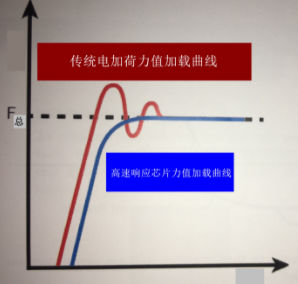
If the loading speed is to be controlled within 8 seconds required by the national standard GBT230/T-91, the red curve in the figure will continue to overshoot and remove to approach the total F when the test force F is total. As a result, the Hardness Tester needs to slow down the speed of the test, resulting in too long a detection time; Second, the overshoot phenomenon affects the test accuracy to a certain extent.
This equipment adopts a more professional and applicable central processing chip, which responds to the entire hardness test process at high speed, and the central processing chip will process 18,000-30,000 sets of data at ultra-high speed from the start to the end of each hardness test. The loading action that can be done by the traditional electric charge Hardness Tester can be shortened to 1.75 seconds (ISO6508-1:99 unifies the test force application time within 1~8s). As shown in the blue curve in the figure, the speed of the loading process reaches the top speed, and the force value is smooth and free of overshoot in the process of loading to the total test force, which improves the loading speed and accuracy of the electric charge Hardness Tester.
Detailed explanation of the "Oron core" curve
1. Force value and depth curve.
During the working process of the Hardness Tester, the main chip reads the data of the pressure sensor and displacement sensor in real time, and converts the data into curves, which are the force values and pressure depth curves of the 28.3HRC hardness block.
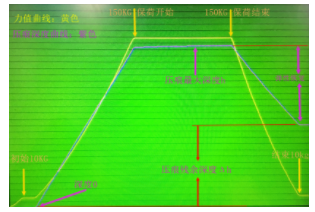
2. Pressure-depth curve
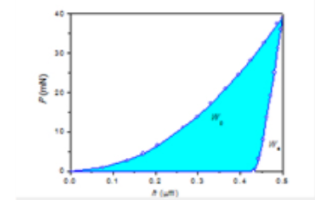
During the detection process, the synchronous data of pressure and pressure depth are exported, the pressure-depth curve is automatically generated, and the area of the shaded part is obtained for the study of elastic modulus.
In the figure, the ordinate is the pressure, and the abscissa is the depth
Precise hardness correction
For example, the standard hardness curve is a straight line, as shown in the black line segment in the figure.
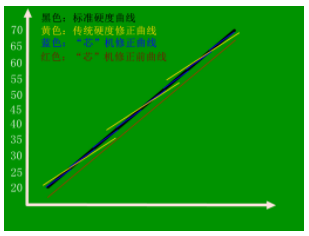
For example, the standard hardness curve is a straight line, as shown in the black line segment in the figure.
The hardness of the traditional electric digital Hardness Tester is automatically corrected as shown in the yellow line segment in the figure, and the correction is generally divided into three sections, and only near the calibration point is basically consistent with the standard hardness, and the farther away from the calibration point, the greater the difference in hardness value.
After the further transformation and improvement of the "Orolongxin" control method, the original hardness curve of the machine is shown in the red line in the figure. The hardness correction of the whole range is given a common coefficient, and the hardness curve will be improved to the state of the standard hardness curve, and the experimental conclusion is that after giving a common coefficient, without any interval correction, the hardness of 24HRC, 48HRC and 63HRC standard hardness blocks is tested, and the hardness of 24HRC and standard blocks is 0.9HRC, 48HRC error is 0.2HRC, and 63HRC error is 0.8HRC.
Now the whole hardness range is divided into more than 8 hardness correction ranges, as shown in the blue line in the figure, this correction method refines the entire hardness range, and simplifies and accurately corrects the hardness of the electric digital Hardness Tester.
Experimental data: The hardness accuracy of the test is up to ≤0.15HRC
- 1ASTM -2023《Standard Test Method for Rockwell and Brinell Hardness of Metallic Materials by Portable Hardness Testers》
- 2JJG 2067-2016《Measuring Instruments for Metallic Rockwell Hardness》
- 3JJG 2092-1995《Measuring Instruments for Plastic Rockwell Hardness》
- 4GB/T 713.7-2023《Steel plate,sheet and strip for pressure equipments—Part 7:Stainless steel and heat resisting steel》
- 5GB/T 713.1-2023《Steel plate,sheet and strip for pressure equipments—Part 1:General requirements》
- 6GB/T 42670-2023《Test method for Rockwell hardness of carbon materials》