
MODERNER PH-5859 Swing bar Hardness Tester with Persoz pendulum
 PH-5859

Moderner PH-5859 Swing rod Hardness TesterSPEC
Moderner PH-5859 Swing rod Hardness TesterDetails
Moderner PH-5859 Swing rod Hardness TesterPacking list
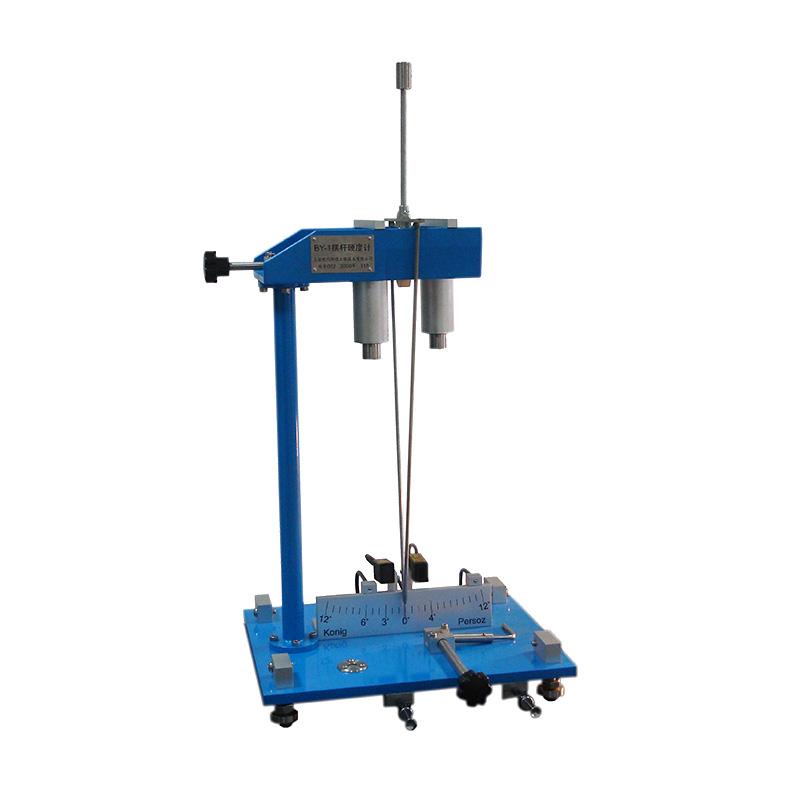
- SKU
- NB016669
- Swing bar type
- Persoz pendulum
- Persoz swing Mass
- 500±0.1g
- Persoz swing cycle
- 1s
- Persoz ball diameter
- 8mm
- Persoz Glass Swing Time
- 430±10s
- Persoz start and end swing angle
- 12°/4°
- Power
- 115V/60Hz;230V/50Hz;0.1A
- Dimensions
- 320*710*300mm
- Host Weight
- 17.5kg
- Application standard
- ASTM D4366、DIN 1522
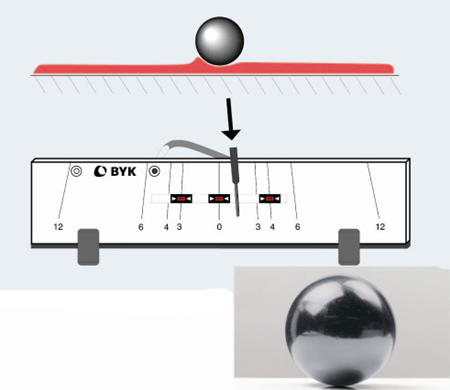
Methods The hardness is evaluated by measuring the decay time of the pendulum swing. The pendulum is supported on the paint surface by two small stainless steel balls. There is a physical relationship between the oscillation time, amplitude, and geometric dimensions of a pendulum. The elasticity of the paint determines the hardness of the paint.
When the pendulum is placed in motion, the ball rolls back and forth across the surface and exerts pressure on the paint surface. Depending on the elasticity of the paint, the oscillations will be stronger or weaker. If there is no elasticity, the pendulum will vibrate more strongly. Highly elastic surfaces lead to faster decay.
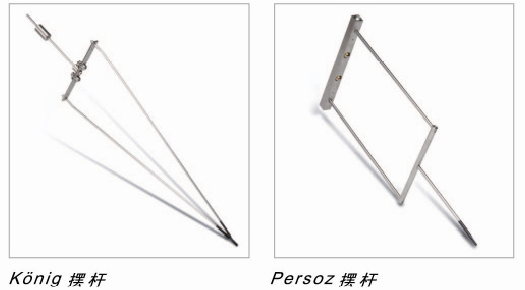
The test is based on two types of pendulum bars:
| König | Persoz | |
| weight | 200±0.2 | 500g±0.1 |
| ball diameter | 5mm(0.2in) | 8mm(0.3in) |
| Deflection starts | 6° | 12° |
| End of deflection | 3° | 4° |
| vibration period | 1.4 seconds | 1 second |
| Swing time on glass plate | 200±10 seconds | 400±10 seconds |
This is a simple laboratory instrument for hardness measurement according to the method of König and Persoz described previously.
â Automatic counting and accordingly an audible signal when the deflection is as low as 3° (König) or 4° (Persoz)
â Record deflection using two photosensitive probes
â Digital counter
â The third photosensitive probe converts the König to Persoz measurement method
â Select button can display seconds or number of swings
standard
ASTM D4366, DIN 1522
- 1NF 《Paints and varnishes - Pendulum damping test》
- 2EN ISO 1522-2006《Paints and varnishes - Pendulum damping test (ISO 1522:2006)》
- 3NF EN ISO 1522-2007《Paints and varnishes - Pendulum damping test.》
- 4JB/T 9386-2017《Pendulum damping testers》
- 5JB/T 9386-1999《Pendulum damping tester, technical conditions》
- 6GB/T 1730-1993《Paint film hardness determination method Pendulum damping test》
- 7GB/T 1730-1993《Paint film hardness determination method Pendulum damping test》