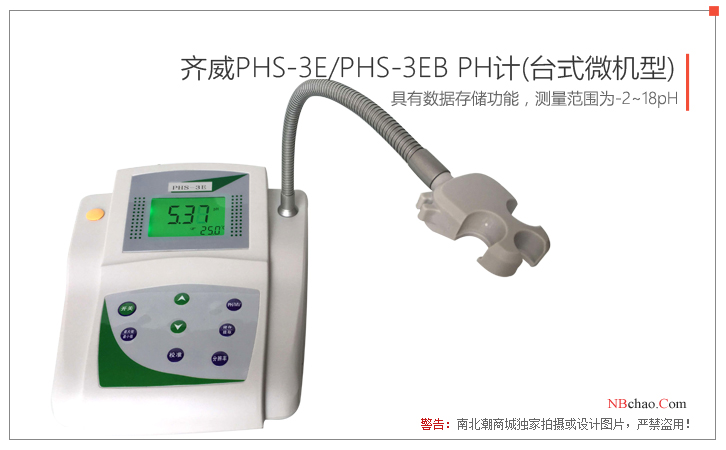
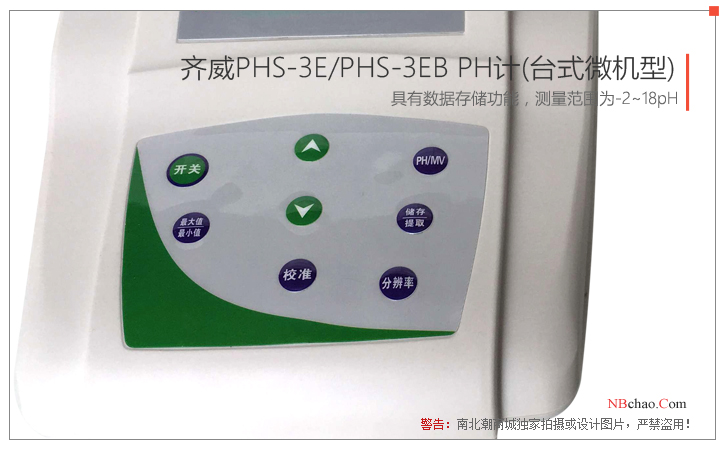
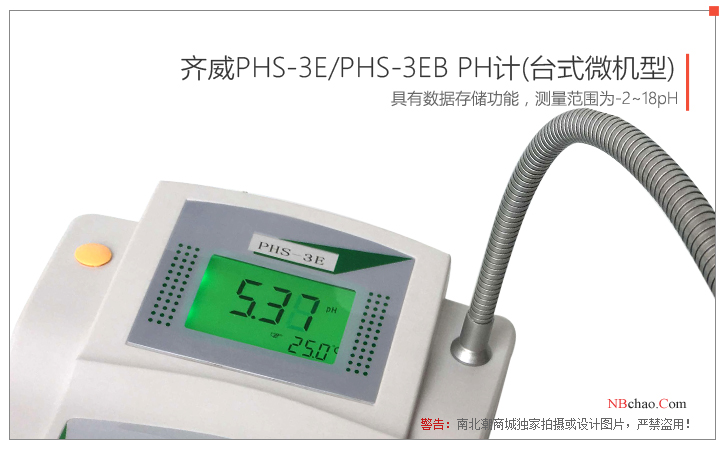
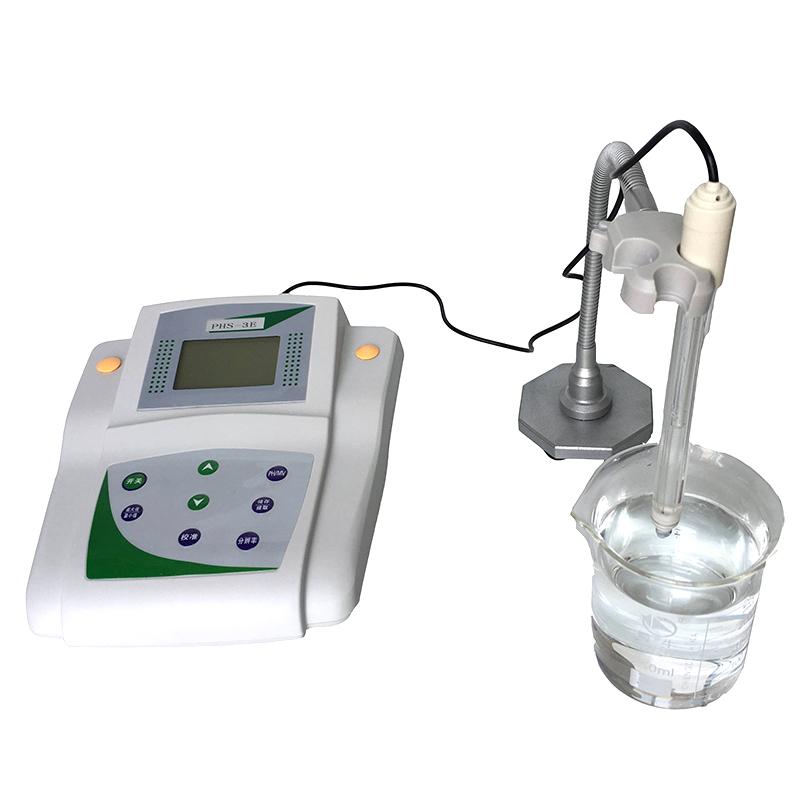
QIWEI PHS-3E PH acidity meter, desktop microcomputer-2~ 18pH
 PHS-3E

QiWei PHS-3E pH Meter (desktop microcomputer)SPEC
QiWei PHS-3E pH Meter (desktop microcomputer)Details
QiWei PHS-3E pH Meter (desktop microcomputer)Packing list

- SKU
- NB017286
- Measurement parameter
- pH, mV, temperature
- PH range
- -2~18pH
- PH Measurement Accuracy
- ±0.01/0.1pH
- resolution
- pH: 0.01pH/Temperature: +/- 1 ℃
- Measurement range
- 0~100℃
- Stability (zero drift)
- ≤ 0.01pH +/- 1 word/2h
- Data storage
- Data storage function
- Power Supply
- 9V DC Power Supply
- Dimension
- 230*200*60mm
- Weight
- About 1.5Kg
- Standard electrode reagent
- E201-C-L Glass PH composite electrode (suitable for solution temperature measurement in the range of 0-100 ℃); temperature electrode (only suitable for solution use in 0-65 ℃); PH buffer; power adapter
- Environmental temperature
- 0~40℃
- Allowable Relative Humidity
- <85%
- Impedance
- >1x10¹²Ω
- Solution temperature compensation range
- 5~60℃
- Measurement Accuracy
- ±1℃
- Temperature compensation method
- Automatic/manual
- Measurement range mV
- ±1000mV
- Measurement range
- 0~100℃
Overview
Qi WeiPHS-3EPH meter (desktop microcomputer) is a PH meter with a relatively large measurement range, with a measurement range of -2~18pH, PHS-3E PH meter is adoptedMade of a special sensitive thinThe glass electrode has high sensitivity, can be stored and extracted for data, can automatically compensate for temperature, is convenient and simple to operate, and the measurement data is stable.
Principle
The head of the glass electrode is made of a special sensitive film that is sensitive to hydrogen ions, and when it is inserted into the solution, its potential changes with the concentration and temperature of the hydrogen ions in the solution. At a solution temperature of 25 °C, the electrode potential changes by 59.16 mV for every 1 pH change. This is the theoretical slope coefficient of the electrode.
The glass electrode is used as an indicator electrode,Since its potential does not change with the concentration of hydrogen ions in the measured solution,The reference electrode is generally a calomel electrode. When the concentration of hydrogen ions in the solution (strictly speaking, the activity), i.e. the pH of the solution, changes, the potential generated between the glass electrode and the calomel electrode also changes, and the relationship between the electric potential changes according to the following formula:
△E = -58.16×△pH×(273+t℃)/293(mV)
△E: Indicates the change in electric potential, measured in millivolts. (mV)
△pH: Indicates the change in the pH value of the solution.
t: Indicates the temperature (°C) of the solution to be measured.
The pH value is measured by measuring the potential difference between two electrodes. When the potential difference between a pair of electrodes in the solution is equal to zero, the pH of the measured solution is the zero potential pH, which is related to the solution in the glass electrode.PHS-3E The pH meter is equipped with a composite electrode consisting of a glass electrode and an Ag-Agcl electrode, with a zero pH value of 7±0.25 pH.
Actual picture of the product