
BOTECH botech 934-1 Pap Hardness Tester
 934-1
934-1

BoTech 934-1 Pap Hardness TesterSPEC
BoTech 934-1 Pap Hardness TesterDetails
BoTech 934-1 Pap Hardness TesterPacking list
- SKU
- NB017377
- mileage
- 0~100HBa (equivalent to 25~ 150HBW)
- Resolution
- 0.5HBa
- Error of indication
- 42~48HBa ±2Hba,81~88Hba ±1HBa
- Repeatability Error
- 42~48HBa ±2.5Hba,81~88Hba ±1.5HBa
- crimp
- 26 ° frusto-cone, cone diameter 0.176mm
- ruler body material
- Good stainless steel
- Weight
- 0.5kg
product description
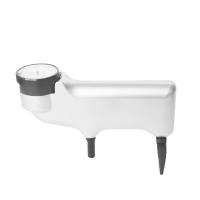
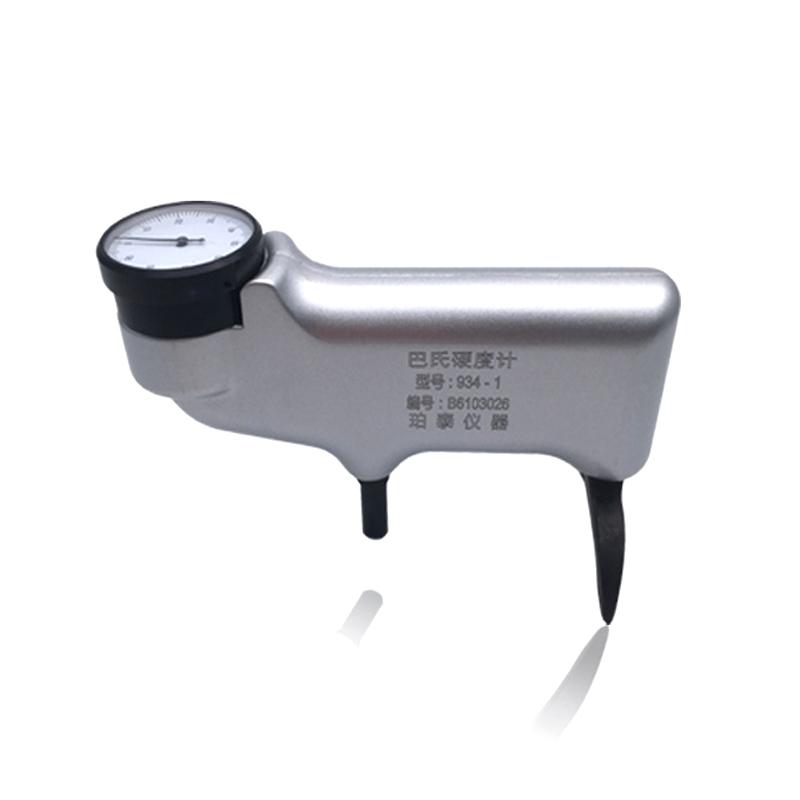
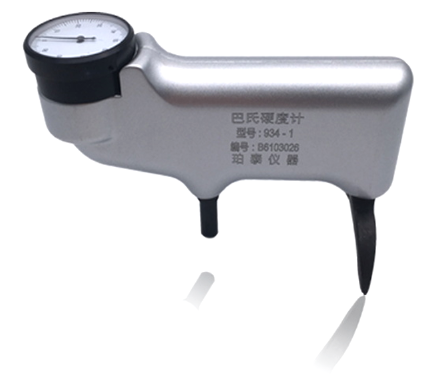
Petai 934-1 Barcol Hardness Tester, also known as Barcol Hardness Tester and Barcol Hardness Tester, is a portable indentation Hardness Tester. It uses a specific indenter to press into the sample under the action of standard spring force. The depth of the indentation determines the hardness of the specimen. It is easy to use and requires no experience. The operator can hold the Hardness Tester and use it in any position and space. The hardness value is immediately indicated on the dial through the pointer, making it easy and quick to read without waiting. 934-1 has 100 scales, each scale represents a depth of 0.0076mm, which can meet the hardness measurement needs of aluminum, aluminum alloys, soft metals, plastics, optical fibers, fire ladders, composite materials, rubber or leather, fiberglass and other materials. , is a special testing instrument widely used in quality certification, quality monitoring, measurement testing, etc.
Features
Easy to use: one-handed operation, easy to use, high efficiency, can be used in any occasion
High sensitivity: The Barcol Hardness Tester has 100 scales, and its sensitivity is much higher than the Webster Hardness Tester commonly used in the aluminum processing industry.
Convenient testing: no sampling is required during the testing process, and the material hardness can be detected non-destructively
Wide hardness measurement range: everything from pure aluminum to super-hard aluminum alloys can be tested, the effective measurement range is equivalent to Brinell hardness 25 ~ 130HBW
Wide thickness measurement range: any material thickness greater than 0.8mm can be tested
No support required: Testing can be done by only touching one side of the sample. There is no need to move or support the sample. It can test ultra-large, ultra-wide, and ultra-thick materials, and test assembled aluminum alloy products.
Convenient conversion: can be easily converted into hardness values ââsuch as Webster, Brinell, Rockwell, and Vickers
High-quality indenter: The indenter of Tianxing Barcol Hardness Tester has high hardness, long life and good interchangeability.
Comply with Chinese standard GB/T3854-2005, American standard ASTM B648-2000
The main purpose
Mainly used for thick-walled aluminum alloy profiles that cannot be detected by Webster Hardness Tester, testing pure aluminum, softer aluminum alloys, super-hard aluminum alloys, aluminum plates, aluminum rods and aluminum alloy castings, forgings, die-castings, etc.
Assembled aluminum alloy products (aluminum alloy doors and windows, curtain walls, fire escapes, etc.)
The hardness of non-metallic materials such as fiberglass and hard plastics
Operating Conditions
The thickness of the material measured should not be less than 1mm
The surface of the specimen should be smooth, clean, and free of mechanical damage. Can be lightly polished to remove scratches or coatings
When measuring, be careful not to have excessive impact or sliding scratches to avoid damaging the indenter.
The instrument should be avoided from being used in environments with strong vibration, moisture and corrosive gases.