
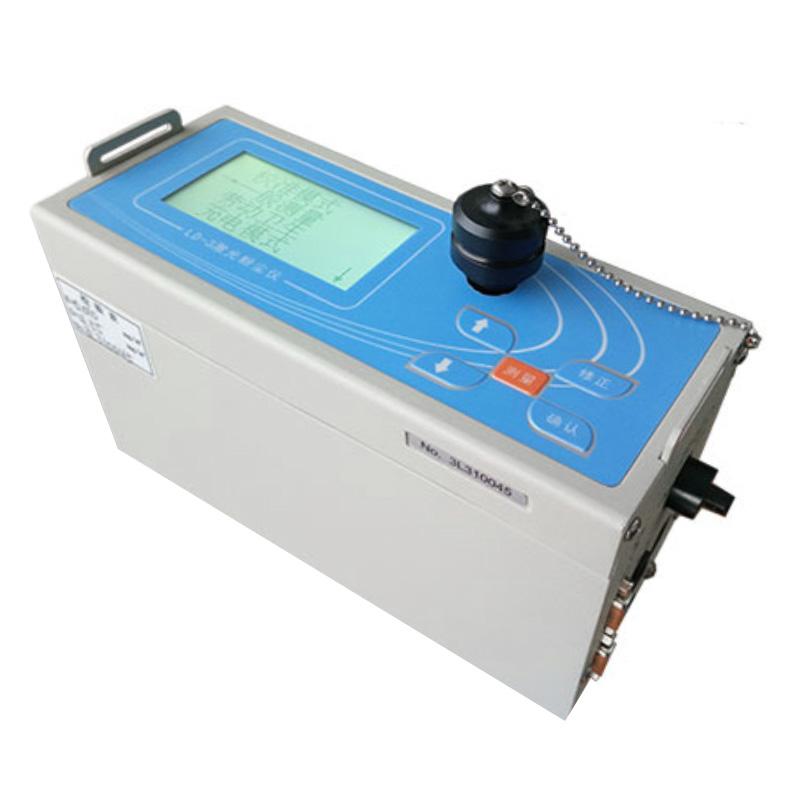
JDHS LD-3H Portable Laser Dust Meter, Range 0.001~ 10mg/m ³
SE LD-3H
LD-3H

JDHS LD-3H Laser dust MeterSPEC
JDHS LD-3H Laser dust MeterDetails
JDHS LD-3H Laser dust MeterPacking list
- SKU
- NB017954
- Detection sensitivity
- 0.001mg/m³
- Measurement range
- 0.001~10mg/m³
- Measurement time
- Sampling standard time is 1 minute, with 0.1, 1-9999 minutes and Timer (set Sampling time arbitrarily)
- Repeatability Error
- ±2%
- Measurement Accuracy
- ±10%
- Display
- Large LCD display, Chinese Operating interface
- storage
- 99 sets of data can be recycled
- Timed sampling
- Measurement time 1~ 9999 seconds and sampling times 1~ 9999 times
- output interface
- PC Communication interface (RS232) and printer output interface
- Environmental temperature
- 0℃~40℃
- Storage temperature
- -20℃~60℃
- Power Supply
- AC/DC dual-use, with rechargeable battery and charger
- size
- 195mm*85mm*132mm
- Weight
- 1.4Kg
- optional
- Instrument-specific communication software, micro-printer, tripod
Introduction
LD-3 laser dust analyzer This instrument is suitable for the rapid determination of inhalable particulate matter (PM10) concentration in public places, the detection of labor dust concentration in industrial and mining enterprise production sites, and the monitoring of inhalable dust concentration in the field of environmental protection, and can also be used for the evaluation of purification efficiency of air purifiers. In recent years, more than 1,000 LD-3 instruments have been used all over the country and have been well received by users.
The instrument conforms to the Ministry of WS/T206-2001 "Determination of Respirable Particulate Matter (PM10) in the Air in Public Places - Light Scattering Method" standard, the Ministry of Labor LD98-1996 "Light Scattering Determination Method of Dust Concentration in the Air" standard and the Ministry of Railways TB/T2323-92 "Conversion Method for Determination of Relative Mass Concentration and Mass Concentration of Dust in Air Instruments in Railway Work Sites" and other industry standards, as well as the Ministry of Health Supervision and Development [2006] No. 58 document promulgated and implemented the " Specification for centralized air-conditioning and ventilation systems in public places. LD-3H/L has obtained the People's Republic of CHINA Measuring Instrument Manufacturing License and Measuring Instrument Type Approval Certificate.
Principle of laser light scattering dust meter
The laser beam is irradiated on the dusty gas stream, so that the beam produces scattered light, and the higher the dust concentration, the greater the scattered light intensity, so that the dust concentration is measured. The light scattering method determines the concentration of inhalable particulate matter in the air in public places, which has the advantages of rapidity, sensitivity, good stability, small size, light weight, no noise, easy operation, safety and reliability. On the one hand, the method requires a small amount of sample due to its high sensitivity, and can eliminate or simplify sample handling steps, so that sampling and analysis times can be greatly reduced, and on the other hand, the method does not require sample storage, thus avoiding or reducing all possible error factors in the analytical method.
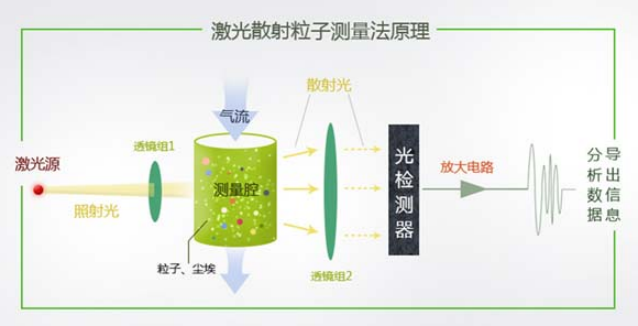
Main technical features:
1. The mass concentration of particulate matter (mg/m³) can be directly read, and the result will be issued in 1 minute, or the sampling time can be set arbitrarily according to the user's needs;
2. The measurement is fast, accurate and the detection sensitivity is high;
3. The self-calibration system is designed, and the instrument performance is stable and reliable;
4. It has the functions of air curtain shielding and clean air self-cleaning to ensure that the optical system is not polluted;
5. The software is automatically zeroed;
6. It has the function of two-way communication with the computer, and can process data through the PC and print out curves and tables;
7. It has a variety of functions such as continuous monitoring of particulate matter concentration, regular sampling and alarm of dust concentration exceeding the standard;
8. Large-screen LCD screen