
Light spectrum and thermal quenching analysis system for EVERFINE chromatic EX-1000 fluorescent materials

EVERFINE EX-1000 Light spectrum and thermal quenching analysis system for fluorescent materialsSPEC
EVERFINE EX-1000 Light spectrum and thermal quenching analysis system for fluorescent materialsDetails
EVERFINE EX-1000 Light spectrum and thermal quenching analysis system for fluorescent materialsPacking list

- SKU
- NB002087
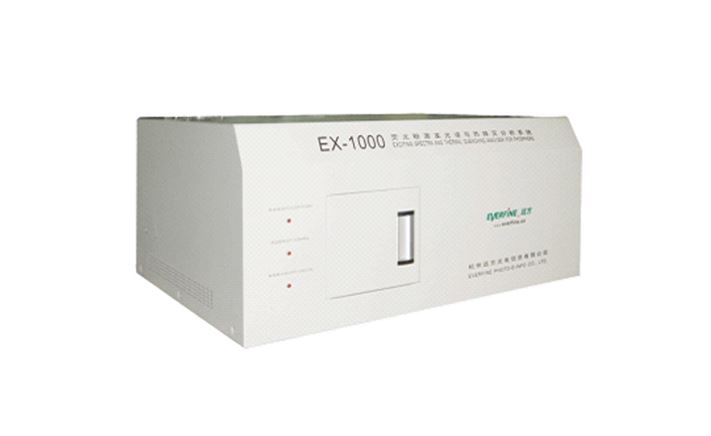
The EX-1000 fluorescent material excitation spectrum and thermal quenching analysis system can measure the excitation spectrum characteristics and emission spectrum characteristics of fluorescent materials, which is helpful for screening effective excitation light sources, or improving the excitation spectrum characteristics of fluorescent materials under the premise of specific excitation light sources. to achieve higher excitation-to-luminescence conversion efficiency. It can also measure the luminescence characteristics (thermal quenching characteristics) of fluorescent materials under real Operating Conditions (high temperature conditions) to avoid using their normal temperature characteristics to replace the real Operating Conditions and ensure the luminous quality of fluorescent materials.
The EX-1000 fluorescent material excitation spectrum characteristics and thermal quenching analysis system is a comprehensive phosphor measuring instrument that can be used for the research and development of various phosphors such as rare earth three-color phosphors for lamps and rare earth yellow phosphors for white light LED lamps. and quality control to provide comprehensive and objective measurement data.
Main Specifications
1) Excitation spectrum range: 200~800nm;
2) Excitation spectrum bandwidth: adjustable from 1 to 10nm;
3) Excitation Wavelength Accuracy: ±0.3nm;
4) Excitation light source stability: ±1%;
5) Emission spectrum measurement device: HAAS-2000 high-precision fast spectral radiometer, using precision concave flat-field grating and HAMAMATSU scientific-grade refrigerated CCD;
6) Emission spectrum measurement range: 380~780nm;
7) Emission spectrum wavelength measurement accuracy: ±0.3nm;
8) Chromaticity coordinate accuracy: ±0.0003 (under standard A light source);
9) Chromaticity coordinate repeatability: ±0.00015x, ±0.0002y (constant temperature blue LED);
10) Photometric linearity: ±1%;
11) Photometric repeatability: ±1%;
12) Temperature control: room temperature to 200℃; (when the temperature is 150℃-200℃, the recommended working time is 10 minutes);
13) Temperature control accuracy: ±2%;
14) Powder plate size: inner diameter Φ20mm, depth 3mm, edge less than 0.5mm, stainless steel;
15) Excitation/observation conditions: CIE 0/45;
16) It has three-dimensional excitation-emission spectrum diagram, two-dimensional excitation spectrum diagram, two-dimensional emission spectrum diagram, and temperature-brightness.