
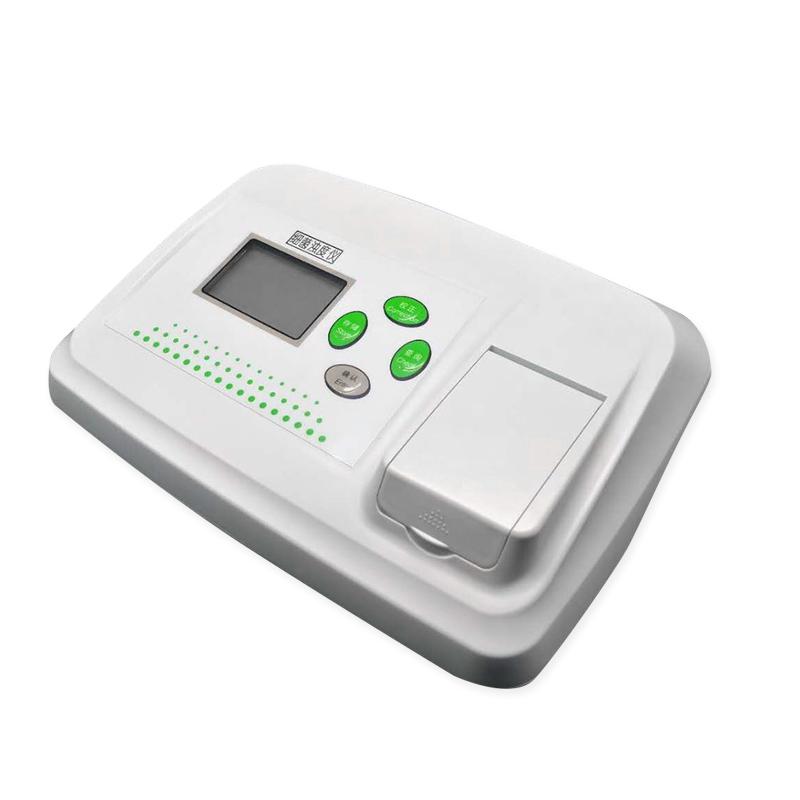
Qiwei WGZ-XT Bacterial Turbidity Meter 0~6MCF
SE WGZ-XT

QiWei WGZ-XT Bacterial Turbidity MeterSPEC
QiWei WGZ-XT Bacterial Turbidity MeterDetails
QiWei WGZ-XT Bacterial Turbidity MeterPacking list

- SKU
- NB020925
- Measurement principle
- 0.001 MCF
- resolution
- 0~6MCF (McDonnell Turbidity Unit) 1MCF = 3 × 10⁸CFU/ml
- Error of indication
- ±6%(±5%F.S)
- Sexual repeability
- ±0.5%F.S
- Zero drift
- ±0.5%F.S
Introduction
WGZ-XT Bacterial Turbidimeter is mainly used to determine the concentration of bacteria in the suspension of strains to be identified. The instrument is calibrated with (BaSO4) McFarland turbidity standard solution, using MCF (McFarland) McFarland turbidity unit. Directly display the McFarland unit turbidity value. It is suitable for the determination of bacterial liquid concentration in medical and health units, biological products, quarantine institutions and scientific research institutions.
Instrument principle
The basic principle of this instrument is that after the measuring device is placed in the sample, the light beam emitted by the light source forms scattered light when encountering bacterial particles, and the McFarland turbidity signal of the 90° scattered light generated thereby is received by the photosensitive element, and the light signal After circuit amplification and single-chip microcomputer data processing, the measured McFarland turbidity value is displayed.
Key Description
Calibration key: enter the calibration state and perform zero calibration on the blank value
Confirm key: confirm the previous operation
Storage key: save the measured value
Query key: query saved measured values
Features
1. Microcomputer, touch keyboard, LCD backlit liquid crystal display, make reading more comfortable, and not affected by natural light
2. Quickly set the average measurement mode to get correct data in the shortest time. .
3. Simple operation, appropriate measurement range and high cost performance, more suitable for use in various industries.
4. The unique positioning structure and high-precision optical path system can effectively ensure the correctness and repeatability of the measured values.
5. The circuit system with low drift, high precision and good stability, and effective long-life light source can effectively ensure the stable operation of the instrument for a long time
6. Can store 20 historical records, no loss when power off
Operating Conditions
1. The instrument should be placed in a dry room at a temperature of 5°C-35°C.
2. When in use, it should be placed on a flat work surface and avoid vibration.
3. The indoor lighting should not be too strong, and avoid direct sunlight.
4. Try to stay away from high-intensity magnetic fields, electric fields and electrical equipment that generate high-frequency waves.
5. Avoid high temperature close to the instrument.
6. Power supply to the instrument: 220V±22V, 50±1Hz, and a good grounding wire is required.
- 1JIS K0801-1986《Continuous turbidimeter》
- 2JJF 1700-2018《Program of Pattern Evaluation of Turbidimeters》
- 3JJF 1571-2016《Calibration Specification for Seawater Turbidity Analyzers》
- 4 100-2007《Test method of seawater turbidity analyzer》
- 5DIN EN ISO 15715-2006《Binders for paints and varnishes - Determination of turbidity》
- 6GB/T 13531.3-1995《Generel methods on determination of cosmetrics--Determination of cloudiness》
- 7GB/T 13200-1991《Water quality--Determination of turbidity》
- 8HJ 1075-2019《Water quality.Determination of turbidity.Nephelometry》
- 9HJ 1075-2019《Water quality.Determination of turbidity.Nephelometry》
- 10GB/T 18570-2009《》